
Results
-
 £78.00
Coronation March - Giacomo Meyerbeer
Giacomo Meyerbeer (1791-1864) was a German opera composer of Jewish origins, who has been described as perhaps the most successful stage composer of the nineteenth century. From 1831 until his death, he remained a dominating figure in the world of opera. His contemporary Hector Berlioz summed up his public career claiming that he 'has not only the luck of being talented, but the talent to be lucky'. His works made him the most frequently performed composer at the world's leading opera houses in the nineteenth century. Giacomo Meyerbeer composed his opera Le Prophte in 1849. In this opera a coronation is preceded by a splendid march. Although the opera itself is rarely performed, the Coronation March has gained a place in the concert repertoire.Franco Cesarini's arrangement for concert band of the Coronation March stands out for its skillful instrumentation which underlines the powerful sounds of this classic concert march.
Estimated dispatch 7-14 working days
-
 £138.00
The Saints And the Royal - Eric Swiggers
The Saints and the Royal was composed on behalf of Royal brass band St. Willibrord Heeswijk on the occasion of its 200th anniversary in 2023.When the marching band was founded in 1823, it was given the name "Harmonie Sint Cecilia," referring to Saint Cecilia, the patron saint of music. Around 1904, the name was changed to 'Kerkelijke fanfare Willibrord', strongly emphasizing the connection with the church in Heeswijk, of which Saint Willibrord is the patron saint. In 1973, at its 150th anniversary, the band received the predicate 'royal'. From that time on one speaks of the Royal brass band Saint Willibrord.The composition musically depicts both Saints Saint Cecilia and Saint Willibrord and the jubilee royal brass band. Although one of the oldest musical societies in the Netherlands, this fanfare is alive and kicking and will celebrate its 200th anniversary in 2023. The composition therefore opens festively and energetically. The alto saxophone plays a recitative, the Gregorian "Cantantibus organis Caecilia virgo in corde suo soli domino decantabat" from the vespers of the feast day of Saint Caecilia, the patron saint of music. This is taken over by the full wood and soft brass group. After a brief, playful interlude, this chant is played by the full orchestra, like an organ, larded with circumambulations.St. Willibord was born in England but made the crossing to the Netherlands in 690 to preach the gospel as a missionary. This was far from harmless and he faced frequent uprisings. After his death he was buried in Echternach in Luxembourg. In this place he is commemorated to this day with the annual "Spring Procession" or "Dance Procession". This procession of Echternach went as follows until 1947: 3 steps forward, 2 steps backward. Hence we hear this procession back in a 5/8 measure: 3 + 2.After this procession, the Gregorian vesper of Sint Caecilia sounds one more time, leading the composition to a reprise of the opening: The jubilee Royal Fanfare Sint Willibord Heeswijk.
Estimated dispatch 7-14 working days
-
 £149.40
Storsltt - Øystein Olsen Vadsten
"Storsltt" or in English "Grand Nordic Tune" is one of many original pieces written by composer ystein Olsen Vadsten. "Sltt" is a general term for music played to traditional Norwegian dances."Grand Nordic Tune" was a commissioned work for the Rlingen Musikklag's 70-year anniversary concert in 2022, where the piece was premiered. They wanted something a little pompous, and preferably something in the style of Nordic folk music, which the composer is known for. The title in Norwegian then was obvious, "Storsltt", which in Norwegian has a double meaning, both a big tune and, in a double meaning, pompous or magnificent.As usual, the starting point is a traditional Nordic dance form, and this time the choice fell on the distinctive Swedish "polska", which is played in . The dance, despite its name, reportedly has no connection to Poland, but is entirely of Scandinavian origin. It has been danced for centuries, and has also been called the devil's dance, because it had a hypnotizing effect on people, so that they could not stop, but danced themselves to death. Hence people thought that it must have been the devil who caused it.Traditionally, there is a lot of repetition in this type of music, which contributes to this hypnotic effect.
Estimated dispatch 7-14 working days
-
 £94.99
Majesty - Thierry Deleruyelle
Majesty is a powerful and spectacular overture. Right from the start, the brass open the work brilliantly before making way for a majestic hymn mostly played by the woodwind. The end of the piece repeats the opening fanfare as a monumental finale in the style of an American symphonic march. This work was commissioned by the Bourbourg Wind Orchestra (France), conducted by Claude Deconinck, on the occasion of its 230th anniversary. This piece was premiered by the commissioning orchestra on 19 November 2022, just two months after the death of Queen Elizabeth II. Naturally, this work is dedicated to her.
Estimated dispatch 7-14 working days
-
 £105.80
Magellano - Andrea Moncalvo
This composition was written on the occasion of the 500th anniversary of the death of Ferdinand Magellan, a Portuguese explorer (1480 - 1521), who embarked on what would have become the first circumnavigation of the globe. Unfortunately, he did not complete it because, in 1521, he was killed in the region that is today the Philippines. This adventure triggered various images in the author's mind; evocations that the composer elaborated in this piece, which is in a tripartite form (A B A) and is introduced and concluded by a solemn fanfare evoking the departure of the expedition, consisting of 5 ships with a total of 234 crewmen. The first part (Allegro) presents a main theme with a cantabile character that describes the fleet that, intrepid, plows the ocean. This initial melody is then contrasted by a more rhythmic and syncopated theme in a minor key, which instead refers to the indigenous peoples they have encountered during the journey. The central section (Adagio) is an oasis of reflection because, as in other great adventures, this too has tragic aspects: mutinies, shipwrecks, clashes with indigenous peoples, up to the disappearance of those who had desired and planned this enterprise. The last part proposes the themes of the first section but in reverse order, to describe the return to the homeland. The solemn fanfare welcomes the arrival of the Victoria, the only surviving ship with only 18 men on board, which returns to the port of departure after completing the circumnavigation of the earth in 2 years, 11 months, and 17 days.
Estimated dispatch 7-14 working days
-
 £124.99
A Hero's Tale - Bert Appermont
This composition is based on the life of the German cavalry general Hans Michael Elias von Obentraut (1574-1625), who was known for his nerve, loyalty and courage. The figure Van Obentraut is closely connected to the town of Seelze, where he died a heroic death and where a monument was erected in his honour. The work consists of four movements in which various aspects of this historical figure are featured. What is extra special about this work is the fact that its first movement (Hymn for a Hero) had been made available as an easy version for flexible band. This makes it possible for a youth or beginner band to play along with a band of adults or advanced players. This hymn can also be played as a separate piece.
Estimated dispatch 7-14 working days
-
 £183.99
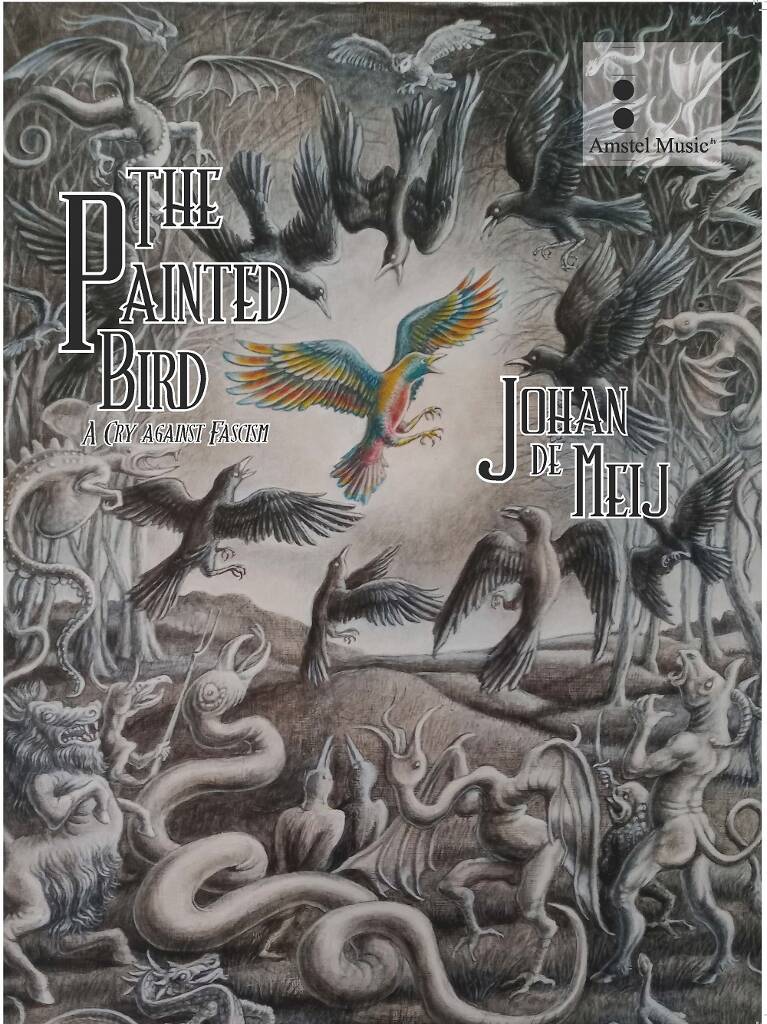
The Painted Bird - Johan de Meij
The Painted Bird, the controversial novel by Jerzy Kosinski (1933-1991), tells the story of a Jewish boy during World War II. For his safety, the child was sent to the Polish countryside by his parents. The title refers to a barbaric tradition among Polish farmers. The wings of a captured bird were painted in bright colors, after which the animal was released. Almost immediately, the bird was attacked and pecked to death by its peers. The boy underwent the same fate. Wherever he wandered, the local rural people cruelly mistreated him because of his distinctly different appearance. However, he survives the horrors and is reunited with his parents after the war. To escape the yoke of the Soviet occupation in his country, the Polish-Jewish Kosinski emigrated with counterfeit papers to the United States in 1957, where he became an American citizen in 1965. His landmark novel The Painted Bird was translated into thirty languages and sold millions of copies. Plagued by illness and accusations of betraying his country and plagiarism the writer ended his life in 1991.
Estimated dispatch 7-14 working days
-
 £134.99
Cleopatra - Thierry Deleruyelle
Queen Cleopatra ruled Egypt for over 20 years. She is one of antiquity's best-known women, in particular because of her relationships with Julius Caesar and, above all, Mark-Anthony, but also because the cause of her death remains a mystery. The work is split into three parts and performed without breaks. The first section begins with a bright introduction representing Mark-Anthony. Dynamic in nature and reminiscent of military music, this characterises the Roman general. But soon after, another theme emerges, softer and more melodic, symbolising Cleopatra's femininity. The two characters then combine on a faster tempo. The middle section of the work depicts the love that Mark-Anthony and Cleopatra feel for each other. This passionate relationship lasted ten years and produced three children. This is expressed by a warm and intense theme, just like the beauty of the Egyptian queen. The third and last section opens in a determined and military mood. Mark-Anthony and Cleopatra were often apart, the Roman general was often away on a campaign. They met up in Alexandria to celebrate their triumph. But, as the targets of the jealousy and ambition of Octavius, Julius Caesar's son, the lovers are trapped and await the inevitable conquest of Egypt by the Romans. When Mark-Anthony heard the false news that Cleopatra had committed suicide, he ended his own life. The Queen of Egypt, for her part, was imprisoned shortly afterwards. The two lovers remain one of History's most famous couples. This piece was commissioned by the Wind Orchestra of the town of Antony, near Paris, directed by Philippe Rossignol, to mark its 90th anniversary.
Estimated dispatch 7-14 working days
-
 £119.60
Episodes - Alfred R. Stevenson
"Falling Rocks" is reminiscent of the landslide in Dobratsch, Austria and the resulting despair of the population afterwards, musically represented by "A Folk Song". "Black Death, Bonaparte and the End of the Monarchy" refer to other dark moments in history. Far off trumpets play hints of the Marseillaise and the old Austrian Imperial anthem. A silent witness observes these events; the ruins of the castle Finkenstein.
Estimated dispatch 7-14 working days
-
 £73.60
The Day After? Don't Forget - Lorenzo Bocci
War ... a word that embodies images of death, destruction, devastation, suffering ... emotions of anger, fear, alienation, annihilation ... The Day After ... Don't Forget is an original song written by Lorenzo Bocci in 2008; a musical reflection on what the war leaves after its passage, hoping that, in a not too distant future, mankind will understand that "Peace" is the only solution to prevent self-destruction.
Estimated dispatch 7-14 working days
 View Music