Searching for Brass Band Music? Visit the Brass Band Music Shop
We've found 221 matches for your search

Results

  • £59.95

    Weird Sisters - Richard Haydn Taylor

    Weird Sisters 'something wicked this way comes' celebrates the 400th anniversary of William Shakespeare's death and takes its inspiration from Macbeth: Act 4, scene 1. The three witches (Weird Sisters) are stirring the bubbling cauldron, ready for Macbeth's arrival. The...

    Estimated dispatch 5-7 days
  • £55.00

    The Declaration of Arbroath - Andrew Duncan

    Programme notes from the composer, Andrew Duncan:Originally written for The West Lothian Schools' Annual Concert 2006 and scored for Concert Band, Brass Band, Highland Bagpipes, Children's Choir and Narrator. This version has been rescored for Concert Band with optional parts for Highland Bagpipes and Narrator. The piece celebrates the internationally renowned Declaration of Arbroath. The music begins in the uncertain times of Scotland's early 14th century, following the Battle of Banockburn and the death of William Wallace. The narrator describes this scene and explains the origins of the Declaration. The music builds to a climax, but once again gives way to uncertainty, allowing the narrator to explain further the history surrounding the Declaration. A group of Scottish Nobles wrote the Declaration which was an appeal to the Pope to recognize Scotland's independence. The piece then reflects a positive outcome following the Pope's support of the Declaration. Further information is provided by the narrator which draws to a rousing build to express the emotive inspiration behind this composition.The original scoring (to include Concert Band, Brass Band, Highland Bagpipes, Choir and Narrator) is also available by request.

    In stock: Estimated delivery 1-3 days
  • £37.40

    Elizabeth Remembered (Wind Band) Debbie Wiseman arr. Andrew Wainwright

    Released as a charity single in aid of The Queen's Commonwealth Trust, this sublime work was composed by Debbie Wiseman OBE and performed by the BBC Concert Orchestra in tribute to Queen Elizabeth II after her death in September 2022. This tender and contemplative piece was played many times during the BBC's live coverage of the ceremonies across ten days of national mourning; and the full three-minute piece was played at the end of the Queen's State funeral, following Kirsty Young's emotional final words, and accompanied by a poignant and beautiful montage of images from the events of the day. The piece is now available for wind bands through this arrangement by Andrew Wainwright, with permission kindly granted by Debbie Wiseman. To view a follow-the-score video please visit: www.youtube.com/watch?v=gW6AiNQGKEI Sheet music available from : UK: www.wind-band-music.co.uk USA: www.solidbrassmusic.com Difficulty Level: Medium Easy Instrumentation: Flute Oboe 1 Oboe 2 (Cor Anglais) Clarinet in Bb 1-2 Bassoon 1-2 Alto Saxophone Eb Tenor Saxophone Bb Baritone Saxophone Eb Trumpet in Bb Horn in F Trombone Euphonium Tuba Timpani Harp (optional) Glockenspiel (if no Harp) Suspended Cymbal

    In stock: Estimated dispatch 1-3 days
  • £87.00

    Lux (CB) - Roger Derongé

    On 14 September 2021, Luc Craps died of cancer at the age of 59. He was a true pacesetter, extremely funny when he could, serious when necessary. Some time after his death, Luc's wife Erika asked close friend Roger to write a work in lasting memory of Luc.

    Estimated dispatch 7-14 working days
  • £118.99

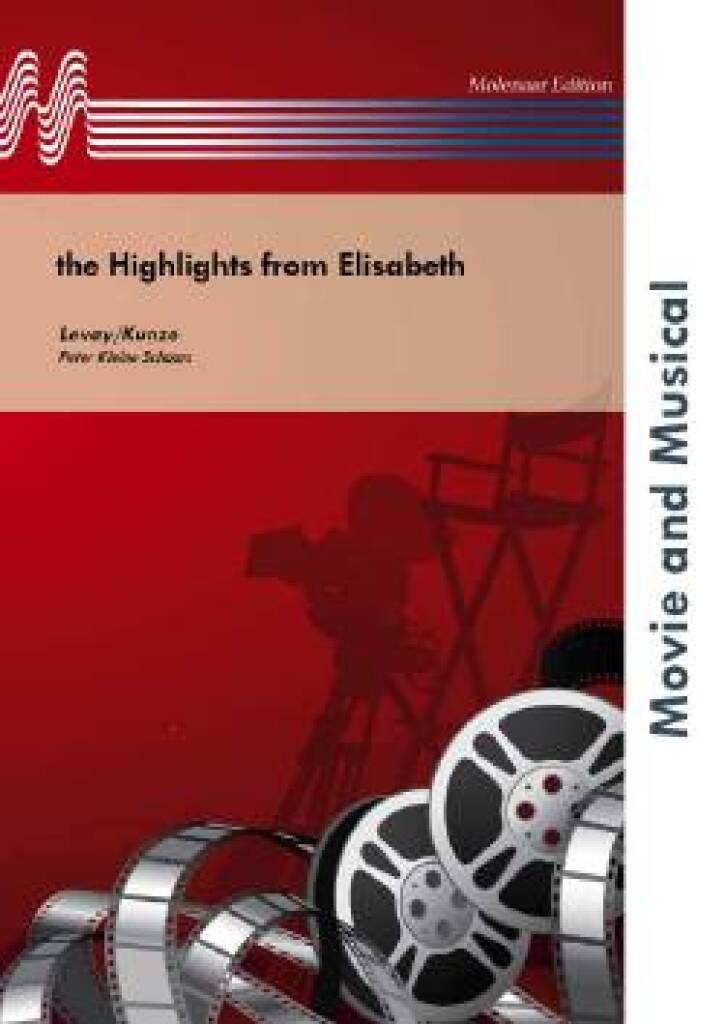
    Elisabeth (Concert Band - Score and Parts) - Levay & Kunze - De Meij, Johan

    The world premiere of the musical Elisabeth took place in Vienna on September 3, 1992. From the great acclaim with which the musical was received, it became clear that the life of the Empress of Austria still appeals to the imagination. Although Elisabeth's life (1837-1898) as an Empress has a fairy-tale-like beginning, it takes a gloomy turn. In this production, Luigi Lucheni, the man who finally takes her life, tells her story. Death plays a major role throughout Elisabeth's life. In the musical, an equally mysterious and attractive man portrays the phenomenon of death, seducing her to the realm of death time after time. Elisabeth's life resembles a fairy tale when she marries the Emperor Franz Joseph at the age of sixteen. Her mother-in-law, Archduchess Sophie, does not make it easy on Elisabeth. But it is life itself that puts the Empress to the test. First, her youngest daughter dies. Then, not long after her son Rudolf is born, her happiness is clouded when her mother-in-law decides she must take pity on him. After her husband's unfaithfulness and Sophie's death, Elisabeth is so disillusioned that she chooses a travelling existence without realizing her husband and her son, Rudolf, miss her. Rudolf's loneliness is one of the reasons he commits suicide. The accumulation of disappointments in Elisabeth's life almost drives her into the arms of Death. In the end, however, it is Lucheni who kills her.Duration: 8.30

    Estimated dispatch 7-14 working days

     PDF View Music

  • £124.95

    SWORD AND THE CROWN, The (Prestige Concert Band - Score and Parts) - Gregson, Edward

    In 1988 I was commissioned by the Royal Shakespeare Company to write the music for The Plantagenets trilogy, directed by Adrian Noble in Stratford-upon-Avon. These plays take us from the death of Henry V to the death of Richard III. Later, in 1991, I wrote the music for Henry IV parts 1 and 2, again in Stratford. All of these plays are concerned with the struggle for power (the crown) through the use of force (the sword) and they portray one of the most turbulent periods in the history of the British monarchy.This work quickly became established in the mainstream repertoire and has received performances worldwide as well as five commercial recordings and many broadcasts. In 2002 I was approached by the Parc and Dare Band regarding their summer festival and commissioned to do a version for brass band. This was given its first performance in Treorchy Hall by the combined bands of Black Dyke and Parc and Dare conducted by Nicholas Childs.When the Royal Air Force Music Services commissioned me to write a work especially for their British tour in 1991 I immediately thought of turning to this music and transforming some of it into a three-movement suite for symphonic band.The first movement opens with a brief fanfare for two antiphonal trumpets (off-stage), but this only acts as a preface to a Requiem aeternam (the death of Henry V) before changing mood to the English army on the march to France; this subsides into a French victory march, but the English army music returns in counterpoint. Finally, a brief reminder of the Requiem music leads to the triumphal music for Richard Plantagenet, Duke of York, father of Edward IV and Richard III (the opening fanfare transformed).The second movement takes music from the Welsh Court in Henry IV (part 1) which is tranquil in mood; distant fanfares foreboding battles to come are heard, but the folktune is heard three times in different variations and the movement ends as it began with alto flute and gentle percussion.The final movement starts with two sets of antiphonally placed timpani, drums and tam-tam, portraying the 'war machine' and savagery of battle. Trumpet fanfares and horn calls herald an heroic battle theme which, by the end of the movement, transforms itself into a triumphant hymn for Henry IV's defeat of the rebellious forces.- Edward GregsonPerformance time 13'54"Recorded on QPRM117D FESTIVAL OF MUSIC 1991, Massed Bands of the Royal Air ForceRecorded on QPRM120D THE SWORD AND THE CROWN, Central Band of the Royal Air Force'Finale' recorded on QPRM142D FESTIVAL OF MUSIC 2002, Massed Bands of the Royal Air Force)

    Estimated dispatch 7-14 working days

     PDF View Music

  • £123.20

    3 Letzte Motetten (Concert Band - Score and Parts) - Bruckner, Anton - Doss, Thomas

    Anton Bruckner (b. 4.9.1824, Ansfelden, d. 11.10.1896, Vienna) didn't have it easy. Throughout his life, the Austrian composer was plagued by self-doubt. Anton Bruckner came from a simple, rural background. After the death of his father, he was accepted as a choirboy at the monastery of Sankt Florian in 1837. After several years as a school assistant and his own organ and piano studies, he first worked as organist in St. Florian, then from 1855 as cathedral organist in Linz. Introduced to music theory and instrumentation by Simon Sechter and Otto Kitzler, he discovered Richard Wagner as an artistic role model, whom he admired throughout his life and also visited several times in Bayreuth. In 1868 Anton Bruckner became professor of basso continuo, counterpoint and organ at the Vienna Conservatory; ten years later court organist; and in 1891 finally honorary doctor of the University of Vienna. He was considered an important organ virtuoso of his era, but had to wait a long time for recognition as a composer. It was not until Symphony No.7 in E major, composed between 1881 and 1883, with the famous Adagio written under the effects of Wagner's death, that he achieved the recognition he had hoped for, even if he was reluctant to accept it given his inclination towards scepticism and self-criticism. Anton Bruckner was a loner who did not want to follow a particular school or doctrine. He composed numerous sacred vocal works, such as his three masses, the Missa Solemnis in B flat minor (1854), the Te Deum (1881-84) and numerous motets. As a symphonic composer, he wrote a total of nine symphonies and many symphonic studies from 1863 onwards, tending to revise completed versions several times over. Bruckner's orchestral works were long considered unplayable, but in fact were merely exceptionally bold for the tonal language of their time, uniting traditions from Beethoven through Wagner to folk music, on the threshold between late Romanticism and Modernism. Anton Bruckner composed about 40 motets during his lifetime, the earliest a setting of Pange lingua around 1835, and the last, Vexilla regis, in 1892. Thomas Doss has compiled some of these motets in this volume for symphonic wind orchestra. These motets show many characteristics of personal expression, especially Bruckner's colourful harmony in the earlier works, which is in places aligned with Franz Schubert (changes between major and minor; and movements in thirds). Later works are characterised by many components which, in addition to the expanded stature of the movements, include above all a sense of the instrumentation as an outward phenomenon and the harmony as a compositional feature that works more internally. Some aspects of Bruckner's work are the result of his long period of study, which familiarised him not only with the tradition of his craft, but also gave him insights into the "modernity" of his time in such composers as Wagner, Liszt and Berlioz. From this developed his personal standpoint, which always pursues the connection between the old and the new.Duration: 14.00

    Estimated dispatch 7-14 working days

     PDF View Music

  • £95.99

    5 Tantum Ergo (Concert Band - Score and Parts) - Bruckner, Anton - Doss, Thomas

    Anton Bruckner (b. 4.9.1824, Ansfelden, d. 11.10.1896, Vienna) didn't have it easy. Throughout his life, the Austrian composer was plagued by self-doubt. Anton Bruckner came from a simple, rural background. After the death of his father, he was accepted as a choirboy at the monastery of Sankt Florian in 1837. After several years as a school assistant and his own organ and piano studies, he first worked as organist in St. Florian, then from 1855 as cathedral organist in Linz. Introduced to music theory and instrumentation by Simon Sechter and Otto Kitzler, he discovered Richard Wagner as an artistic role model, whom he admired throughout his life and also visited several times in Bayreuth. In 1868 Anton Bruckner became professor of basso continuo, counterpoint and organ at the Vienna Conservatory; ten years later court organist; and in 1891 finally honorary doctor of the University of Vienna. He was considered an important organ virtuoso of his era, but had to wait a long time for recognition as a composer. It was not until Symphony No.7 in E major, composed between 1881 and 1883, with the famous Adagio written under the effects of Wagner's death, that he achieved the recognition he had hoped for, even if he was reluctant to accept it given his inclination towards scepticism and self-criticism. Anton Bruckner was a loner who did not want to follow a particular school or doctrine. He composed numerous sacred vocal works, such as his three masses, the Missa Solemnis in B flat minor (1854), the Te Deum (1881-84) and numerous motets. As a symphonic composer, he wrote a total of nine symphonies and many symphonic studies from 1863 onwards, tending to revise completed versions several times over. Bruckner's orchestral works were long considered unplayable, but in fact were merely exceptionally bold for the tonal language of their time, uniting traditions from Beethoven through Wagner to folk music, on the threshold between late Romanticism and Modernism. Hymns for four-part mixed choir a cappella (1846, St. Florian) No. 1 in E flat major (WAB 41/3): Quite Slow No. 2 in C major (WAB 41/4): Andante No. 3 in B flat major (WAB 41/1): Slow No. 4 in A flat major (WAB 41/2): Slow Hymn for five-part (SSATB) mixed choir and organ No. 5 in D major: Solemnly They are simple works, completely subordinate to their liturgical use, which nevertheless already show numerous characteristics of personal expression. These small pieces were able to stand up to the harsh scrutiny of the mature master: in 1888, Bruckner subjected them to a revision in which he made only minor corrections.Duration: 11.00

    Estimated dispatch 7-14 working days

     PDF View Music

  • £256.00

    14 Motetten (Concert Band - Score and Parts) - Bruckner, Anton - Doss, Thomas

    Anton Bruckner (b. 4.9.1824, Ansfelden, d. 11.10.1896, Vienna) didn't have it easy. Throughout his life, the Austrian composer was plagued by self-doubt. Anton Bruckner came from a simple, rural background. After the death of his father, he was accepted as a choirboy at the monastery of Sankt Florian in 1837. After several years as a school assistant and his own organ and piano studies, he first worked as organist in St. Florian, then from 1855 as cathedral organist in Linz. Introduced to music theory and instrumentation by Simon Sechter and Otto Kitzler, he discovered Richard Wagner as an artistic role model, whom he admired throughout his life and also visited several times in Bayreuth. In 1868 Anton Bruckner became professor of basso continuo, counterpoint and organ at the Vienna Conservatory; ten years later court organist; and in 1891 finally honorary doctor of the University of Vienna. He was considered an important organ virtuoso of his era, but had to wait a long time for recognition as a composer. It was not until Symphony No.7 in E major, composed between 1881 and 1883, with the famous Adagio written under the effects of Wagner's death, that he achieved the recognition he had hoped for, even if he was reluctant to accept it given his inclination towards scepticism and self-criticism. Anton Bruckner was a loner who did not want to follow a particular school or doctrine. He composed numerous sacred vocal works, such as his three masses, the Missa Solemnis in B flat minor (1854), the Te Deum (1881-84) and numerous motets. As a symphonic composer, he wrote a total of nine symphonies and many symphonic studies from 1863 onwards, tending to revise completed versions several times over. Bruckner's orchestral works were long considered unplayable, but in fact were merely exceptionally bold for the tonal language of their time, uniting traditions from Beethoven through Wagner to folk music, on the threshold between late Romanticism and Modernism. Anton Bruckner composed about 40 motets during his lifetime, the earliest a setting of Pange lingua around 1835, and the last, Vexilla regis, in 1892. Thomas Doss has compiled some of these motets in this volume for symphonic wind orchestra. These motets show many characteristics of personal expression, especially Bruckner's colourful harmony in the earlier works, which is in places aligned with Franz Schubert (changes between major and minor; and movements in thirds). Later works are characterised by many components which, in addition to the expanded stature of the movements, include above all a sense of the instrumentation as an outward phenomenon and the harmony as a compositional feature that works more internally. Some aspects of Bruckner's work are the result of his long period of study, which familiarised him not only with the tradition of his craft, but also gave him insights into the modernity of his time in such composers as Wagner, Liszt and Berlioz. From this developed his personal standpoint, which always pursues the connection between the old and the new.Duration: 39.00

    Estimated dispatch 7-14 working days

     PDF View Music

  • £205.70

    In Nomine (Concert Band - Score and Parts) - Schwarz, Otto M.

    How often has something been justified by, declared to be, or blessed as 'in the name of' some cause or other? How can it be that opposing armies and the use of weapons are ever 'in the name of...'? This is a common thread in the history of different faiths. Good was created but evil was committed and all 'in the name of...' This thread is also found in the history of the Premonstratensian Abbey at Wadgassen. The abbey was built in the 12th century on unfertile, desolate moorland, which later evolved into the most powerful religious community in the Saarland. The history of the abbey records quite astounding achievements under the motto desertum florebit quasi lilium ('the desert will bloom like a lily'); but also the harsh treatment of delinquents. The order had its own school, in which children were taught the seven liberal arts (which included music as well as geography and astronomy), but the poor were left to starve outside the abbey walls and were only allowed to eat from the members' leftovers on feast days. The medieval witch trials demanded their pound of flesh, and one group that fell victim were ecstatic dancers who moved wildly to music, which was interpreted as the devil's work. The result: a show trial that sentenced the dancers to death by fire. All in the name of... The year is 1789: Abbot Bordier is in the tenth year of his command. He does not yet know that he is to be the last abbot of an almost 700-year tradition. Not far from the abbey is the French border, which has long been making itself felt with the sound of gunfire, and the brothers continue to keep a nervous eye on it. The first portents of the French Revolution loom, but no one wants to believe it, that is, until the French pound the door down, storm the abbey and come right into the brothers' chambers. In a blind fury, all the pipes of the abbey organ are torn out, icons beheaded with swords and brothers beaten death while numerous buildings are set on fire. The abbey church is in flames. A frantic and desperate escape begins. Abbot Bordier and a handful of brothers make their getaway via the River Saar, adjacent to the abbey, to the neighbouring village of Bous. They survive, but their life, the Premonstratensian abbey, is destroyed. While they flee towards Prague and the sanctuary of the Strahov Monastery, the abbey at Wadgassen is razed to the ground and becomes a stone quarry. The desert blooms once more, however. A few short decades later, a glasswork arises from the foundations of the abbey. As peace returns to the region, it brings jobs and a new vision for its people.Duration: 11.15

    Estimated dispatch 7-14 working days

     PDF View Music