
Results
-
 £95.00
Hymn to the Creator of Light (from The Gift of Life) (Concert Band with Optional Choir - Score and Parts) - Rutter, John - Noble, Paul
The Gift of Life was written early in 2015 as a commission to honour a retiring Minister of Music at a church in Dallas, Texas. In planning this piece, John Rutter has stated: In 1985 I had written a Requiem - which, like any Requiem, inevitably reflects on death - why not write the opposite, a work celebrating life? Unlike a Requiem, where a set form of words is laid down in Catholic liturgy, no framework exists for a celebration of life, and I had to choose (and in three cases, write) texts which were appropriate to a theme rarely expressed in music since Haydn's wondrous oratorio The Creation in 1798. The six movements reflect different facets of the miracles of creation and of life. This arrangement is written for combined Concert Band and Chorus, but may be performed by Concert Band alone.
Estimated dispatch 7-14 working days
-
 £95.00
O All Ye Works of the Lord (from The Gift of Life) (Concert Band with Optional Choir - Score and Parts) - Rutter, John - Noble, Paul
The Gift of Life was written early in 2015 as a commission to honour a retiring Minister of Music at a church in Dallas, Texas. In planning this piece, John Rutter has stated: In 1985 I had written a Requiem - which, like any Requiem, inevitably reflects on death - why not write the opposite, a work celebrating life? Unlike a Requiem, where a set form of words is laid down in Catholic liturgy, no framework exists for a celebration of life, and I had to choose (and in three cases, write) texts which were appropriate to a theme rarely expressed in music since Haydn's wondrous oratorio The Creation in 1798. The six movements reflect different facets of the miracles of creation and of life. This arrangement is written for combined Concert Band and Chorus, but may be performed by Concert Band alone.
Estimated dispatch 7-14 working days
-
 £95.00
O Lord, How Manifold are Thy Works (from The Gift of Life) (Concert Band with Optional Choir - Score and Parts) - Rutter, John - Noble, Paul
The Gift of Life was written early in 2015 as a commission to honour a retiring Minister of Music at a church in Dallas, Texas. In planning this piece, John Rutter has stated: In 1985 I had written a Requiem - which, like any Requiem, inevitably reflects on death - why not write the opposite, a work celebrating life? Unlike a Requiem, where a set form of words is laid down in Catholic liturgy, no framework exists for a celebration of life, and I had to choose (and in three cases, write) texts which were appropriate to a theme rarely expressed in music since Haydn's wondrous oratorio The Creation in 1798. The six movements reflect different facets of the miracles of creation and of life. This arrangement is written for combined Concert Band and Chorus, but may be performed by Concert Band alone.
Estimated dispatch 7-14 working days
-
 £69.95
Scaff (Concert Band - Score and Parts) - Wheeler, Alastair
This clarinet sonata was composed in 1894 for clarinetist Richard M?hlfeld. This was an interesting time in Brahms' life as he vowed he would retire from composing in 1890 but after he heard a performance of the Weber clarinet concerto no. 1 and the Mozart clarinet quintet he so admired the soloist that he felt he should come out of retirement and compose 2 clarinet sonatas for him. These were completed in 1894 and first performed in a private concert in September of that year. These 2 sonatas were the last chamber pieces he composed before his death.
Estimated dispatch 7-14 working days
-
£13.95
Scaff (Concert Band - Score Only) - Wheeler, Alastair
This clarinet sonata was composed in 1894 for clarinetist Richard M?hlfeld. This was an interesting time in Brahms' life as he vowed he would retire from composing in 1890 but after he heard a performance of the Weber clarinet concerto no. 1 and the Mozart clarinet quintet he so admired the soloist that he felt he should come out of retirement and compose 2 clarinet sonatas for him. These were completed in 1894 and first performed in a private concert in September of that year. These 2 sonatas were the last chamber pieces he composed before his death.
Estimated dispatch 7-14 working days
-
 £74.95
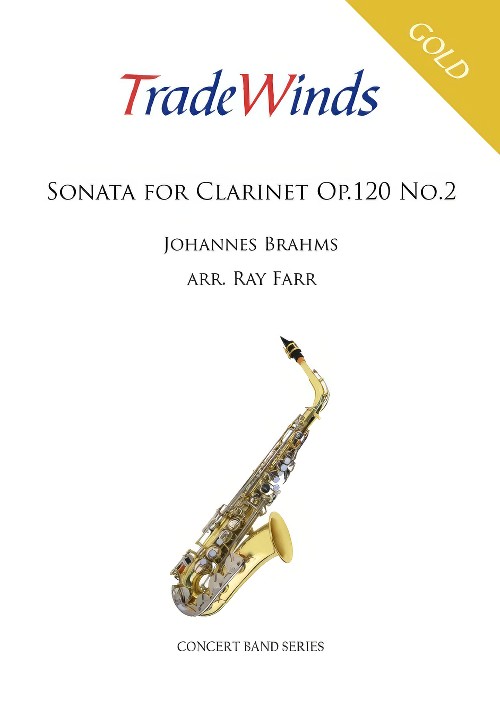
Sonata for Clarinet Op.120 No.2 in Eb (Concert Band - Score and Parts) - Brahms, Johannes - Farr, Ray
'Scaff' is an adaptation of the famous 4th movement of the Symphonie Fantastique by Berlioz in swing style. The story of the 'March to the scaffold' is a tragic one where the subject, in a depressive state over a love interest, overdoses on opium. He dreams that he has killed his beloved and after his procession to the scaffold is now witnessing his own death. This arrangement doesn't really reflect those tragic circumstances but instead redresses this great tune into a toe-tapping 'big band' number.
Estimated dispatch 7-14 working days
-
£14.95
Sonata for Clarinet Op.120 No.2 in Eb (Concert Band - Score Only) - Brahms, Johannes - Farr, Ray
'Scaff' is an adaptation of the famous 4th movement of the Symphonie Fantastique by Berlioz in swing style. The story of the 'March to the scaffold' is a tragic one where the subject, in a depressive state over a love interest, overdoses on opium. He dreams that he has killed his beloved and after his procession to the scaffold is now witnessing his own death. This arrangement doesn't really reflect those tragic circumstances but instead redresses this great tune into a toe-tapping 'big band' number.
Estimated dispatch 7-14 working days
-
 £75.00
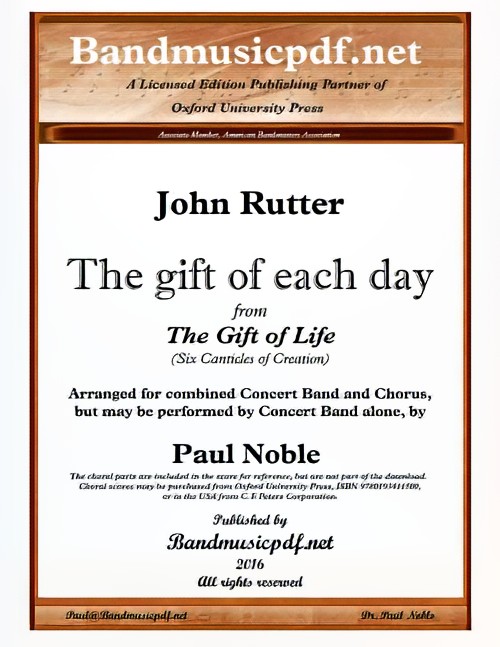
The Gift of Each Day (from The Gift of Life) (Concert Band with Optional Choir - Score and Parts) - Rutter, John - Noble, Paul
The Gift of Life was written early in 2015 as a commission to honour a retiring Minister of Music at a church in Dallas, Texas. In planning this piece, John Rutter has stated: In 1985 I had written a Requiem - which, like any Requiem, inevitably reflects on death - why not write the opposite, a work celebrating life? Unlike a Requiem, where a set form of words is laid down in Catholic liturgy, no framework exists for a celebration of life, and I had to choose (and in three cases, write) texts which were appropriate to a theme rarely expressed in music since Haydn's wondrous oratorio The Creation in 1798. The six movements reflect different facets of the miracles of creation and of life. This arrangement is written for combined Concert Band and Chorus, but may be performed by Concert Band alone.
Estimated dispatch 7-14 working days
-
 £440.00
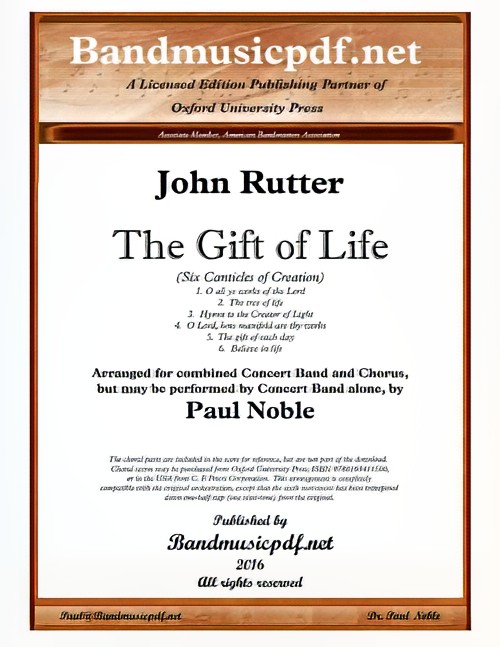
The Gift of Life (Concert Band with Optional Choir - Score and Parts) - Rutter, John - Noble, Paul
The Gift of Life was written early in 2015 as a commission to honour a retiring Minister of Music at a church in Dallas, Texas. In planning this piece, John Rutter has stated: In 1985 I had written a Requiem - which, like any Requiem, inevitably reflects on death - why not write the opposite, a work celebrating life? Unlike a Requiem, where a set form of words is laid down in Catholic liturgy, no framework exists for a celebration of life, and I had to choose (and in three cases, write) texts which were appropriate to a theme rarely expressed in music since Haydn's wondrous oratorio The Creation in 1798. The six movements reflect different facets of the miracles of creation and of life. This arrangement is written for combined Concert Band and Chorus, but may be performed by Concert Band alone.
Estimated dispatch 7-14 working days
-
 £85.00
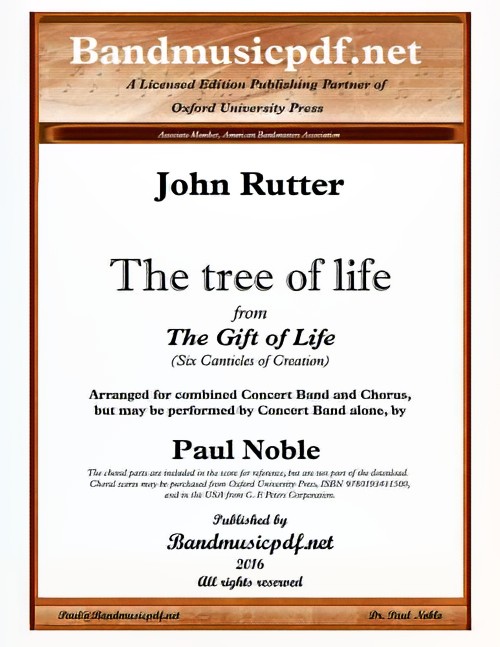
The Tree of Life (from The Gift of Life) (Concert Band with Optional Choir - Score and Parts) - Rutter, John - Noble, Paul
The Gift of Life was written early in 2015 as a commission to honour a retiring Minister of Music at a church in Dallas, Texas. In planning this piece, John Rutter has stated: In 1985 I had written a Requiem - which, like any Requiem, inevitably reflects on death - why not write the opposite, a work celebrating life? Unlike a Requiem, where a set form of words is laid down in Catholic liturgy, no framework exists for a celebration of life, and I had to choose (and in three cases, write) texts which were appropriate to a theme rarely expressed in music since Haydn's wondrous oratorio The Creation in 1798. The six movements reflect different facets of the miracles of creation and of life. This arrangement is written for combined Concert Band and Chorus, but may be performed by Concert Band alone.
Estimated dispatch 7-14 working days
 View Music