
Results
-
 £332.99
Cantica de Sancto Benedicto - Jacob de Haan
Cantica de Sancto Benedicto is a three-movement work for mixed choir, soprano solo, concert band and organ ad libitum - on Latin lyrics that relate to the life of Saint Benedict. It was commissioned by the city of Norcia in Italy, whereBenedict was born. The holy Benedict (480-547) is considered the founder of monastic life within the Roman Catholic Church. His enormous influence is especially owing to his monastic rule, the Regula Benedicti.Jacob de Haan has named the movements ofCantica de Sancto Benedicto after the Holy Trinity: the Father (Gloria Patri), the Son (Gloria Filio) and the Holy Spirit (Gloria Spiritui Sancto). The lyrics of thehymn Gemma Caelestis, (which, like the othertexts, were originally used in Gregorian chant) are voiced by the choir. To this purpose, Jacob de Haan composed new, choral-like, homophone music. The sequence Laeta Quies is rendered by the soprano; the verses (divided over the threemovements) are alternated with those of Gemma Caelestis. The work closes with an impressive grand finale, in which texts are used from the proprium of the mass in honor of the saint's day of the holy Benedict (11 July). Notes to the conductor:For this cantata, there are various possibilities for the performance. The first involves a performance in which the choir and soprano parts are only accompanied by organ. Such a performance has several advantages: since the band never soundstogether with the choir and the soprano, no balance problems occur, and even a performance with a large concert band and a small cantata choir is conceivable. A special layout is also possible - with which you can set up a three-dimensionalperformance in a church. For example, the choir can sing in the chancel, accompanied by the choir organ; the soprano can stand on the gallery, accompanied by the main organ; and the band can be seated in another part of the church. The choir couldalso sing from a gallery. With layouts like this, working with two conductors is advisable. Choral parts available separately.
Estimated dispatch 7-14 working days
-
 £174.99
Le Lion de Belfort - Jan de Haan
Le Lion de Belfort was composed for the official inauguration of the sculpture Le Lion de Belfort: an enormous red sandstone lion that dominates the landscape of the French city of Belfort. This 22 metre long and 11 metre high lion symbolises the heroic French resistance during the Prussian siege of Belfort in 1870-1871. The composer added a narrator and three-part choir to the concert band instrumentation, who utilise texts written specially for the occasion by Jean Ehret.The work's premire took place at the inauguration of Le Lion de Belfort on 28 November 2010, 130 years after sculptor Frdric Auguste Bartholdi (1834-1904) completed the statue.
Estimated dispatch 7-14 working days
-
 £245.50
Symphonie de l'Eau - Serge Lancen
This symphony was composed in 1984 and is dedicated to the great French composer Ida Gotkovsky a good friend of the Lancen family. It was the test piece in the Seccion Primera of the famous Spanish wind band contest Certamen International de Bandes de Msica Ciudad de Valncia and was recorded by the Symphonic Band of the Maastricht Conservatory of Music conducted by Sef Pijpers. Serge Lancen himself related the genesis of this symphony as follows:When I was twelve years old I had started composing a piece which described the cycle of the water. The project was however abandoned and only some themes were left unused. In July 1983, I went by boat to the WASBE conference in Skien, Norway and was seduced by the North Sea. During the travel a musical theme was born and was the trigger for the realisation of my ancient project which I still fancied'. The 'Symphonie de l'Eau' is in fact a musical description of the cycle of the water which the composer defines as follows:'A slight mist rises and turns into a cloud. Water drops fall on the mountain. A brooklet rises and clears a way throughout the alpine pastures. Soon other small watercourses join the original brook that is now reinforced as to become a real roaring mountain river falling in a lake amidst a quiet and poetic surrounding. The water turns again into a river when leaving the lake and gradually becomes a big stream which majestically flows towards the sea. A slight mist is rising from the huge surface and so the cycle of the water starts all over again.
Estimated dispatch 7-14 working days
-
 £76.80
Vale De Cambra - Carlos Marques
The march 'Vale de Cambra' was commissioned on the occasion of the centenary celebration of the band of Vale de Cambra (Portugal). Conducted by the composer, was premiered in October 2011, in Vale de Cambra, with about hundred musicians. It begins with a fanfare, rhythmical, thence to the first section, which traditionally develops. With a grand final, as is fitting for a celebration as important as a centenarian, the march creates either in the audience and in the musicians, and during all its duration, an effect of power and excitement to which no one stays indifferent.
Estimated dispatch 7-14 working days
-
 £92.00
1o de Agosto - Nuno Osório
1 de Agosto. This piece was composed in commemoration of the centenary of Sociedade Musical 1 de Agosto, located in Vila Nova de Gaia - Portugal. It's a festive piece in a Pasodoble style. It starts with a percussion section and trumpet solo, to mark the beginning of a voyage through the band's experiences, from the orchestration to the musical set pieces used.
Estimated dispatch 7-14 working days
-
 £186.20
Symphonie de Paris - Serge Lancen
This composition, written in 1973, was commissioned by the French Ministry of Cultural Affairs and is dedicated to Dsir Dondeyne who premiered it with the 'Musique des Gardiens de la Paix' at the Paris 'Palais des Congrs' on 27 February 1975. The piece was recorded in 1994 by the 'Orchestre d'Harmonie de la Police Nationale' (National Police Band) conducted by Pierre Bigot. Serge Lancen included the following text with the score: 'The Symphonie de Paris is a musical walk through the capital. Once the visitor has arrived, the composition evokes successively: the familiar cheerfulness of the popular quarters, the hustle and bustle of the great boulevards, the mysterious elegance of the Champs Elyses, the poetic charm of the banks of the river Seine, the impressive Notre-Dame cathedral looking in the mirror of the Seine. Then we have the 'Rive Gauche' (Left bank): the young and dynamic 'Latin Quarter', 'Saint-Germain-des-Prs' an ideal place to stroll. The walk ends near the Eiffel Tower and during the ascension we really discover Paris with its monuments, its avenues, the meanders of the Seine. Finally we enjoy the unique sight of the entire city perspective.'
Estimated dispatch 7-14 working days
-
 £61.00
Marche de Concert - Serge Lancen
This concert march was originally written for the piano in 1960. In the meantime, his friend Dsir Dondeyne whom Serge Lancen had met as fellow-pupil at the Paris Conservatoire National Suprieur de Musique had drawn Serge's attention to the symphonic band. Dondeyne had been appointed conductort of the Paris Metropolitan Police Band in 1954. The Marche de Concert was orchestrated by Dsir Dondeyne in March 1961 and it was the very first time that both great musicians collaborated. The march was premiered by the Musique des Gardiens de la Paix on the bandstand of the famous and beautiful Paris public garden 'Jardin du Luxembourg' on 8 July 1961.
Estimated dispatch 7-14 working days
-
 £224.99
Les Marteaux de la Marine - Rob Goorhuis
Les Marteaux de La Marine was composed in 1999 as a commission by the Marine Band of the Royal Netherlands Navy. The composition contains three static elements which interchange. Static in this case means that development of the material isnot pursued (by the composer). The first element with which the piece begins is tranquil and colourful. The second element is sharp and incisive, while the third expresses energy. In all elements a repeated tone is the starting point whichexplains the hammers in the works title.The instrumentation is richly variegated with a harp also determining the palette of colours in the slower movements. The composition opens with an atmospheric Larghetto containing fine harmonies in thesoft and subtly moving wood-winds. The introduction breathes an impressionistic atmosphere in which expressive cantilenas and soloistic agile motifs stand out. A strong setting is followed by an Allegro virtuoso containing fast motifs contrasted withshort and rhythmic stars of the various instrumental sections. Trumpets and horns add a virtuoso bugle-call motif. After a short stringendosection, the transparent Larghetto returns with a varied setting of the opening elements. The beautifulleading roles in this section are reserved for cornet (trumpet) and horn. Subsequently, the flashing Vivo starts with continuous movements in triplets from both wood-winds and brass. Next, the opening Allegro re-appears once again and thus LesMarteaux de la Marine ends with a fast and virtuoso climax. Les Marteaux de La Marine was selected as a compulsory grade 6 contest piece for symphonic bands in the Netherlands.
Estimated dispatch 7-14 working days
-
 £186.20
Le Chant de l' Arbre - Serge Lancen
Serge Lancen was born in Paris in 1922. The whole of his life has been dominated by music. He wrote his first work at the age of four. He studied with Tony Aubin at the Paris Conservatoire. In 1949 he won a prize for his Etudes, and some time later he was awarded the Prix de Rome.His work as composer is very varied and includes a number of solo concerti (for example for flute, double bass and piano), a Sinfonietta and a large number of works in the light symphonic genre (many of these commissioned by the French Radio), chamber music, film music, and during the last ten years various works for wind band, such as the Manhattan Symphony, Festival in Kerkrade, Symphonie de Paris and this beautiful Chant de l'Arbre (Song of the Tree).
Estimated dispatch 7-14 working days
-
 £70.00
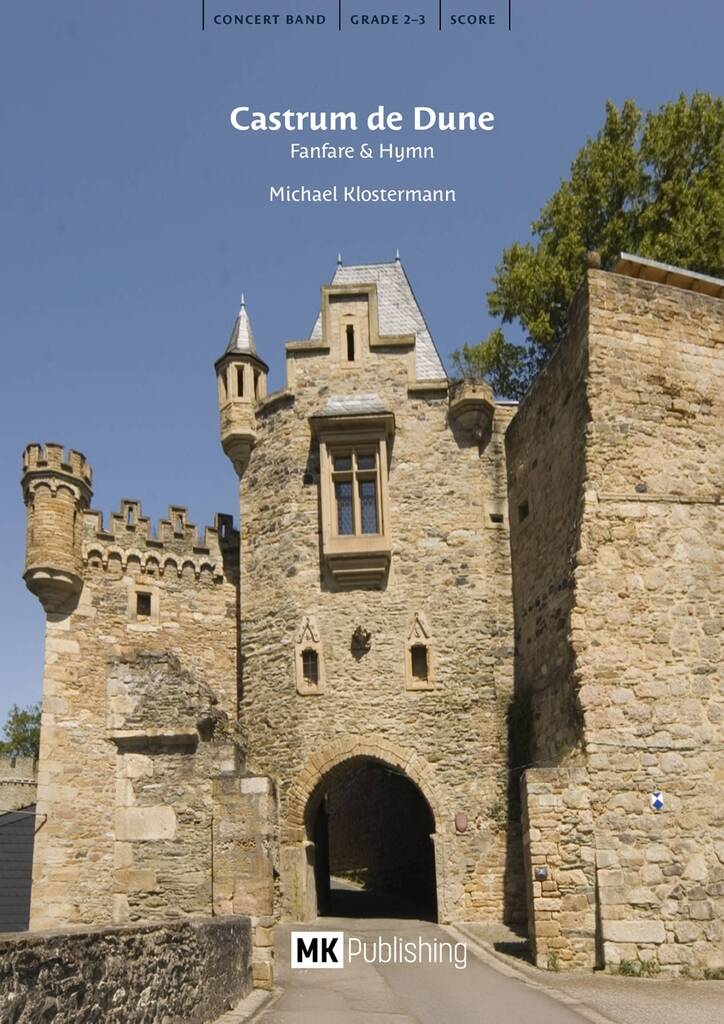
Castrum de Dune - Michael Klostermann
"Castrum de Dune" is an impressive work composed in 2021 to mark the acquisition of Dhaun Castle (Rhineland-Pfalz). Originally created as a fanfare and hymn for this ceremonial opening and premiered in a reduced instrumentation, the piece enjoyed considerable success. This inspired Michael Klostermann to orchestrate the composition for symphonic wind orchestra. The powerful fanfare opens the piece with striking, historically inspired sounds that musically reflect the Roman origins of the region. This is followed by a majestic hymn that vividly depicts the flight of an eagle soaring over the castle landscape in rich musical language.With the eagle's return, the fanfare resounds once more - familiar yet newly interpreted - leading the work to a harmonically complete and impressive finale."Castrum de Dune" combines historical elements with modern orchestral arrangements, creating a compelling musical experience that takes listeners on a brief journey through history and the majestic beauty of nature.
Estimated dispatch 7-14 working days
 View Music