
Results
-
 £84.99
Es ist ein Ros Entsprungen (Concert Band - Score and Parts) - Praetorius, Michael - Schwarz, Otto M.
The many sided and productive Michael Praetorius (1571-1621) is known as a composer of dance music, sacred music and music for the advent and Christmas time. He worked as Kapelmeister to the court at Wolffenbuttel, but he was also asked to serve in other places, including Dresden. Praetorius was valued for the new impulses he gave to music by means of his use of instrumental accompaniment. His main contribution is his theoretical work "Syntagma Musicum", one of the most important musical reference books, in connection with instruments and instrumentation in the early 17th Century. "Es ist ein ros entsprungen" is a well known ancient melody which has inspired numerous composers and arrangers throughout the Centuries. Otto M. Schwarz has made a choral arrangement.Duration: 3:00
Estimated dispatch 7-14 working days
-
 £67.99
Dances Fantastique - David Shaffer
This exciting work for concert band is a set of three delightful dances. Opening with a bold fanfare statement, the first dance reveals the melodic material that is the basis for all three movements. The title of this movement, Double Dance, is derived from the second statement of the melody, appearing in doubled rhythmic values. The second movement, Round Dance, the melody is written as a three part round. You could not have a Round Dance without a Square Dance, which is the title of final movement. Lots of fun percussion instruments add interesting timbres throughout. This interesting and clever composition is perfect for contest and festival.
Estimated dispatch 7-14 working days
-
 £156.30
Simoon Concert - Ferrer Ferran
The Simoon Concerto is a two part composition for alto saxaphone and wind orcehstra. The first part, Dance of the Dunes, describes how the sand dunes form and alter their shape due to the scorching desert winds. In the following section, Dance of the Tuaregs, the snare drum signals the start of the dance of the legendary nomadic desert dwellers. The proud Tuareg people dance according to the ancient traditional rhythms of their ancestors
Estimated dispatch 7-14 working days
-
 £119.99
The African Connection - Carl Wittrock
Carl Wittrock's wide interest in global folk-music resulted in this concert-piece based on original African rhythms. Obviously, the percussion section has a conspicious role to play, but the band too may indulge itself in moments of thoroughly delightful excitement. The introduction depicts the awakening of nature, and develops into a dance. The (main) motif of this dance is from a dance entitled Apollo and comes from Gambia. Its accompaniment consists of an ostinato pattern by balaphon-master Maudo Susa. The quiet middle movement is based on the rhythm of the 'gigbo' : a traditional dance from Ghana. In the final movement -which also bears a slight resemblanceto a theme from 'The Lion King'- the so-called 'Kono' rhythm is used. The work is played most advantageously using djembes. Challenge and please your percussion section with 'The African Connection'. Carl Wittrock's brede interesse voor de wereldmuziek resulteerde in dit op originele Afrikaanse ritmes gebaseerde concertwerk. Het slagwerk speelt uiteraard een opvallende rol, maar ook het orkest kan zich op een heerlijke manier uitleven. De inleiding schildert het ontwaken van de natuur, welke overgaat in een dans. Het motief van deze dans (Apollo) is afkomstig uit Gambia. De begeleiding bestaat uit een ostinaatpatroon van de balafon-meester Maudo Susa. De basis van het rustige middendeel is gelegen in het ritme van de Gigbo, een traditionele dans uit Ghana. Het laatste deel (met enige gelijkenis met The Lion King) maakt gebruik van het zogenaamde Kono ritme. Het werk komt het best tot zijn recht als er gebruik wordt gemaakt van djembes.Daag uw percussie sectie uit en doe ze een groot plezier met: The African Connection!
Estimated dispatch 7-14 working days
-
 £159.60
Sci-Fi Suite of Dances - Bernhard Bogisch
1. Harvest Dance - Phoeboia II Like many of the inhabited planets Phoebia II was first colonized by the survivors of a spaceship crash. There is no certainty as to where these survivors originated from. In the late 21st century many spaceship were launched manned by people who were looking for a new future, away from an over-populated Earth. Some succeeded, some managed to return, some were never heard of again. In 2311 a survey ship had to make an emergency landing on Phoebia II and they found a triving colony there. Although the early history of the colony is shrouded in antiquity, certain aspects of the language, as well as physical features, seem to point to a south-east European origin. The harvest dance, in the aspects of rhythm, melody and harmony has many things in common with the music of what once were the countries of Macedonia, Greece and Turkey, little of which has unfortunately, been left due to primitive recording methods of the period.2. Ritual Seduction Dance - Rugel VWhen first discovered Rugel V was already a very civilized planet populated by a humanoid race and governed by a class of superior females. The first settlers from Earth were held as slaves but gained freedom over the years. It is assumed that this happened because the Earth people were all male and considered very attractive by the native females in comparison with the aboriginal males. The Earth males were evidently very attractive to the native women, who on their part used all their womanly wiles to entice them. We all know that Rugel V is now a very advanced and totally integrated society. The people have not forgotten their roots, and these Ritual Seduction Dances are performed on a regular basis in commemoration of the original Grand Seduction. Musically speaking Romanian origin influenced by native characteristics is virtually certain.3. Attack Dance - Planet Khi't'onThis is the only dance in this suite that is purely native. The natives people know as Khi't'och are now very civilized, but initial contact was difficult due to the difference in physical make-up between the two peoples. Suffice it to say that in the early stages Earth people referred to the Khi't'och as 'mosquito people'. We still don't know very much about them, other then that they have a history of violence but are now quite peaceful although they love to relive their past in a stylised way, not unlike the Maories of the former New Zealand, whose fearsome tattoos were later only painted on. This Attack Dance is, at best, an imitation due to the lack native instruments, and it was a very happy occasion for this composer when, at a concert at the House of Culture on Khi't'on, the Khi't'och showed their appreciation by clicking their feeding tubes and emitting loud shouts.4. Wedding Dance and Prayer - Planet B'lGarThere is little doubt that the people of this planet originate in the former country of Bulgaria. Several examples of similar pieces featuring the quaint 11/8 time signature have been found in old archives and recordings. Russian influence is also noticeable in the prayer the style of which is reminiscent of that of the now extinct sect of Raskolniky.
Estimated dispatch 7-14 working days
-
 £89.99
Symphonic Dances from Fiddler on the Roof - Jerry Bock
This landmark Broadway musical includes marvelous dance sequences with unique ethnic stylings. From the rousing To Life and Tradition to the tender Chava Sequence and Perchik and Hodel Dance to the signature Wedding Dance #1 (Bottle Dance) this is a magnificent work for the mature ensemble.
Estimated dispatch 7-14 working days
-
 £74.00
Galop - Amilcare Ponchielli
La Gioconda, with a libretto by Arrigo Boito, is the most successful theatrical work by Amilcare Ponchielli (1844-1886). In this work there are two dance pieces: the Furlana at the conclusion of the 1st act and the Danza delle ore in the 3rd act. The Dance of the Hours has a precise choreographic outline: it is a masked ball which includes the "hours" of dawn, day, evening and night successively, and ends with a wild finale of galop. The latter is a sort of fast polka, in binary rhythm and unbridled pace. A French variant of it is the can-can. The finale in galop time of the Dance of the Hours recalls certain playful dances by the composer Jacques Offenbach, such as the famous Can-can that concludes the overture of the operetta Orphe au enfers.
Estimated dispatch 7-14 working days
-
 £174.99
The Graces of Love - Oliver Waespi
"The Graces of Love" (Le Gratie d'Amore) is the title of a book published in 1602 by Cesare Negri, the famous dance master of the Milanese court in the Renaissance. It contains numerous dance tunes and precise descriptions of courtly dances. It also includes the tune 'Il bianco fior' (The White Flower) on which the first movement of Oliver Waespi's piece is based. A vigorous dance in three-four, it leads to an acceleration and a sudden shift to an even meter towards the end. The second movement, calm and contemplative in character, features the tune 'Vaghe bellezze ...' (Veiled Beauty ...). Widely spaced melodic parts surround two solos during which the tune is varied anddeveloped. Finally, the third movement contains a Saltarello based on a tune by Vincenzo Galilei, the father of the famous astronomer, Galileo Galilei. It brings the work to a close with a hypnotic rhythm which is noble and virtuosic at the same time.
Estimated dispatch 7-14 working days
-
 £85.00
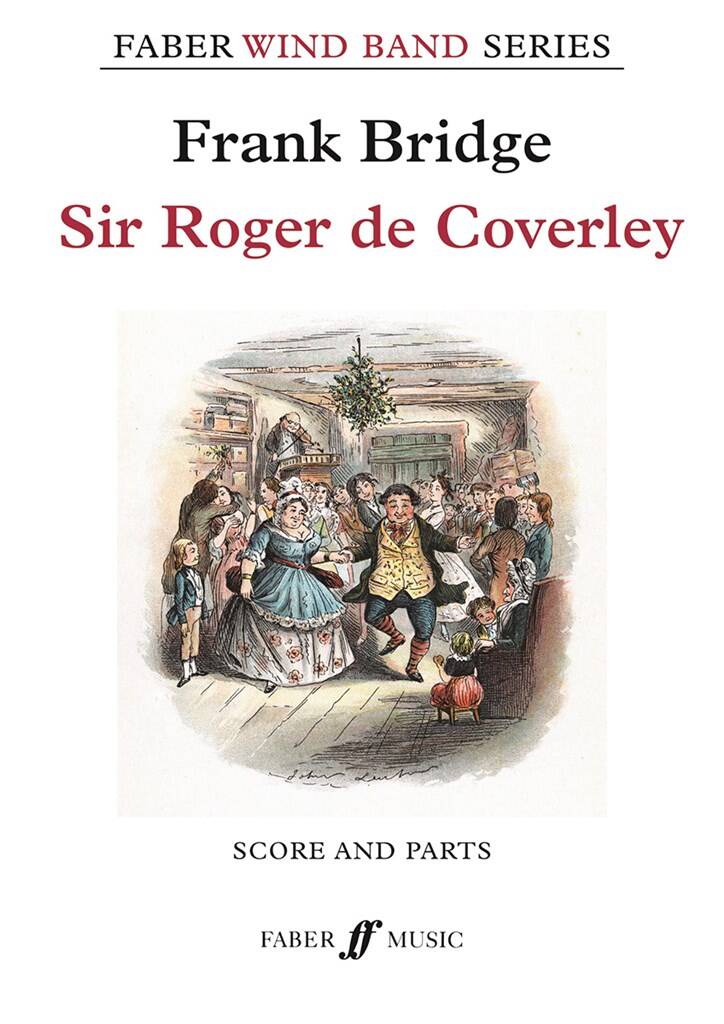
Sir Roger de Coverley - Frank Bridge
Frank Bridge (1879 - 1941) was one of the leading English composers of his time. In October 1922 he adapted his popular string quartet Sir Roger de Coverley for full symphony orchestra and Sir Henry Wood agreed, at the last minute, to include it in the last night of the Queen's Hall Promenade Concerts at the end of that month.This elaborate and colourful orchestral version has never been widely performed, but has now been brilliantly transcribed by Alastair Wheeler to provide a miniature dance poem for grade 5 level concert band.Bridge's lively treatment of one of England's most famous traditional dance melodies willmake a fitting end to any concert, with the strains of Auld Lang Syne introduced by Bridge as a nod towards Sir Roger de Coverley's traditional function as the final dance of a Christmas Ball, as it was in Old Mr. Fezziwig's party in Dickens' A Christmas Carol.
Estimated dispatch 7-14 working days
-
 £149.40
The Battle of the Hats - Øystein Sjøvaag Heimdal
The word svimesltt, which is the title of this piece in Norwegian, has two meanings. One meaning is "knocked out", whilst the other, "sltt", means a folk melody/dance.Svimesltt is one of several folk dances, all of them with humorous titles, originally written by ystein Olsen Vadsten. Norwegian culture is the basis for these dances, both rhythmically and melodically. The accompaniment has brought this funpiece into the 21st Century.When it comes to Svimesltt, it is the traditional dance "halling" that is the inspiration. Halling is a rather wild dance, where the man tries to win the heart of a lady by attempting to kick a hat off a stick,held up in the air. This iswhere "The Battle of the Hats" gets its distinctive name A truly Norwegian tradition.The composer wanted to write a "crazy" melody, which highlights how "knocked out" a man can be by love, as he tries to win the chosen ones heart.
Estimated dispatch 7-14 working days
 View Music