
Results
-
 £214.99
El Muro (The Wall) - Ricardo Lorenz
Made up of tightly woven riffs, El Muro suggests a variety of Latin American musical styles, from the Colombian cumbia, Peruvian huayno, Mexican son, and the Cuban montuno. Venezuelan-born composer Ricardo Lorenz personalizes these styles, incorporating them seamlessly without compromising the underlying musical logic of his work. Conceptually, the piece challenges the notion of both physical and imaginary walls which divide and oppress people. The resulting drama that plays out in the piece portrays these rich musical traditions confronting the wall. (Grade 6) Dur: 12:00
Estimated dispatch 7-14 working days
-
 £154.60
Sabor Caribeo - Sverre Indris Joner
"Sabor Caribeo" means "Taste of Caribbean". This original composition is written by Norwegian composer Sverre Indris Joner who has studied Caribbean music since mid-80s.The music presents traditional elements from Cuban and Puerto Rico. Polyrhytmics is an important part of the music which consist of up to four melody lines at the same time.It's recommended that both conductor and the percussionists study the rhythm patterns very closely. Especially congas and timbales which vary patters a lot. The role of the guiro must not be underrated.It is possible to simplify the percussion parts by choosing some patterns and play these for longer periods than written.
Estimated dispatch 7-14 working days
-
 £113.30
Moderate Dances - Angelo Sormani
This piece is a tribute to dance music, especially passionate, intense and meditative dance music. "Moderate Dances" is divided into three movements: a "Tango", a "Slow Waltz" and a "Bossa Nova". Each movement and each dance has its own particular characteristics but, when combined, these different rhythmic beats and times give the piece a feeling of completeness and uniformity. The Tango started to flourish in the suburbs of Buenos Aires in around 1880. There is still some doubt as to its origins, which may be Cuban (Habanera) but are probably African. It was most popular in Argentina and Brazil: here the male protagonist was originally the "gaucho" with his inseparable guitar, later to be replaced by the proud, elegant "compadre". By around 1910 the Tango had spread to Italy and France. New clubs opened, where the upper classes could watch and dance the Tango. Here the dance also underwent some rapid transformations. The exaggerated and extravagant gestures and body movements disappeared. Slow, gliding steps replaced the old rotational movements. The women's red ankle-boots and the partners "staring into each other's eyes" accentuated the erotic nature and sensuality of this dance. So much so that, in 1913, the German government banned soldiers from dancing the Tango. Those who broke the law were immediately discharged from the army. From a strictly musical perspective, the basic instruments were a flute, a harp (the diatonic harp typically played by the Indians of Paraguay) and a violin, or flute, guitar and violin or even clarinet, guitar and violin. These instruments were easy to transport, ideal for playing at parties, in the streets and in courtyards. The musicians played by ear, frequently improvising: there were no scores, no records, which is the main reason why it is impossible to trace the Tango back to its exact origins. However, the Tango's evolution (and growing popularity) was once again fostered by its fundamental ability to absorb "other" cultures, languages and sounds. And it was the arrival of the "bandoneon" (an accordion-like instrument that was invented in Germany and brought to Rio de la Plata by some immigrant), which replaced the flute, that marked the beginning of the Tango's huge success outside Argentina. A number of talented composers, above all the great Astor Piazzola (1921-1992), transformed the bandoneon from a simple accompanying instrument to a solo instrument that was to become the distinguishing feature of the 20th century Tango. The Slow Waltz originated from the Waltz, the typical dance of the Bavarian and Tyrolese peasants in the 1700s. It was composers like Johann Strauss, father and son, who carried the Waltz to its zenith in the 1800s, creating the sensual and melancholy yet joyful and charming dance we are all familiar with. When the Waltz first became popular in Germany, the members of respectable society were shocked at the closeness of the dancing partners, who had always previously danced apart. The main difference between the Waltz and Slow Waltz is that the latter has a slower, more expressive rhythm: the men wear tails and the women wear ball gowns decorated with beads and feathers and couples dance in graceful rotational movements. "Bossa Nova" is the title of the last movement in the piece. Jobim, the great Brazilian musician, described this musical genre as a combination of modern Jazz and Samba. Bossa Nova means "new wave". This was the name of the artistic and musical movement that evolved in Brazil in the late Fifties and was extremely popular throughout the Sixties. The songs are usually about love or social matters, drawing inspiration from the slums of Rio De Janeiro and the lives of their inhabitants. Bossa Nova, with its original compositions and the artistic talent of its musicians, also became hugely popular in the United States and Europe, and top Jazz musicians (Ella Fitzgerald, Stan Getz, Bob Cooper, Charlie Bird, Sonny Rollins, Dexter Gordon, Dizzy Gillespie) started to include Bossa in their repertoires.
Estimated dispatch 7-14 working days
-
 £45.95
Guantanamera
There's no one better to present Guantanamera to your beginners. Victor Lopez sets the steady Latin rock groove in your percussion section as the foundation for this appealing Cuban melody. Translated, the title means the girl from Guantanamo. With the enhanced program notes, it's a great choice for cross-curricular instruction with a spicy flair.
Estimated dispatch 7-14 working days
-
 £63.50
Danzon - Leonard Bernstein
Influenced by the traditional Cuban dance style, Danzon is a brilliant piece composed by Leonard Bernstein in collaboration with famed choreographer Jerome Robbins for the 1944 ballet Fancy Free.Jay Bocook's skilled adaptation for band captures the sensual mood of the original and offers a unique programming choice.
Estimated dispatch 7-14 working days
-
 £84.50
The Symphonic Gershwin - George Gershwin
Mix one part world-class composer and one part super-skilled arranger and the result is a perfect medley of all-time Gershwin favorites. Our musician's musician, Warren Barker, blends his tasteful takes on An American in Paris, Cuban Overture, and Rhapsody in Blue into a mesmerizing presentation for your concert audiences. This runs at full throttle, from beginning to end! (7:25)
Estimated dispatch 7-14 working days
-
 £120.00
Tocata & La Tumba de Alejandro Garcia Caturla (from Islas y Montanas) (Concert Band - Score and Parts) - Hanson, Shelley
Shelley Hanson originally composed Islas y Montanas for orchestra. Tocata is the first movement and functions as a fanfare or introduction. It features the entire ensemble clapping rhythmic patterns based on the Cuban 3/2-clave rhythm. It's a great way to get the crowd ready for La Tumba de Alejandro Garcia Caturla, originally the fourth movement from Islas y Montanas. It is beautifully transcribed here for concert band. It is a musical rumination about Cuban composer Alejandro Garcia Caturla (1906-1940) who studied with Nadia Boulanger but was later assassinated while presiding as a judge. It opens with a haunting English horn cadenza (alternate cueing provided) followed by harmonic shifts, intense soli writing and driving rhythms that sweep through the ensemble.
Estimated dispatch 7-14 working days
-
 £122.20
Sabor Caribeno (Concert Band - Score and Parts) - Joner, Sverre Indris
Sabor Caribeno means Taste of Caribbean . This original composition is written by Norwegian composer Sverre Indris Joner who has studied Caribbean music since mid-80s.The music presents traditional elements from Cuban and Puerto Rico. Polyrhythmic is an important part of the music which consist of up to four melody lines at the same time.
Estimated dispatch 7-14 working days
-
 £73.00
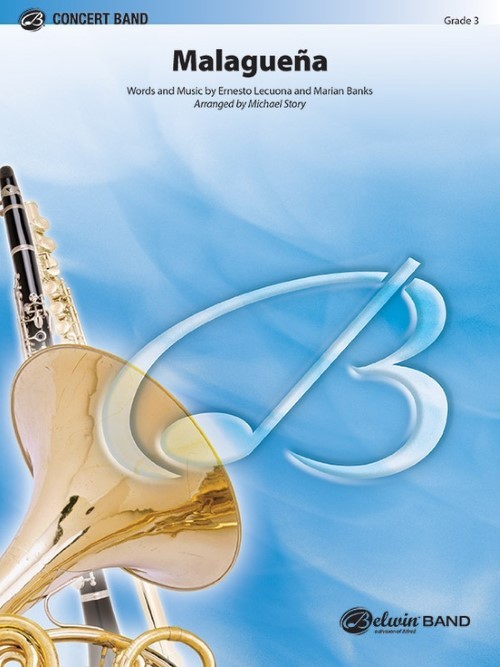
Malaguena (Concert Band - Score and Parts) - Banks & Lecuona - Story, Michael
Malaguena is one of the most recognisable Latin melodies written in the last century. It was originally written by Cuban composer Ernesto Lecuona. Building in intensity and tempo through four distinct motifs to an enthusiastic conclusion, this sultry arrangement explores lower tonality. Passionate! Duration: 3:00
Estimated dispatch 7-14 working days
-
 £45.00
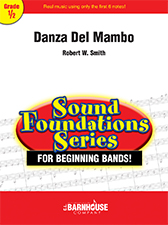
Danza Del Mambo (Concert Band - Score and Parts) - Smith, Robert W.
Using only the first six notes introduced in most band methods, Robert W. Smith gives us "Danza Del Mambo" for beginning band. Written in the classic Cuban dance style, this mambo features the percussion section using standard Latin percussion instruments such as claves, maracas, guiro and agogo bells. The flowing melodic line over the infectious Latin mambo groove will have your musicians moving and the audience dancing in the aisles! Duration: 1.40
Estimated dispatch 7-14 working days
 View Music