
Results
-
 £72.00
Blue and Orange (Flute Solo with Concert Band - Score and Parts) - Wiffin, Rob
A song and dance for flute with wind band accompaniment. Blue is a gentle, tuneful solo. The accompaniment is very much in a chamber-music style and there are very few places where the whole ensemble plays at the same time. There is nothing overt or dramatic in the music and subtlety and rubato are very much the required manner. It is not a desperately sad piece but is just tinged with a little melancholy. Orange on the other hand is a fiery, driving dance which gives the soloist a chance to display technical prowess. During the outer sections Latin percussion carries the music along but the inner sections are more dissonant and are built on inner rhythm. The two pieces are as contrasting as possible, just like the colours of the title.Duration: 3.15 & 4.15
Estimated dispatch 7-14 working days
-
 £211.80
Karneval i Paris - Johan S. Svendsen
Johan Svendsen (1840-1911) composed "Carnival in Paris" in 1872, inspired by the energy and vibrancy of the Parisian carnival celebrations. The piece showcases a variety of moods and orchestral colours, ranging from jubilant and playful sections to more lyrical and elegant passages. It is a lively and colourful work that reflects Svendsen's skill in orchestration and his ability to capture vivid, festive atmospheres in music. In "Carnival in Paris", his Nordic musical roots meet the cosmopolitan influences he encountered while living and working in major European cities. The work has become one of Svendsen's most popular and is frequently performed in concert halls and festivals. About My Transcriptions for Wind Bands Ever since I started playing the clarinet at 8 or 9 years old in the school band "Blveisene" in my hometown of Gjvik, playing transcriptions of orchestral music has been a natural part of the repertoire. In regional bands, Norway's National Youth Band, and during my 10 years in a Military band, I played many such transcriptions. These transcriptions often included handwritten parts, masterfully crafted by colleagues in a time when music notation software didn't exist. Similarly, the scores were often incomplete, typically featuring just a solo clarinet part and condensed score in Bb. The transcriptions also contained parts for instruments like the Eb cornet and multiple tenor horns, but no saxophones, which made them less suitable for modern wind bands. The rise of many skilled Concert Bands and the increasing demands for scores and accessibility made me realize that someone needed to preserve this tradition. The reason I've transcribed these works is to ensure that you can play or conduct a repertoire that I believe has a rightful place in Norwegian Wind Band tradition. These transcriptions are my contribution to preserving some of the unique works in Norwegian music literature. Creating a transcription is a complex task, and I believe the score of "Carnival in Paris" is one of the most intricate I've undertaken. The first part of the process involves entering the entire orchestral score into music notation software. This is time-consuming and requires meticulous work. The next step is to check several editions to see if there are any discrepancies. Mistakes are often found in orchestral material, which can lead to further errors in the transcription. After that, I listen to many different recordings while following along with the score, paying attention to how different conductors emphasize balance and timbre. Gradually, I begin to note down passages I believe will work well for wind bands. One particular challenge in this piece is that the woodwinds and strings operate in the same register. In the original, the tonal difference between the strings and winds helps to clarify the individual musical lines. In the transcription, I've tried to address this by separating the lines, for example through octave adjustments, and highlighting them without compromising other aspects. I've also used some mallet percussion to broaden the tonal palette. There are countless decisions to be made to create a product that will hopefully allow future generations of wind band musicians to play this repertoire. - Stig Nordhagen -
Estimated dispatch 7-14 working days
-
 £104.99
Canterbury Chorale - Jan Van der Roost
This quiet piece with its broad tones was originally written for brass band on request of Robert Leveugle, chairman of the composers own band: Brass Band Midden Brabant (Belgium). The direct cause was a visit to the beautiful cathedral of theEnglish city Canterbury, in which so many fine compositions sounded throughout the centuries. Later on, Jan Van der Roost rescored this piece for symphonic wind band, exploring the full richness of colours of this formation. Besides solo phrases forseveral instruments, there are some massive tutti passages making the wind orchestra sound like a majestic organ. By the way: an "ad libitum" organ part adds an extra richness, colour and power to this piece, making it sound even more broad andgrand.
Estimated dispatch 7-14 working days
-
£264.99
Diferencias on an Old Spanish Song - Yasuhide Ito
I am immensely happy that my Gloriosa, symphonic poem for band (1990), has been performed by so many bands in the last thirty years.During this period, the growth of the internet has made it much easier to access information.When I composed Gloriosa, I only had limited information about the period when Christianity and Western music was first introduced to Japan, and had to rely a lot on my imagination.However, nowadays, it is easy to obtain various source materials and to read interesting studies on the music of the past.In recent years, the music of Luis de Narvez (born ca.1500 - died between 1555-1560), Spanish composer and vihuela player, has become increasingly known, and several CDs of his music are now available.Narvez composed the earliest-known set of diferencias, a forerunner of the variation form. One of his works is Seys diferencias sobre el himno "O gloriosa domina" [Six diferencias on the hymn "O gloriosa domina"] (1538), based on the Spanish Marian hymn, and it was this melody I used in the first movement of my Gloriosa.Western music has been my musical roots since childhood, and throughout my career as a composer, it has continued to fascinate me. One could say that this has provided the inspiration for Diferencias on an Old Spanish Song, my own take on the diferencias form.Actually, such music from the early sixteenth century could sound fresh to our modern ears. So I decided to quote the melody from Narvez's Sey diferencias at the beginning and end of the piece, in order that people can get the feel for the period.The main section (bars 42-390) is formed of 13 diferencias, similar to the first movement of the Gloriosa.In the middle section, which begins after the eighth diferencia(from bar 187), one should be totally absorbed in the tranquility and the beauty of the music. Although it's in the style of a sarabande, it should be taken slower and played as pianissimo as possible.This is followed by folk-style dance music. (As only standard percussion instruments are used, try to be creative with tonal colours and sense of rhythm).The structure of the work is simple, but be aware of the connection between the sections when constructing the whole.Also, think about the tonality. Overall, the work is in F minor. The main section is basically in D minor, but from bar 102, it modulates to A flat minor and G minor, and then in the middle section it suddenly switches to A flat major (which is the furthest key from D minor, and the relative major of F minor). From bar 219, it modulates to F minor and then to C minor, then back to F minor by way of A minor.N.B. The Oboe II part can be substituted by the English Horn (as indicated in the parts). One can choose according to the player's skills or preference.Recent new compositions for wind band are often full of rhythm, dynamism, and tonal colour, and compositional techniques and orchestration have also evolved greatly. Yet on the other hand, they tend to feature fewer melodic or expressive elements. Since this work is the test piece for WMC Kerkrade 2022, I had to think about what "tests" or "challenges" to set, and I decided to compose something that doesn't involve a lot of technical display, but requires beautiful sounds and harmonies, and above all, musical expressivity. I didn't put many expression markings in the score, because I wanted the performers to think about how best to express this music. If it is played merely as notated, it's not going to sound very interesting.Christianity was introduced to Japan in the mid-16th century, but it was subsequently banned and Japan entered a period of national isolation, which meant that there was hardly any international exchange for two hundred years. As a result, the Christian hymns that were introduced prior to the isolation became almost unrecognizable over the centuries. This was the theme I explored in my Gloriosa thirty years ago.Now, in 2021, the whole world has been forced to "isolate" due to the Covid-19 pandemic. In such times, it seems pertinent that I've written a work using this melody again. I sincerely hope that people will be able to gather in Kerkrade in 2022.(English Translation:Nahoko Gotoh)
Estimated dispatch 7-14 working days
-
 £143.00
Psych et ros - César Franck
Csar Franck, composer, pianist, organist and music teacher, completed Cupid and Psych, his sixth and last symphonic poem in 1887. It was first performed in Paris in 1888 and was a complete success, but the piece later fell completely into oblivion, and it was only thanks to some meticulous research that it has returned to concert halls. The intricate love affair between Psyche and Cupid is an original story of the Metamorphoseswritten in the 2nd century AD by Apuleius. The tale is about overcoming obstacles in love and their final union. The symphonic poem is divided into three parts and calls for a choir. The movement that is the subject of this arrangement, Psych et rosis positioned at the end of the second part.Franco Cesarini's version for wind orchestra carefully illustrates the nuances of the instrumental colours, and represents a real test aimed at demonstrating the musicality and interpretative skills of orchestras and their conductors.
Estimated dispatch 7-14 working days
-
 £134.99
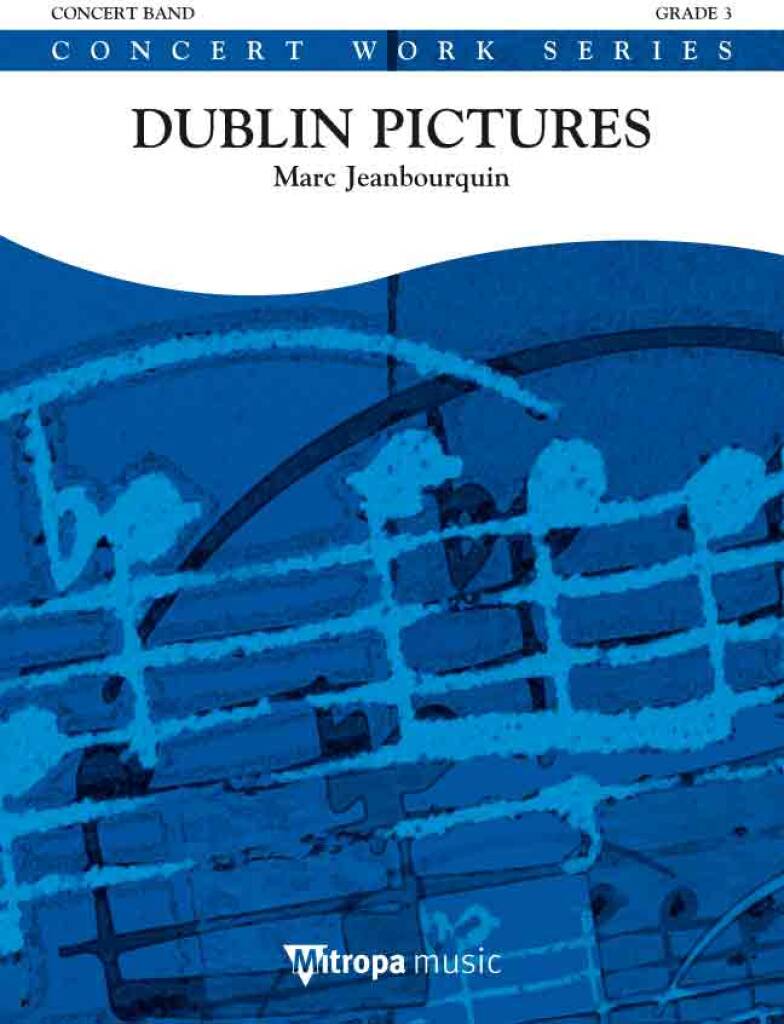
Dublin Pictures - Marc Jeanbourquin
Ireland is a multi-faceted country that has developed a popular and distinctive musical culture. The first movement of Dublin Pictures reflects Irish festivals where there is dancing and traditional beer flowing. More tranquil in its feel, the second movement illustrates the landscape that can be seen from the Ha'penny Bridge, a bridge that crosses the River Liffey in Dublin. This movement highlights the wide range of the orchestra's sound colours as the musicians' voices combine with the wind and percussion to accompany the soloist. The lively and joyful rhythms of the last movement take the listener to Temple Bar, the famous tourist quarter of the city, well knownfor its vibrant nightlife. The music's energy and virtuosic motifs are in contrast to the previous movement and provide a spirited and festive finale.Marc Jeanbourquin wrote this piece in three movements for Azimuts Brass in 2011. He then arranged it for Concert, Fanfare or Brass Band
Estimated dispatch 7-14 working days
-
 £104.99
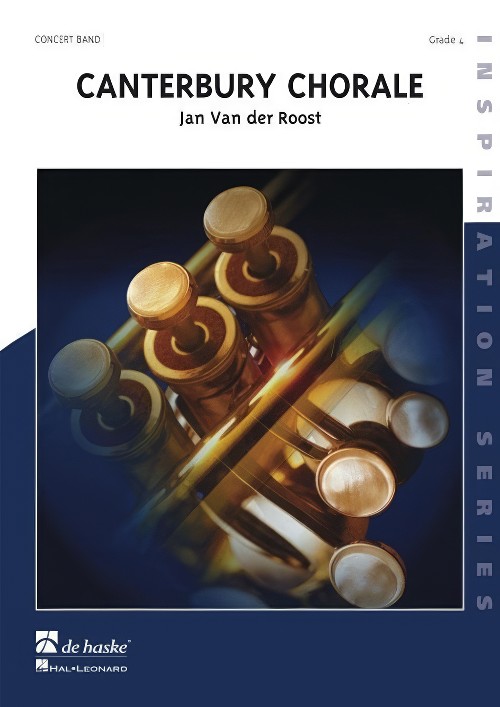
Canterbury Chorale (Concert Band - Score and Parts) - Van der Roost, Jan
This quiet piece with its broad tones was originally written for brass band on request of Robert Leveugle, chairman of the composers own band: Brass Band Midden Brabant (Belgium). The direct cause was a visit to the beautiful cathedral of the English city Canterbury, in which so many fine compositions sounded throughout the centuries. Later on, Jan Van der Roost rescored this piece for symphonic wind band, exploring the full richness of colours of this formation. Besides solo phrases for several instruments, there are some massive tutti passages making the wind orchestra sound like a majestic organ. By the way: an "ad libitum" organ part adds an extra richness, colour and power to this piece, making it sound even more broad and grand.Duration: 6:30
Estimated dispatch 7-14 working days
-
 £143.00
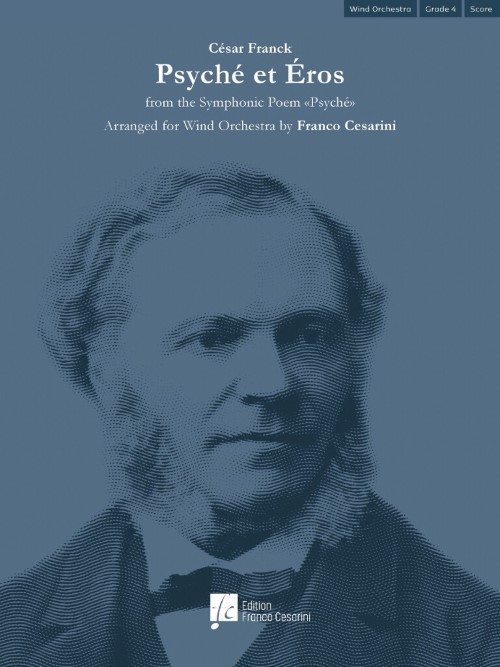
Psyche et Eros (Concert Band - Score and Parts) - Franck, Cesar - Cesarini, Franco
Cesar Franck, composer, pianist, organist and music teacher, completed Cupid and Psyche, his sixth and last symphonic poem in 1887. It was first performed in Paris in 1888 and was a complete success, but the piece later fell completely into oblivion, and it was only thanks to some meticulous research that it has returned to concert halls. The intricate love affair between Psyche and Cupid is an original story of the Metamorphoses, written in the 2nd century AD by Apuleius. The tale is about overcoming obstacles in love and their final union. The symphonic poem is divided into three parts and calls for a choir. The movement that is the subject of this arrangement, Psyche et Eros, is positioned at the end of the second part. Franco Cesarini's version for wind orchestra carefully illustrates the nuances of the instrumental colours, and represents a real test aimed at demonstrating the musicality and interpretative skills of orchestras and their conductors. Duration: 10.30
Estimated dispatch 7-14 working days
-
 £134.99
Dublin Pictures (Concert Band - Score and Parts)
Ireland is a multi-faceted country that has developed a popular and distinctive musical culture. The first movement of Dublin Pictures reflects Irish festivals where there is dancing and traditional beer flowing. More tranquil in its feel, the second movement illustrates the landscape that can be seen from the Ha'penny Bridge, a bridge that crosses the River Liffey in Dublin. This movement highlights the wide range of the orchestra's sound colours as the musicians' voices combine with the wind and percussion to accompany the soloist. The lively and joyful rhythms of the last movement take the listener to Temple Bar, the famous tourist quarter of the city, well known for its vibrant nightlife. The music's energy and virtuosic motifs are in contrast to the previous movement and provide a spirited and festive finale.Marc Jeanbourquin wrote this piece in three movements for Azimuts Brass in 2011. He then arranged it for Concert, Fanfare or Brass Band 07:45
Estimated dispatch 7-14 working days
-
£39.95
Deep River - Score and Parts - William Broughton
Deep River is a 'Count Basie' style arrangement of the well-known spiritual of the same title. William Broughton has transcribed his own work for wind band, making great use of the additional tone colours available.
Estimated dispatch 7-14 working days
 View Music