Searching for Brass Band Music? Visit the Brass Band Music Shop
We've found 694 matches for your search

Results

  • £104.99

    Killing Me Softly with His Song - C. Fox

    The tender ballad Killing Me Softly with His Song was written by Charles Fox and Norman Gimbel in 1971, for de American singer Lori Lieberman. She was very impressed with a performance by the then still unknown Don McLean in the Troubadour in Los Angeles. The feelings described in the lyrics are indeed those of Lieberman, but the one who - two years later - made the song world-famous was Roberta Flack. Her version won as many as three Grammy Awards. Since then, Killing Me Softly has been performed by numerous artists, including Herb Alpert, Frank Sinatra, Aretha Franklin, Anne Murray, Luther Vandross, and the Fugees.

    Estimated dispatch 7-14 working days

     PDF View Music

  • £89.99

    Enjoy the Future - Johan Nijs

    Enjoy the Future was composed for the Politie Orkest Noord-Nederland (Police Band of the Northern Netherlands) to mark its 75th anniversary. This composition, dedicated to manager and assistant conductor Reinder C. Klei, is a dazzling musical number suitable for performance at any festive occasion.

    Estimated dispatch 7-14 working days

     PDF View Music

  • £55.50
  • £66.00

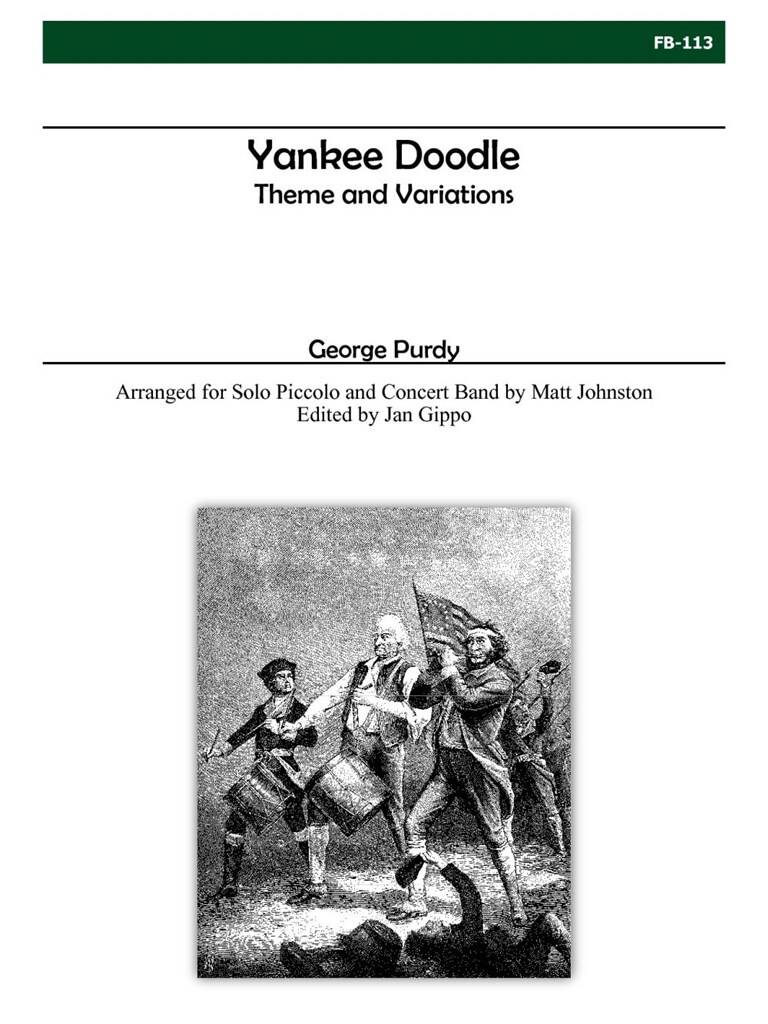
    Yankee Doodle - George Purdy

    A newly revised edition of the classic variations on "Yankee Doodle" by George Purdy, based on the original parts published in 1883. This updated version includes a full score, in addition to a few adaptations/transpositions to accommodate modern band instruments. Also, a solo piccolo part has been provided for D-flat piccolo (D major) as in the original, or C piccolo (E-flat major). Please note, the concert key of this edition is E-flat/A-flat major.

    Estimated dispatch 7-14 working days
  • £164.99

    Invictus - Philip Sparke

    Invictus was commissioned by the United States Army Ground Forces Bands commander and conductor, Major Otis C. French, and is dedicated to various units of the Forces Command, including the Active Army, Army National Guard, Army Reserve, Combat Forces, Combat Support Forces, Combat Service Support Forces and the Civilian Forces. This work is passionate, powerful and turbulent with a real victorious feel!

    Estimated dispatch 7-14 working days

     PDF View Music

  • £69.99

    Prince of Denmark's March - Jeremiah Clarke

    Jeremiah Clarke (c. 1674-1707) belongs to the generation of English composers following that of Henry Purcell. Not much is known about his early life, but by 1685 he was a chorister of the Chapel Royal, a group of liturgical musicians attached to the court. He held the post of organist at Winchester College from 1692 but later returned to London as Master of the Choristers at St Paul's Cathedral. The Prince of Denmark's March is perhaps his best-known work and was originally written for harpsichord, although Clarke later included it in a collection of pieces for wind instruments.

    Estimated dispatch 7-14 working days

     PDF View Music

  • £79.99

    Land of Hope and Glory - Edward Elgar

    Elgar's five Pomp and Circumstance Marches were written between 1901 and 1930 with number 1 undoubtedly being the most popular of the five. King Edward VII told Elgar that the tune would 'go round the world' if words were fitted to it. Elgar took the hint and included it (with slight rhythmic changes) in his Coronation Ode of 1902, with words by A. C. Benson. Thus was born Land of Hope and Glory which is now, of course, an integral part of the annual Last Night of the Proms, when the audience (with varying degrees of success!) sing the words along to the original march. Now your concert band can enjoy all the pomp and ceremony of the proms with this arrangement by Philip Sparke.

    Estimated dispatch 7-14 working days

     PDF View Music

  • £79.99

    A Repton Fantasy - C. Hubert Parry

    Sir Hubert Parry (1848-1918) belongs to a forgotten generation of English composers who are often over-shadowed by Sir Edward Elgar, and the result has been that much of their work is little played or forgotten. In Parry?s case, he is now mostly remembered for his hymn tunes, such as Jerusalem and Repton, both marvellous melodies, of course. The latter first appeared in Parry?s oratorio Judith and was adapted as a hymn tune after the composer?s death.The solo part can be played by a trumpet, clarinet or alto saxophone and will give yourchosen soloist a chance to shine.

    Estimated dispatch 7-14 working days

     PDF View Music

  • £89.99

    Me & Mrs Jones - Billy Paul

    Me and Mrs. Jones was a 1972 soul song written by Kenny Gamble, Leon Huff and Cary Gilbert, originally recorded by Billy Paul. It describes an extramarital affair between a man and his lover, Mrs. Jones. This single became Paul's only #1 single on the Billboard Hot 100 in December 1972. Bart Picquuer arranged this beautiful song for a C/Bb or Eb solo instrument with Concert Band.

    Estimated dispatch 7-14 working days

     PDF View Music

  • £264.99

    Diferencias on an Old Spanish Song - Yasuhide Ito

    I am immensely happy that my Gloriosa, symphonic poem for band (1990), has been performed by so many bands in the last thirty years.During this period, the growth of the internet has made it much easier to access information.When I composed Gloriosa, I only had limited information about the period when Christianity and Western music was first introduced to Japan, and had to rely a lot on my imagination.However, nowadays, it is easy to obtain various source materials and to read interesting studies on the music of the past.In recent years, the music of Luis de Narvez (born ca.1500 - died between 1555-1560), Spanish composer and vihuela player, has become increasingly known, and several CDs of his music are now available.Narvez composed the earliest-known set of diferencias, a forerunner of the variation form. One of his works is Seys diferencias sobre el himno "O gloriosa domina" [Six diferencias on the hymn "O gloriosa domina"] (1538), based on the Spanish Marian hymn, and it was this melody I used in the first movement of my Gloriosa.Western music has been my musical roots since childhood, and throughout my career as a composer, it has continued to fascinate me. One could say that this has provided the inspiration for Diferencias on an Old Spanish Song, my own take on the diferencias form.Actually, such music from the early sixteenth century could sound fresh to our modern ears. So I decided to quote the melody from Narvez's Sey diferencias at the beginning and end of the piece, in order that people can get the feel for the period.The main section (bars 42-390) is formed of 13 diferencias, similar to the first movement of the Gloriosa.In the middle section, which begins after the eighth diferencia(from bar 187), one should be totally absorbed in the tranquility and the beauty of the music. Although it's in the style of a sarabande, it should be taken slower and played as pianissimo as possible.This is followed by folk-style dance music. (As only standard percussion instruments are used, try to be creative with tonal colours and sense of rhythm).The structure of the work is simple, but be aware of the connection between the sections when constructing the whole.Also, think about the tonality. Overall, the work is in F minor. The main section is basically in D minor, but from bar 102, it modulates to A flat minor and G minor, and then in the middle section it suddenly switches to A flat major (which is the furthest key from D minor, and the relative major of F minor). From bar 219, it modulates to F minor and then to C minor, then back to F minor by way of A minor.N.B. The Oboe II part can be substituted by the English Horn (as indicated in the parts). One can choose according to the player's skills or preference.Recent new compositions for wind band are often full of rhythm, dynamism, and tonal colour, and compositional techniques and orchestration have also evolved greatly. Yet on the other hand, they tend to feature fewer melodic or expressive elements. Since this work is the test piece for WMC Kerkrade 2022, I had to think about what "tests" or "challenges" to set, and I decided to compose something that doesn't involve a lot of technical display, but requires beautiful sounds and harmonies, and above all, musical expressivity. I didn't put many expression markings in the score, because I wanted the performers to think about how best to express this music. If it is played merely as notated, it's not going to sound very interesting.Christianity was introduced to Japan in the mid-16th century, but it was subsequently banned and Japan entered a period of national isolation, which meant that there was hardly any international exchange for two hundred years. As a result, the Christian hymns that were introduced prior to the isolation became almost unrecognizable over the centuries. This was the theme I explored in my Gloriosa thirty years ago.Now, in 2021, the whole world has been forced to "isolate" due to the Covid-19 pandemic. In such times, it seems pertinent that I've written a work using this melody again. I sincerely hope that people will be able to gather in Kerkrade in 2022.(English Translation:Nahoko Gotoh)

    Estimated dispatch 7-14 working days

     PDF View Music