
Results
-
 £137.99
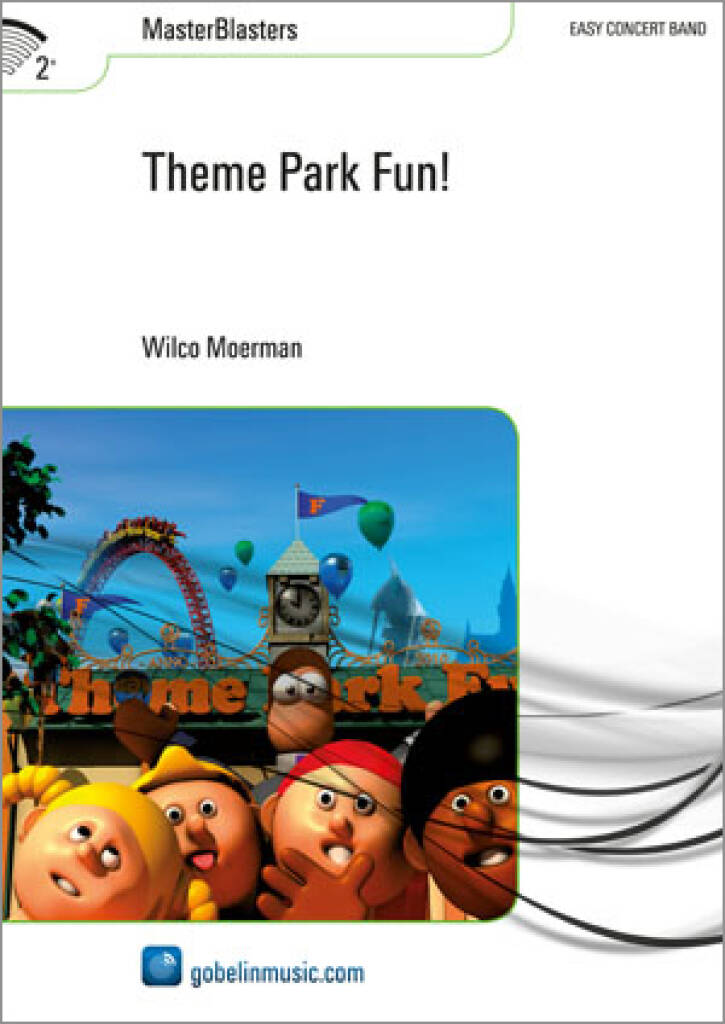
Theme Park Fun! - Wilco Moerman
In Theme Park Fun! your orchestra pays a visit to an amusement park. During your visit, you will experience some spectacular rides and attractions this theme park offers. The uniqueness of Theme Park Fun! is the interplay between music and(moving) images. Animations and illustrations support the visual composition.Part 1: The Entrance & Parade [with animation]The opening of the park is a fact. A day full of fun and pleasure awaits! You and the other visitors willbe confronted with all the rides, attractions and adventures the theme park has to offer. Which ride shall we do first?! There is so much to do and experience on this day in the park! A parade of colorful floats and park figures is passing by.Letthe fun begin!Part 2: The Haunted House [with animation]The only ride in the park that is not related to fun, is the Haunted House. Here visitors will be challenged to visit a house full of ghosts, creepy figures and otherominous things. The clock strikes twelve, there is no turning back. Ghosts are whispering, yelling, screaming... Fortunately it is almost one oclock, so we can leave this creepy place quickly.Part 3: The Swinging Galleon [withillustrations]What a huge pirate ship! Each time you swing back and forth, you will feel that weird feeling in your stomach. When you are thrown completely into the top you will have a fantastic view over the park, but you can not enjoy itfor long. Before you know the ship swings back the other way.Part 4: The Fairy Tale Ride [with illustrations]After all those exciting and spectacular rides and attractions, it is time for a peaceful tour in The Fairy Tale Ride.Surrounded by a fairytale setting, you will discover fable figures, talking animals and colorful designs. Such a beauty and tranquility. Having had this experience, we are ready again for the big rides in the park!Part 5: The Bumper Cars[with illustrations]Now its time to crawl behind the wheel of the Bumper Cars! Shall we all chase the conductor?! Before you know you are hit by another visitor or you will bump against someone else. In this tough ride you can prove yourselfas a real driver, or perhaps as a really bad one.Part 6: The Roller Coaster [with illustrations]The largest, fastest and scariest ride in the park ... we should definitely do the Roller Coaster! All together in the train, theover-the-shoulder restraints are lowering... be ready to ride. The train leaves the station and is heading for the big lift hill. It will be very scary when the train reaches the top and the train will be plunged down the first drop! Loops,corkscrews and other spectacular coaster elements will follow... Before you know it, the ride of your life is over. Shall we ride it again?!Part 7: Leaving the Park [with animation]Unfortunately everything comes to an end. Thisday in the theme park is over, but we have a lot new experiences to talk about! The memories of all the funny and spectacular rides will come up when we walk through the park to the exit. Just one look over the shoulder, the amusement park figuresare waving at us. Hopefully we will come back again soon!
Estimated dispatch 7-14 working days
-
 £89.99
Aviation march - Wilco Moerman
Mankind has always had the desire to fly. Initially we tried to imitate birds to fly, which eventually resulted in the invention of balloons, airships, gliders and powered aircrafts. The first airship in the world that could fly in a controlled way, was invented by Henri Giffard. This airship flew on September 25, 1852 from Paris to Trappes. The ship was 43 meters long and flew 8 km per hour over a distance of 27 km. Other key names for the many changes and developments of the aviation industry, are the Wright brothers on December 17, 1903 with their first motorized flight, of 12 seconds over a distance of 37 meters with a homemade motorized aircraft called the Flyer. Later the same day this record was improved by a flight of 60 seconds over a distance of 260 meters. The first flight across the Channel between England and France was made by Louis Blriot on July 25, 1909. The distance of about 45 km was covered in a time of 37 minutes. In 1910, the first woman, a French pilot (Raymonde de LaRouche), made her first solo flight. She was also the first woman who got a license to fly.This march is a tribute to the many years of development within the aviation industry and gives voice of the pride, the romance, the heroism and the status of this way of transportation.
Estimated dispatch 7-14 working days
-
 £54.99
Highland Fling - Robert Jager
This very playable and appealing overture by Robert Jager is sure to be enjoyable by younger players. Bold and dignified characterize the opening segment which is followed by an energetic faster theme reminiscent of a Scottish Highland dance. A tender hymn-like melody is then developed before returning to the faster theme and powerful closing coda. Very well scored to sound full.
Estimated dispatch 7-14 working days
-
 £59.80
Intermezzo Sinfonico - Pietro Mascagni
Cavalleria rusticana (rustic chivalry) is an opera in one act, composed by Pietro Mascagni, based on a play written by Giovanni Verga. Pietro Mascagni however was the only one to become famous. The work still occupies a permanent place in the current opera repertoire. The symphonic interlude provides a moment of instrumental rest during the opera. Expertly arranged by Willy Hautvast.
Estimated dispatch 7-14 working days
-
 £159.60
Mini Symphonie - Serge Lancen
This Mini Symphony in three movements (moderato - andantino - allegro) has been commissioned by the Swiss wind band happening 'Festliche Musiktage Uster' in 1967. It was premiered at Uster (Switzerland) on 26 October 1968 by the above mentioned 'Banda Primitiva de Lliria' (Spain). This witty composition was the very first wind band composition which Serge Lancen orchestrated himself, after he had had his first four wind band pieces orchestrated by Dsir Dondeyne. Anyhow, the result is remarkable.
Estimated dispatch 7-14 working days
-
 £186.20
Symphonie de Paris - Serge Lancen
This composition, written in 1973, was commissioned by the French Ministry of Cultural Affairs and is dedicated to Dsir Dondeyne who premiered it with the 'Musique des Gardiens de la Paix' at the Paris 'Palais des Congrs' on 27 February 1975. The piece was recorded in 1994 by the 'Orchestre d'Harmonie de la Police Nationale' (National Police Band) conducted by Pierre Bigot. Serge Lancen included the following text with the score: 'The Symphonie de Paris is a musical walk through the capital. Once the visitor has arrived, the composition evokes successively: the familiar cheerfulness of the popular quarters, the hustle and bustle of the great boulevards, the mysterious elegance of the Champs Elyses, the poetic charm of the banks of the river Seine, the impressive Notre-Dame cathedral looking in the mirror of the Seine. Then we have the 'Rive Gauche' (Left bank): the young and dynamic 'Latin Quarter', 'Saint-Germain-des-Prs' an ideal place to stroll. The walk ends near the Eiffel Tower and during the ascension we really discover Paris with its monuments, its avenues, the meanders of the Seine. Finally we enjoy the unique sight of the entire city perspective.'
Estimated dispatch 7-14 working days
-
 £159.60
Rapsodie Symphonique - Serge Lancen
The Rapsodie Symphonique, written in 1976, was commissioned by the French Broadcasting Institution for the European Radio Composition Contest. It was recorded by the Musique des Gardiens de la Paix conducted by Dsir Dondeyne on 4 March 1977 and was awarded a First Prize at the E.R.U. (European Radio Union) contest. The rhapsody was published in 1978 and dedicated to his American friend Professor Al Wright, conductor of the Purdue University Band. The latter recorded the composition in 1979 as it had already recorded the Festival Kerkrade Jan Molenaar conducting in 1971 and the Parade Concerto with the composer at the piano and Jan Molenaar conducting in 1973.
Estimated dispatch 7-14 working days
-
 £140.80
On the Village Green - Werner van Cleemput
Almost any village or town in Flanders boasts an inn called 'Under the Clock Tower'. This composition describes the atmosphere of the musical life in the village, concentrated around the market place or the ... village green.I. To play under the trees: A quiet, charming evocation.II. To play for the landlady and her daughter: The older musicians do their utmost to please the mother, whereas the youngsters try to draw the attention of her daughter.III. To play at the annual Saint Cecilia Festivities: This is festive music, sometimes solemn, sometimes caustic, always light and fresh; towards the end there is a strong enlargement and a stretto. This work was selected by the Belgian Radio for the 1977 ERU Contest in Yougoslavia and was performed by the Belgian Gendarmerie Band conducted by Roland Cardon.
Estimated dispatch 7-14 working days
-
 £90.30
Dedicace - Serge Lancen
The composition Dedicace for alto saxophone was composed in 1981 to honor Adolphe Sax. The first version, written in 1974, was created during the 4th World Saxophone Congress at Bordeaux by Jacques Desloges and the 'Musique de la Police Nationale', conducted by Michel Mriot. The new version was created by the same musicians in Paris in october 1981. This work was composed for a small wind ensemble.
Estimated dispatch 7-14 working days
-
 £116.40
Torre Bermeja - Isaac Albéniz
Although he was born in Catalonia, Albniz was strongly attracted by the music of Southern Spain, Andalusia and especially Granada. He told his friends this was due to the fact he had 'Moorish blood' in his veins. 'Torre Bermeja' (the vermilion tower) is the last of a set of twelve characteristic pieces and is a passionate and fiery representation of an old Moorish prison tower located in the city of Granada. It was made famous by some guitar arrangements, such as those by Antonio Lozano and Andres Segovia. It is a typical serenade with an 'Andalusian touch' which boasts a splendid tune floating between guitar accompaniment elements.
Estimated dispatch 7-14 working days
 View Music