
Results
-
 £116.40
Little Suite No. 1 - Malcolm Arnold
Sir Malcolm Arnold (1921) put an end to his career as leading trumpeter with several famous London symphony orchestras to become a full-time composer. He became world famous with his soundtrack music for 'The Bridge over the River Kwai', but he composed a lot of orchestral, vocal, ballet and chamber music. He wrote several works for wind band and for brass band, such as three 'Little Suites for Brassband'. The 'Little Suite Number 1' Opus 53 for orchestra (followed by the Second Opus 78) consists of a 'Prelude' (Maestoso), a 'Dance' (Allegretto) and a well-known 'March' (Allegro con brio). The march is still on the concert repertoire of many British military bands.
Estimated dispatch 7-14 working days
-
 £61.00
Trumpet Tune - W. Boyce
Originally the second movement of Boyce's Voluntary in D, this piece has become popular in the English Church as a postlude for occasions such as weddings. In this edition it has been extensively re-arranged by Rodney Parker in baroque style for two solo trumpets and band.The solo trumpets are best placed apart, ideally above and to each side of the band but not too far away. The piece should be played in a clear baroque style with special attention to dynamics and articulation. The accompaniments should never overpower the soloists and it should always be performed lightly. This is most important for the Tuba and other bass instruments for which this piece is a fitness test!
Estimated dispatch 7-14 working days
-
 £90.30
Happy Mill of Jensen - M. Carros
Michel Carros is the pen name chosen by a well-known Dutch wind band music composer to sign some compositions in the lighter vein. Among those compositions is this short but joyful piece 'The Happy Mill of Jensen'. The sails of this typical Dutch windmill turn happily in this allegretto which suggests the Dutch joy of living.
Estimated dispatch 7-14 working days
-
 £76.80
Berceuse - Johann Sebastian Bach
Bach arranged quite a lot of both his own music and that of others for all kind of instrumental combinations. Sometimes he also used the same tunes in several of his works. This 'Berceuse' (Lullaby) is not only known as an air from the famous 'Christmas Oratorio' (Weihnachtsoratorium), but is also a part of the cantata 'Lat uns Sorgen, lat uns wachen'. Despite the abundance of notes, the lullaby character is apparent.
Estimated dispatch 7-14 working days
-
 £140.80
Cinquantieme - Serge Lancen
Cinquantieme, the fiftieth composition for symphonic band by Serge Lancen, was composed in the fall of 1993. It is written in an overture form and built on four distinct themes. First there is a merry and dynamic March, followed by a Waltz of the same character; then comes a small melody and finally the March turns up again, but this time it ends with a triumphant theme. The overture is dedicated to Alain Thiery and his Symphonic Band of Pont-Ste-Marie/La-vau/Creney. It was premiered during the gala concert closing the 120th anniversary celebrations of that band. The number in the title 'Cinquantieme' (Fiftieth), indicates the richness of Lancen's wind band repertoire. Fascinated by the symphonic band's extremely rich range of tone colours, Lancen has devoted all his talent and passion to it. For this type of orchestra he has written symphonies, rhapsodies, several concertos and even religious compositions with choirs and soloists.
Estimated dispatch 7-14 working days
-
 £90.30
Flowersong From Carmen - Georges Bizet
Bizet's famous opera "Carmen" is frequently performed as a commercial production, also for television. One of the most beloved arias, the Flower Song, is now arranged not only for tenor voice, but also for Euphonium with wind orchestra.
Estimated dispatch 7-14 working days
-
 £116.40
Belcanto Ouverture - Willy Hautvast
This overture has been inspired by the Italian opera and bel canto and this explains why it is extremely melodious. As there is no underlying story, the composition is meant as pure easy listening music. The work starts with an Adagio, a slow canatbile introduction, followed by a lightfooted Allegro Vivo. Then comes the aria, an Andante Rubato which creates a moment of rest. Then the Allegro comes back and the composition ends very joyfully with a short but energetic coda. Finally 'all's well that end's well'.
Estimated dispatch 7-14 working days
-
 £140.80
Belvedere Suite - Wilhelm Koenen
Part One: 'Danse mditerranenne'This part is composed of stylized folkmusic elements from several regions of Mediterra-nean countries. If this music recalls memories of your holidays on the sunny beaches, the composer will have reached his goal.Part Two: 'Impression'This part is meant as a contrast with the first and the third parts. The conductor should not stick to the metronome tempo, but he can express his own interpretation by means of 'rubato playing'. This 'impression' was inspired by the Provence landscape.Part Three: 'Marche grotesque'We deliberately used non-typical characteristics of the traditional march. The underlying idea is: A band starts playing a march at the ordinary marching tempo. There is already a mistake at measure 4 when some musicians play the wrong bar which causes the fifers to start too early with the drum and fife signals. A grumpy 'Stop' brings and end to the false start by means of a pathetic quaver (eighth note). The drummers however continue to play their drum beats, so the fifers start again and play very quickly in order to catch up with the drummers. They even manage to do so, thanks to that late quaver (eighth note). The band now also starts to play again and reacts to this chaos by laughter. The march that comes next does not match the metric characteristics of the usual march. The woodwinds, dreaming of holidays, get caught in a Tarantella. A compelling signal by the trumpets and the horns, soon joined by all band registers, leads the band back to reality. We deliberately chose well-known 'secondary parts' in order to make the audience accept the 'out-of-tune playing'. Original themes would not have had the same effect. The whole composition is just one great musical joke. If the audiance chuckles the composer will have achieved his aim. The third part is extremely well suited to end a concert or to be used as encore.
Estimated dispatch 7-14 working days
-
 £116.40
Suite de Salon - Henk van Lijnschooten
Commissioned by the NIB, the Dutch Wind Music Institute, with the financial support of the 'Fonds voor de scheppende Toonkunst'.CommentaryThis suite brings us back to the 18th century when an important part of the musical life took place in the salons, the favorite quarters of monarchs and important people.There is a ball and we can hear the music in four successive short movements.1. Entree. After an opening fanfare we see the solemn reception of the guests. The composer uses some 17th century musical principles such as the echo dynamics.2. Invitation a la Danse. The guests proceed to the ballroom and are officially introduced. This movement has a 'classical' character.3. Chiaconna. A solemn dance of Spanish origin with a single theme that is repeated with different embellishments and accompaniments.4. Danse Finale. A cheerful dance announces the departure of the guests, but, for sure, the feast will have lasted much longer than this suite.
Estimated dispatch 7-14 working days
-
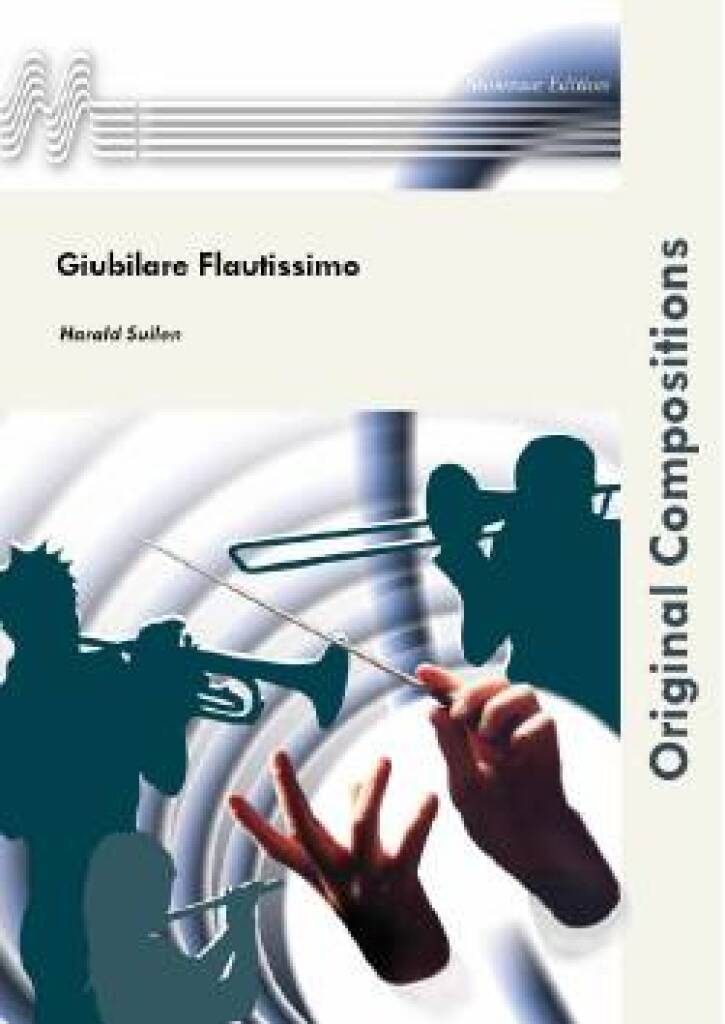 £90.30
Giubilare Flautissimo - Harald Suilen
It was for the 80 anniversary as musician of Mr. Denessen that the wind band Harmonie St. Cecilia' at Tegelen, The Netherlands asked me to write this march. As his slogan is 'Playing music keeps me fit' the 94 year old Wiel Denessen still plays the flute in the band and is an example for many a musician. This march is a homage to a special music amateur, an exemplary band member, but above all a man of great qualities.The march 'Giubilare Flautissimo' was premiered at the anniversary concert on 17 November 1996.Harald Suilen
Estimated dispatch 7-14 working days
 View Music