
Results
-
 £76.80
Splashing Sounds - Manfred Schneider
Manfred Schneider (1953), musician with the German Army Band Heeresmusikkorps 300 in Koblenz, got a good reputation with wind bands in Europe with his overture 'Upside Down', 'Song of Freedom', 'Rock and Go' and 'Rock Symphony' .'Splashing Sounds' is a lively modern quick march, quite complying with its title.
Estimated dispatch 7-14 working days
-
 £133.20
The Phoenix - Paul Hertel
This nice composition, commissioned by the Swiss Army Brass Band was arranged for symphonic band at Johann Msenbichler's request. The legendary bird called 'Phoenix' rises from its ashes as a symbol of optimism and vitality. From a choral with Southeastern European characteristics develops an impressive middle part resulting in a stretto with a compelling finale. Because of its splendid brilliant sounds, this composition is appreciated by musicians of all ages.
Estimated dispatch 7-14 working days
-
 £86.70
Toward a New Life - Josef Suk
Towards A New Life (Josef Suk) was written in 1919 as a patriotic march, dedicated to the young Czechoslovakian army. In the same year he submitted this work to a composition competition where this march was chosen as the winner. Suk's festive march received further accolades when it was chosen as the winners march during the Olympic Games held in Los Angeles in 1932. During World War II it was the opening tune to the radio broadcast of the Czech government in the United Kingdom. A splendid opening piece for Harmony or Fanfare Band, skilfully arranged by Ton van Grevenbroek.
Estimated dispatch 7-14 working days
-
 £75.50
Interlude - Andrew Pearce
As a young man, Andrew Pearce had fond memories of playing cornet in the local Youth Brass Band, where he first experienced the power and beauty of brass music. After completing 'The Maestro' concertino for Philip Cobb, he decided to write a more gentle and lyrical piece for him, which paid homage to his musical roots in the Salvation Army. 'Interlude' is ideal for a proficient solo cornet player in any brass band: tuneful, reflective and elegiac with lots of expression.
Estimated dispatch 7-14 working days
-
 £195.30
Guggisberg Fantasie - Rob Goorhuis
The composition Guggisberg Fantasie is based on a beloved and well known Swiss folksong. This song from the 17th century tells the sad story of two lovers who can never be together. The girl Verena is married off against her wishes. Simon her lover, has a fight with her rich new husband and ends up believing he has killed his wealthy opponent. To escape punishment he joins the army. When Simon returns, years later, he discovers that Verena has died of a broken heart.
Estimated dispatch 7-14 working days
-
 £124.20
Scherzo - Andrew Pearce
Commissioned by Philip Cobb & The New York Staff Band of the Salvation Army. A classic trumpet solo full of exciting tempo changes and technical feats. A challenge for every modern trumpet player!
Estimated dispatch 7-14 working days
-
 £38.20
Hoch und Deutschmeister Marsch - D. Ertl
Dominik Ertl (1857-1911) was subsequently musician, drum major and assistant conductor with the Band of the Austrian Infantry Regiment Number 4, better known as the 'Hoch-und Deutschmeister Regiment'. He was very popular in the fashionable Vienna high society of the last decades of the nineteenth century. He left the army to tour all over Europe with his own orchestra. He composed some ten marches but only the 'Hoch- und Deutschmeister' march became internationally famous. It is of course dedicated to the illustrious regiment and, though considered as the most musical of all Austrian military marches, it never became the official regimental march.
Estimated dispatch 7-14 working days
-
 £149.40
Det er jul - Lars Martin Myhre
This song was composed by the Norwegian singer-songwriter Lars Martin Myhre.The lyrics describe a person seeing the Holiday season approaching, with the feeling of being a bit on the side of society. Remembering the Childhood memories, the memories that are both warm but also bitter-sweet.The song was produced in cooperation with The Salvation Army in Norway in 2020.
Estimated dispatch 7-14 working days
-
 £79.50
Flying Fortress - Robert W. Smith
This stunning fanfare by veteran composer Robert W. Smith was inspired by the historic and legendary Boeing B-17 aircraft used by the United States Army Air Corps in World War II. Beginning with a powerful timpani statement, the brass section responds with a bold introductory theme. Strong melodic lines interacting with woodwind flourishes make this piece sound more mature and difficult than the grade level indicates. We highly recommend this majestic fanfare for any concert, festival or ceremonial performance!
Estimated dispatch 7-14 working days
-
 £113.30
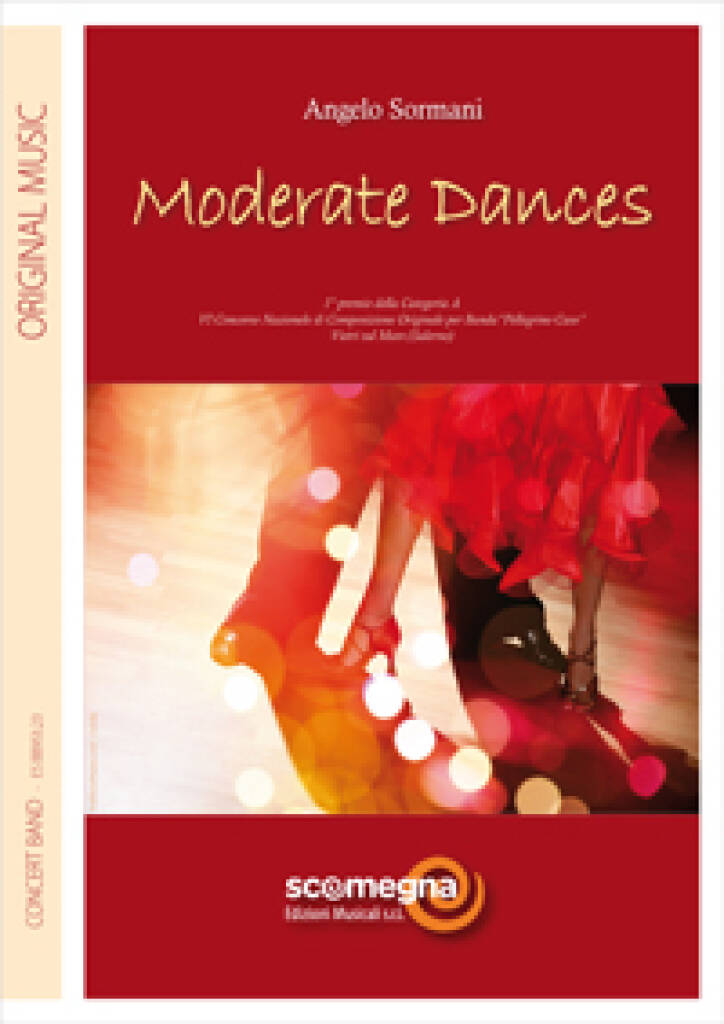
Moderate Dances - Angelo Sormani
This piece is a tribute to dance music, especially passionate, intense and meditative dance music. "Moderate Dances" is divided into three movements: a "Tango", a "Slow Waltz" and a "Bossa Nova". Each movement and each dance has its own particular characteristics but, when combined, these different rhythmic beats and times give the piece a feeling of completeness and uniformity. The Tango started to flourish in the suburbs of Buenos Aires in around 1880. There is still some doubt as to its origins, which may be Cuban (Habanera) but are probably African. It was most popular in Argentina and Brazil: here the male protagonist was originally the "gaucho" with his inseparable guitar, later to be replaced by the proud, elegant "compadre". By around 1910 the Tango had spread to Italy and France. New clubs opened, where the upper classes could watch and dance the Tango. Here the dance also underwent some rapid transformations. The exaggerated and extravagant gestures and body movements disappeared. Slow, gliding steps replaced the old rotational movements. The women's red ankle-boots and the partners "staring into each other's eyes" accentuated the erotic nature and sensuality of this dance. So much so that, in 1913, the German government banned soldiers from dancing the Tango. Those who broke the law were immediately discharged from the army. From a strictly musical perspective, the basic instruments were a flute, a harp (the diatonic harp typically played by the Indians of Paraguay) and a violin, or flute, guitar and violin or even clarinet, guitar and violin. These instruments were easy to transport, ideal for playing at parties, in the streets and in courtyards. The musicians played by ear, frequently improvising: there were no scores, no records, which is the main reason why it is impossible to trace the Tango back to its exact origins. However, the Tango's evolution (and growing popularity) was once again fostered by its fundamental ability to absorb "other" cultures, languages and sounds. And it was the arrival of the "bandoneon" (an accordion-like instrument that was invented in Germany and brought to Rio de la Plata by some immigrant), which replaced the flute, that marked the beginning of the Tango's huge success outside Argentina. A number of talented composers, above all the great Astor Piazzola (1921-1992), transformed the bandoneon from a simple accompanying instrument to a solo instrument that was to become the distinguishing feature of the 20th century Tango. The Slow Waltz originated from the Waltz, the typical dance of the Bavarian and Tyrolese peasants in the 1700s. It was composers like Johann Strauss, father and son, who carried the Waltz to its zenith in the 1800s, creating the sensual and melancholy yet joyful and charming dance we are all familiar with. When the Waltz first became popular in Germany, the members of respectable society were shocked at the closeness of the dancing partners, who had always previously danced apart. The main difference between the Waltz and Slow Waltz is that the latter has a slower, more expressive rhythm: the men wear tails and the women wear ball gowns decorated with beads and feathers and couples dance in graceful rotational movements. "Bossa Nova" is the title of the last movement in the piece. Jobim, the great Brazilian musician, described this musical genre as a combination of modern Jazz and Samba. Bossa Nova means "new wave". This was the name of the artistic and musical movement that evolved in Brazil in the late Fifties and was extremely popular throughout the Sixties. The songs are usually about love or social matters, drawing inspiration from the slums of Rio De Janeiro and the lives of their inhabitants. Bossa Nova, with its original compositions and the artistic talent of its musicians, also became hugely popular in the United States and Europe, and top Jazz musicians (Ella Fitzgerald, Stan Getz, Bob Cooper, Charlie Bird, Sonny Rollins, Dexter Gordon, Dizzy Gillespie) started to include Bossa in their repertoires.
Estimated dispatch 7-14 working days
 View Music