
Results
-
 £155.90
Cantina Band - John Williams
Cantina Band (or Mad About Me) was written by John Williams in 1977 for the film Star Wars (later Star Wars IV: A New Hope). Even with quite a bit of the Star Wars music being quite well known, Cantina Band is literally in a style of its own. In the Star Wars-universe this style is called jizz, Williams' take on the more well-known genre jazz. Williams was tasked by Star Wars-creator George Lucas to make music that sounded like several creatures in a future century finding some 1930's Benny Goodman swing band music ... and how they might attempt to interpret it and ended up with Cantina Band #1 and #2. Both numbers are played in the legendary scene taking place in Chalmun's Spaceport Cantina where Luke Skywalker and Obi-Wan Kenobi gets in a fight causing even the band to stop playing.The band, which goes by the name Figrin D'an and the Modal Nodes, comes from the planet Clak'dor VII and specializes in jizz and the nearby, slightly older style of jatz. Performers of this music often go by the name "jizz-wailers", and the Bith people from Clak'dor VII are especially well suited for jizz-wailing since they can hold every note as long as they want thanks to a unique respiratory system - something many perhaps would like to be able to do in the performance of this arrangement as well.The arrangement is relatively faithful to Williams' original version, but with a somewhat different ending. Although the woodwind section undoubtedly has the biggest technical challenges, an understanding of the musical style is the very key to making the arrangement sound good - and here all groups must work together. Playing lightly but quite articulated, and very precise, will be an absolute necessity to get the music drifting off all the way to Tatooine.In measure 113 there is a small improvised solo in either trombone or trumpet, but if you want the real authentic Cantina Band-sound this is of course done on a steel drum.
Estimated dispatch 7-14 working days
-
 £407.00
Symphony Nr. 3 Urban Landscapes Op. 55 - Franco Cesarini
Fascinated by the beauty of Chicago, Franco Cesarini has translated his emotions into music: this is how Symphony No. 3 "Urban Landscapes" Op. 55, was born, a musical portrait of this metropolis overlooking Lake Michigan. The composition is divided into three movements: The Wrigley Building from Dawn to Noon, Blue Silhouette and Cloud Gates, which by sharing the same thematic material arranged in cyclical form, strengthen the overall cohesion of the piece. The first movement, preceded by a short slow introduction in which the main theme is presented in an almost dreamlike form, metaphorically represents the city at dawn. The sudden change of time symbolizes the start of activities with all its noises and sounds: you can hear the bell that announces the closing of the subway doors, the sound of cars speeding by, the siren of a patrol car. If the first movement represents the day, the second introduces a nocturnal environment: a melancholic melody played by the English horn anticipates a more animated tempo depicting melodies coming from jazz clubs. Powerful fanfares that take up the second theme of the first movement introduce the third movement. In this finale, the role of the two themes is reversed compared to the first movement and one takes the place of the other in a kind of games of mirrors. Symphony No. 3 "Urban Landscapes" Op. 55: a sumptuous musical portrait of the "Windy City".
Estimated dispatch 7-14 working days
-
 £129.99
Ratatouille Satirique
Erik Satie, born in Honfleur in Normandy (France) in 1866 is undoubtedly one of the most striking personalities in the history of French music. He composed in various, often quite divergent, styles. Besides light-hearted, entertaining works he also wrote several serious compositions, among which the three ballets: Parade, Rel che and Les Aventures de Mercure. However his piano pieces, such as Trois Gymnopdies or Gnossiennes will remain his most popular compositions. Satie co-operated with almost all great artists of his time: Pablo Picasso, Jean Cocteau, Sergej Diaghilev and Georges Braque and the composers Darius Milhaud (Le Groupe des Six) and Claude Debussy. Johan deMeij made an orchestration of three short pieces by Erik Satie: I. Prlude (from: Jack in the Box) II. Rverie (from: Trois petites pices montes) III. Marche: Le Piccadilly (1904) It was only after Satie's death in 1925 that the manuscript of the piano piece Jack in the Box was recovered. Satie himself thought he had lost the manuscript in a bus. When his flat in Arceuil was cleaned out, a small notebook was discovered behind his piano and it contained the manuscript which was assumed to be lost forever. The Rverie (De l'Enfance de Pantagruel) is an extract from Trois petites pices montes, originally composed for small symphony orchestra. In this suite it is meant as a restful intermezzo. It is clear that, as with Milhaud (La Cration du Monde) and Debussy (Golliwogg's Cakewalk; Le Petit Ngre), it is hard to deny obvious influences of jazz music in Erik Satie's compositions. Le Piccadilly, dating from 1904, displays a lot of similarities with the compositions of Scott Joplin.
Estimated dispatch 7-14 working days
-
 £129.99
Ratatouille Satirique - Traditional
Erik Satie, born in Honfleur in Normandy (France) in 1866 is undoubtedly one of the most striking personalities in the history of French music. He composed in various, often quite divergent, styles. Besides light-hearted, entertaining works he also wrote several serious compositions, among which the three ballets: Parade, Rel che and Les Aventures de Mercure. However his piano pieces, such as Trois Gymnopdies or Gnossiennes will remain his most popular compositions. Satie co-operated with almost all great artists of his time: Pablo Picasso, Jean Cocteau, Sergej Diaghilev and Georges Braque and the composers Darius Milhaud (Le Groupe des Six) and Claude Debussy. Johan deMeij made an orchestration of three short pieces by Erik Satie: I. Prlude (from: Jack in the Box) II. Rverie (from: Trois petites pices montes) III. Marche: Le Piccadilly (1904) It was only after Satie's death in 1925 that the manuscript of the piano piece Jack in the Box was recovered. Satie himself thought he had lost the manuscript in a bus. When his flat in Arceuil was cleaned out, a small notebook was discovered behind his piano and it contained the manuscript which was assumed to be lost forever. The Rverie (De l'Enfance de Pantagruel) is an extract from Trois petites pices montes, originally composed for small symphony orchestra. In this suite it is meant as a restful intermezzo. It is clear that, as with Milhaud (La Cration du Monde) and Debussy (Golliwogg's Cakewalk; Le Petit Ngre), it is hard to deny obvious influences of jazz music in Erik Satie's compositions. Le Piccadilly, dating from 1904, displays a lot of similarities with the compositions of Scott Joplin.
Estimated dispatch 7-14 working days
-
£176.50
Concertango - Luis Serrano Alarcón
Opus III is proud to announce that we are now the exclusive distributor for North America and Asia of Concertango, by Luis Serrano Alarcn. A 25 minute work exploring musical fusion on multiple levels through the contrast of symphonic winds to a jazz trio (piano, bass, drums). Both groups are independent at times followed by a merge into a single unique musical force. The alto saxophone soloist stands as the uniting musical element between the two groups. The omnipresent and uniting musical force is the tango and, in particular, the works of Astor Piazzolla. Luis Serrano Alarcn has transformed the rhythms, ensemble settings and stylistic idioms into a powerful artisticstatement that communicates to all. A highly effective work for mature ensembles.
Estimated dispatch 7-14 working days
-
 £79.50
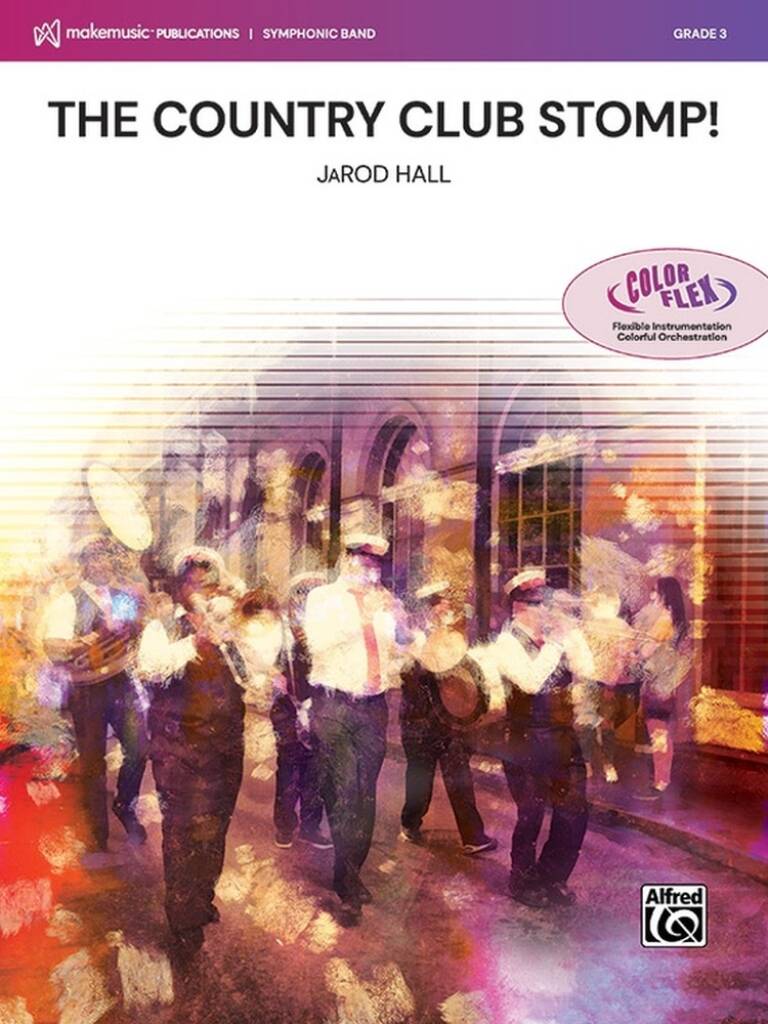
The Country Club Stomp! - Jarod Hall
Now in ColorFlex format for groups with limited instrumentation !Experience a New Orleans vibe with this exciting, parade-inspired crowd-pleaser! The Country Club Stomp! is based on an infectious rhythmic groove and spirited melody. JaRod Hall uses elements of jazz as well as a strong reference to the West African circle dances from which this music evolved. Stellar writing that is fun, catchy, and informative! (3:00)About ColorFlexConductors no longer need to choose between function and texture! Ensembles with instrumentation challenges still have numerous options to cover all parts, yet orchestration is elevated significantly to be faithful to the composer's original intent. Musicians have more opportunities to rest, and timbre once again becomes a central element of each work. So go ahead and have the best of both worlds: flexible and colorful.
Estimated dispatch 7-14 working days
-
 £84.99
Georgia On My Mind
This jazz ballad from 1930 is probably one of the most covered standards of all times. The most famous interpretation dates back from 1960, covered by the one and only Ray Charles. Since then, in 1979 the song was declared the official state anthem for Georgia in the United States. Top arranger Peter Kleine Schaars has now made an amazing arrangement for band using the Ray Charles version it's so close to the original that you can still feel the vibe of the 60s.
Estimated dispatch 7-14 working days
-
 £83.00
Speak to Me - Dana Wilson
There is a long tradition in jazz of instruments carrying on a conversation - either intricate with soloistic dialogues (often improvised) or the call and response of larger forces. Speak to Me is above all such a conversation, at first among soloists and then among more and more performers as they gradually join in. This piece begins with a simple tune that increasingly overlaps with and is interrupted by other ideas, generating enormous energy along the way.
Estimated dispatch 7-14 working days
-
 £189.99
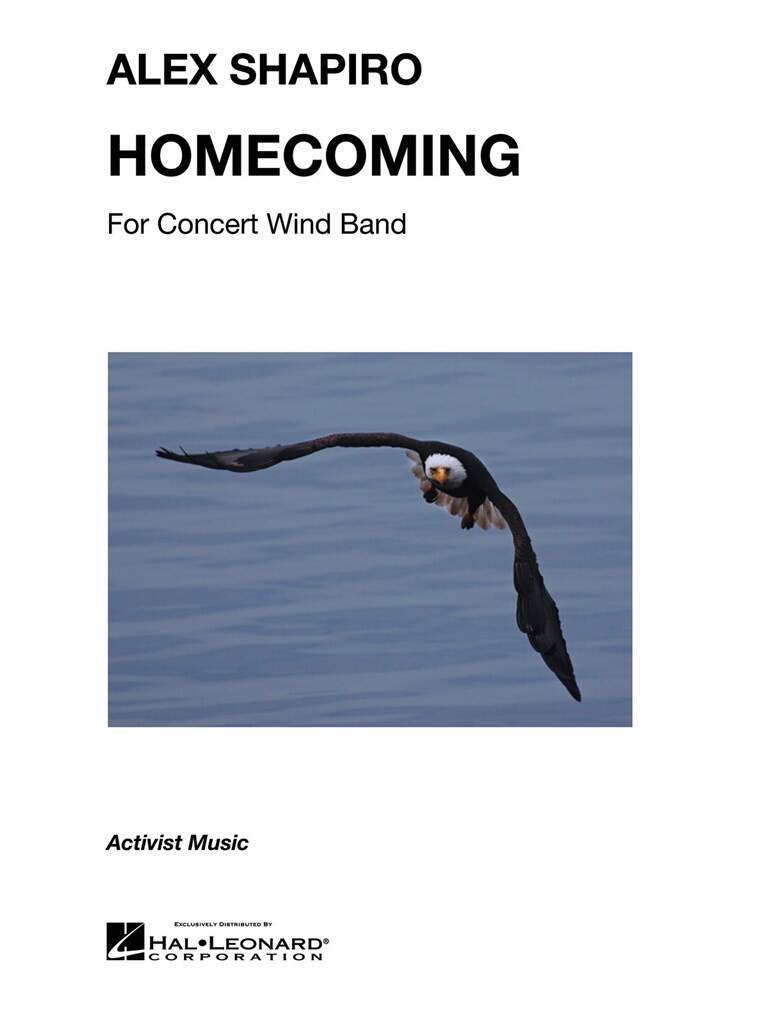
Homecoming - Alex Shapiro
Homecoming is a distinctly American piece of music which ventures emotionally from doubt, to hope, and finally to celebration. The most simple wind instrument of all, the human voice, echoes meaningful homecomings, wherever home may be and from whatever circumstance one returns. Written for the soldiers of the U.S. Army TRADOC Band, Homecoming seamlessly flows between traditional styles that originated in the U.S., from post-minimalist concert music to jazz. As the music grows into a waltz rhythm, welcoming smiles dance with it to the end as loved ones are reunited.
Estimated dispatch 7-14 working days
-
 £76.80
Woody - P. Butter
Phil Butter is a most experienced Dutch wind band music arranger. He wrote this composition as a piece of symphonic jazz in the Leroy Anderson style. However, this work has the advantage that it can be performed by wind band from all levels, especially also by youth wind bands. Here you have a fine piece of light orchestral music without technical difficulties.
Estimated dispatch 7-14 working days
 View Music