
Results
-
 £61.00
Septimos - Alfred Willering
This composition, subtitled 'Light after Darkness' starts in a rather mysterious mood, but soon turns into a solemn, serious and impressive adagio. With its rich orchestration this short but most effective piece makes an ideal opener for your next concert.
Estimated dispatch 7-14 working days
-
 £135.70
Romanesco - Luís Cardoso
Romanesco is a Symphonic Poem of an epic narrative depicting the medieval fights between the Christians and Moors. It begins with the plain-chant of the monks, inside the walls of the monastery who are then interrupted by the arrival of the Moors entering the walls disguised as jongleurs, and thereby provoking a battle. The central section is a Adagio Elegiaco, where our hero travels all over the village and laments all the destruction. Relying strongly on the main themes, the last section develops into the glorious final battle. This work is predominantly based around the environment modal and the polyrhythmic characteristics of medieval music. Conducted by the composer with his own band in the Ateneu Vilafranquense International Wind Band Contest, Romanesco achieved the biggest applause and the highest recognition of the public and the international jury.
Estimated dispatch 7-14 working days
-
 £159.60
Mais Alto e mais Longe - Afonso Alves
This beautiful overture by the Portuguese composer Afonso Alvares starts with a broad andante that soon turns into a partly rhythmical partly singing allegro evoking the world of thrilling adventures in grandiose settings. The atmosphere calms down and becomes more lyrical in the spinned out adagio that describes inner feelings and yet refers from time to time to the suggested adventures. Repetition of several themes leads to an impressive climax.
Estimated dispatch 7-14 working days
-
 £157.50
Composizione Prima - Flavio Vicentini
Many works are composed with the precise aim of describing landscapes, atmospheres or telling stories. "Composizione Prima", on the other hand, was composed with the sole intention of experimenting with some uses of modern musical language. The piece is formally structured in three movements: allegro, adagio and fanfare, without however complying with any standard pattern. The main theme, "fanfara", can be heard several times throughout the piece. It is the only feature of this work that in any way evokes an onomatopoeic sound, to indicate the gradual approach through three dimensional space of a Napoleonic band (fanfare).
Estimated dispatch 7-14 working days
-
 £75.00
Sonata - Derek Bourgeois
This work, composed in 1998, was commissioned by the American trombonist Don Lucas as a work for trombone and piano and first performed by him in Birmingham on 19th May 2000. Subsequently, I arranged the music for both solo trombone and brass band and solo trombone and wind band so that it now exists in three formats. The first movement, in B flat major, is brisk and energetic, and is cast in sonata form. The second subject is gentler and more lyrical. The second movement, a scherzo in C major, is the most complex of the four. Basically the structure is a rond. For a long time the music remains in the opening 5/8 time until a new theme introduces more broken rhythms in a more jazzy idiom. After a return of the opening theme the following episode is more tonally ambiguous. Finally, the main theme returns to round off the movement. The third movement, a lyrical adagio, is really one long extended melodic flow. The harmonies are lush and the textures simple and direct. The tonal center is A minor, but the music meanders through so many keys, that this key centre is heavily disguised. The finale is a fiery affair. G minor is really its home key, but throughout the movement the music moves about a lot and the second subject is first heard in A flat minor. The movement's underlying sonata structure is masked not only by its loose tonality but also by its frequently changing time signatures. Like the first movement the second subject is more lyrical in nature and for a while it seems that the music will end peacefully, but a final flurry heralds a triple forte unison on the home note of the first movement - B flat. Derek Bourgeois
Estimated dispatch 7-14 working days
-
 £104.50
Introit and Celebration - Tom Mitchell
This work opens with a dramatic adagio maestoso consisting of broad contrasting rhythms and dissonant brass harmonies. It then leads to the bright allegro con spirito that is marked with rhythmic chordal figures under flowing melodic lines and exciting meter changes. A brief andante expressivo supplies a change of mood and texture before the grandiose and powerful ending. A highlight for any program.
Estimated dispatch 7-14 working days
-
£87.00
Platoon - Samuel Barber - John Glenesk Mortimer
Adagio for Strings
Estimated dispatch 10-14 working days
-
 £139.99
Concerto d'Amore (Concert Band - Score and Parts) - De Haan, Jacob
In Concerto d'Amore, a maestoso opening is followed by a quick and energetic movement that leads to a magnificent adagio. A motif from this adagio can be heard in a swinging movement, after which the piece comes to a close with the return of the adagio. This arrangement for concert band certainly brings this beautiful music to life.Duration: 7:19
Estimated dispatch 7-14 working days
-
 £37.95
SYMPHONY No.2 (Novello Symphonic) Score only - Bedford, David
Symphony No.2 contains four movements and a coda, all played without a break, following the traditional symphonic pattern. The Introduction presents the main thematic material of the piece which is characterized by rising and falling 5ths a semitone apart. The Quaver Machine has a repeated, relentless constant quaver pulse from the vibraphone. The harmony circles around only 3 chords and the section builds with more and more instruments being played in harmony and in canon. A shift in tonality gradually leads to Adagio, an almost opulently romantic presentation of the main theme with a rippling accompaniment. After a massive climax, the music leads to Finale with the main theme presented as an Ostinato gradually introducing the full band to another large climax. Gradually, everything quietens down for the Coda, a varied repetition of the Introduction but ending with a last reminiscence of the Adagio. Duration: 14 mins.
Estimated dispatch 7-14 working days
-
 £104.99
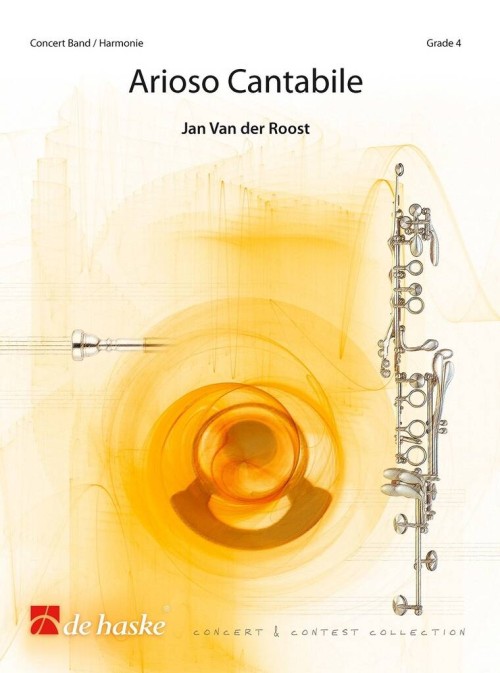
Arioso Cantabile (Concert Band - Score and Parts) - Van der Roost, Jan
This composition exudes serenity and tranquillity, but also intensity and expressiveness - giving it similar qualities to earlier works by Van der Roost, like Canterbury Chorale and Adagio for Winds. Long melodic lines characterize the main themes that arise in different registers and develop through varying keys. The band rather sounds like an organ: the varying timbres and broad musical phrases fully justify the comparison with this majestic instrument. There is no bombast, and the work contains no exaggerated technical or rhythmic tours de force. On the contrary, from a lush richness it moves towards a softening final passage that culminates in a slowly fading final chord: following the many warm harmonies and grand melodies, this work concludes in a contemplative mood.Duration: 7.45
Estimated dispatch 7-14 working days
 View Music