
Results
-
 £164.95
SUITE OF ENGLISH FOLKDANCES (Symphonic WB) - Tomlinson, Ernest
Score & Parts. In 1951 Ernest Tomlinson, at the invitation of his sister Freda, attended a Festival of Dance and Song presented by the English Folk Dance and Song Society. He was so captivated by the tunes danced to, that he resolved to write an orchestral suite based on some of them. The composer's arrangement for wind band follows closely the textures and colour contrasts of the orchestral original. The Suite, which is dedicated to his sister, is in six movements, all the tunes being selected from the first edition of John Playford's The English Dancing Master. Includes: Jenny Pluck Pears; Ten Pound Lass; Dick's Maggot; Nonesuch; Hunt the Squirrel; Woodicock. Duration: 12 mins.
Estimated dispatch 7-14 working days
-
 £118.99
The Universal Band Collection (Concert Band - Score and Parts) - De Haan, Jacob
A collection of 5 short works in pop style which can be performed by any kind of compilation. The titles can be presented on the programme as separate works but the Universal Band Collection can also be performed as a complete suite. From a didactic point of view it is a suitable work to teach musicians something about the structure in music. For this purpose not only the big structure but also the small structure was kept very clear.Western Girl: A girl from the west of the USA rides her horse across the prairie, dreaming of her future. The rough structure: introduction - theme in a blues scale - the same thing in a different instrumentation - finale.Just a ballad: A ballad in pop style with a rough A-B-A form. First there is the introduction of the main theme (A), then follows a tenor melody in minor with a rhythmical reference to the main theme (B). Finally there is the main melody, performed tutti with a different rhythm in the drums (A').Play the Game: An English saying meaning: play fairly. Playful music in up-tempo with a wink to China, where almost all games are manufactured nowadays. Once again an A-B-A structure here.San Diego: A Mexican fugitive enjoys his freedom in America but also remembers his place of birth with melancholy. A sad minor melody with a straight trendy beat appears twice. The second time it has a slightly different instrumentation, in which the muted trumpets represent the Mexican feeling.Final Dance: Eventually there is a dance with an introduction in renaissance style, followed by a fast dance in rock style. All this composed in a classical song structure: introduction, verse, bridge, chorus, shortened verse, bridge, chorus, chorus.Duration: 10:30
Estimated dispatch 7-14 working days
-
 £36.95
Sing Lullaby (Concert Band - Score and Parts) - Wiffin, Rob
Sing Lullaby, also known as The Infant King, is an arrangement of a Basque Carol. The words were translated into English by Sabine Baring-Gould (1834-1924) an Anglican priest and folk song collector. The melody was harmonized by the English organist and music editor Edgar Pettman (1866-1943) who included it with other Basque carols (also rendered by Sabine Baring-Gould) in The University Carol Book in 1922. I use a little of Pettman's harmony but also take a different look. I also set it in 3/4 time rather than Pettman's 6/8 (starting with an anacrusis) which allowed me more freedom of expression and a chance to use a few hemiolas in poignant moments. It is a beautiful, tender carol as befits a lullaby though not without a few suspensions which allude to the future trials of the Infant King described in Baring-Gould's words.- Rob WiffinDuration: 4.15
Estimated dispatch 7-14 working days
-
 £64.90
Bollywood (Flexible Ensemble - Score and Parts) - Esplo, Haakon
Bollywood is a popular name for a part of the film industry in India that is based around Mumbai. The name is a combination of Hollywood and Bombay the older name of Mumbai and is the largest film producer in the world. Music, song and dance are a very important part of a Bollywood film and this piece is intended to give a small taste of what the tone can be. The music is rhythmic, fun to play and provides enough challenges and tasks for percussion.Duration: 3.00
Estimated dispatch 7-14 working days
-
 £102.99
Three Blind Mice (Concert Band - Score and Parts) - Appermont, Bert
This composition is based on the children's song Three Blind Mice, of which the melody is featured in a range of variations: in a canon, in inversion, in minor, transformed, with changing harmonisations and orchestrations, and in different times and tempi. The work consists of three continuous, contrasting movements:Mouse March: The mice cheerfully set off while the original melody is presented as a marchHymn: In a tuneful hymn, the wonderful praises of the life of mice are sungCatch Me If You Can: In an animated chase, the farmer's wife is trying to catch the mice. Following a stirring acceleration, she cuts off their tails in accordance with the lyrics of the songThis work, with its humorous touch, will be a welcome contribution to the expansion of interesting repertoire for the lower divisions.Duration: 6.45
Estimated dispatch 7-14 working days
-
 £242.50
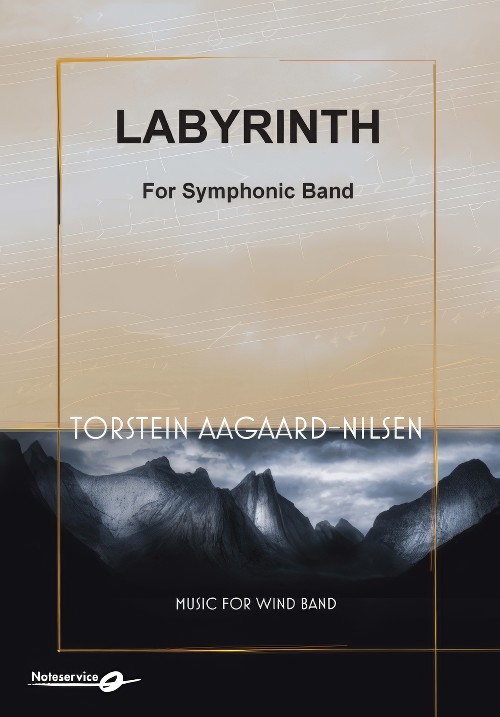
Labyrinth for Symphonic Band (Concert Band - Score and Parts) - Aagaard-Nilsen, Torstein
I wrote Labyrinth to celebrate the 450th anniversary for the city of Fredrikstad. The Danish king Fredrik II agreed to establish a new town further down the river Glomma, to make it easier to defend from the Swedes. The piece is a network of quotations mixed with my own pitch material. My versions of the quoted melodies are not authentic, and sometimes hard to recognize. However, the different quotations give the music an aura of tonality. For example, a dance tune composed by the Flemish composer Mattheus Le Maistre (1505-1577). The melody also occurs in the first danish book of hymns written after the reformation. Since Norway for 400 years was a part of Denmark and everybody had to write and read Danish, they used much of the same music, too. I also use regular Danish hymn tunes and quote from a religious folk song from the area around Fredrikstad. The military signals I use are authentic (for example, The Old Danish March), and I am very sure they were used in the Old Town (the fortress) of Fredrikstad. The drums quote from The Downfall of Paris. This could have been heard played by professional soldiers hired by the Swedes from Scotland. This edition is a revised version made in 2020. - Torstein Aagaard-Nilsen. Duration: 23.00
Estimated dispatch 7-14 working days
-
 £159.99
Traversada (Concert Band - Score and Parts) - Waespi, Oliver
The crossing of a mountain pass is called traversada in Romansh. Such a crossing bears uncertainties and dangers, but also hope and new opportunities. Whoever sets out for a traversada is leaving behind what's familiar in the quest for new places and people. The piece Traversada, based on a Romansh song about farewell and uncertain reunion, musically depics such a journey. At the offset, off-stage soloists introduce fragments of the melody after which a dramatic narrative unfolds. An intense musical shift leads to a calm section, featuring the original melody in pulsating, muted sound colours. Towards the end, the whole structure is gradually rebuilt and leads to an exuberant ending, where the vibrant melodic motifs reemerge. Duration: 12.00
Estimated dispatch 7-14 working days
-
 £75.00
Good King Wenceslas (Concert Band with Optional Choir - Score and Parts) - Noble & Willcocks
Good King Wenceslas is a Christmas carol that tells a story of a Bohemian king going on a journey and braving harsh winter weather to give alms to a poor peasant on the Feast of Stephen (December 26, the Second Day of Christmas). During the journey, his page is about to give up the struggle against the cold weather, but is enabled to continue by following the king's footprints, step for step, through the deep snow. The legend is based on the life of the historical Saint Wenceslaus I, Duke of Bohemia or Svat Vclav in Czech (907-935). The name Wenceslas is a Latinised version of the old Czech language Venceslav. In 1853, English hymnwriter John Mason Neale wrote the Wenceslas lyrics, in collaboration with his music editor Thomas Helmore, and the carol first appeared in Carols for Christmas-Tide, 1853. Neale's lyrics were set to the melody of a 13th-century spring carol Tempus adest floridum (The time is near for flowering) first published in the 1582 Finnish song collection Piae Cantiones. This arrangement represents one in the Series of Band Arrangements compatible with David Willcocks' Carols for Choirs.
Estimated dispatch 7-14 working days
-
 £110.00
Down by the Riverside (Concert Band with opt. Choir - Score and Parts) - Rutter, John - Noble, Paul
Down by the riverside is a spiritual that was sung by slaves in the South as a work song. It dates back to before the American Civil War. John Rutter's lively arrangement of this barnstorming American folk-song builds up from a quiet opening to a triumphant conclusion. This arrangement is a faithful adaptation of the original orchestration for chorus and orchestra, but it is arranged so that it may be performed by band alone. The style is an authentic toe-tapping early jazz creation that relates to the 'jitterbug' era, and the band arrangement is complete with an optional jazz clarinet solo as well as a rousing chorus by the sax section. The piano part is cued if needed. This is a perfect opportunity to get the entire band 'swinging', and could even entice a 'One mo' time!' finale.
Estimated dispatch 7-14 working days
-
 £32.95
Trombone Concerto (Trombone Solo with Concert Band - Score only) - Wiffin, Rob
The composer writes:My Trombone Concerto was commissioned by Brett Baker following an earlier piece I had written for him called Shout. The concerto was composed in Spain the summer of 2010. Once I started writing I realised this concerto was, inevitably, going to draw on my own experiences as a trombone player.The first movement was really a matter of getting the right thematic ideas and balancing the tutti and solo passages so, for formal structure, I studied the Gordon Jacob Trombone Concerto. There is a lyrical section preceding the first Allegro that owes much in spirit (but not the actual music) to The Eternal Quest, Ray Steadman-Allen's Salvation Army solo.The slow movement seemed determined to come out in the vein of a Richard Strauss song. I wanted to write ineluctably cantabile as we trombone players rarely get a chance to play the melody! There is a brief allusion to that wonderful moment when the trombone gets to sing above the orchestra in Sibelius' seventh symphony. Arthur Wilson (my teacher at college) died in the summer of 2010 so it seemed appropriate to dedicate this movement to him.The last movement is the lightest of the three in style and is slightly jazz-inflected, hopefully providing some fun for the soloist.While wanting to test the instrument, I did not set out with the intention of making the concerto difficult but there are undoubtedly challenges of technique, range and style to be met by the soloist.Recorded on Polyphonic CD QPRM161D Roman TrilogyDuration: 19:30
Estimated dispatch 7-14 working days
 View Music