
Results
-
 £189.99
The Story of Anne Frank (Concert Band - Score and Parts) - Schwarz, Otto M.
The impressive musical images created by Otto M. Schwarz tell the story of the German girl Anne Frank, who lived in hidden rooms of an Amsterdam town house until her family was betrayed and deported to Auschwitz where they all - apart from her father - went to their deaths. The composer, who himself is the father of two daughters, has illustrated various scenes from this young girl's short life in a dramatic and cinematic style.Duration: 13:15
Estimated dispatch 7-14 working days
-
 £134.99
Funky Winds (Concert Band - Score and Parts) - Schwarz, Otto M.
The success of works like Band Fever, Funk Attack and Groovin'Around stimulated Otto M. Schwarz to compose another work within this genre. Groovy percussion elements, which, through the exact phrasing of the bass line and an accessible melody line, reflect the individual style of the composer, are featured throughout. This successful formula is sure to make Funky Winds is a great addition to the light repertoire for concert band.Duration: 4:45
Estimated dispatch 7-14 working days
-
 £58.50
Cohan Celebration (Concert Band - Score and Parts) - Cohan, George M. - Smith & Story
You can't go wrong combining the efforts of Robert Smith and Michael Story arranging two of George M. Cohan's favorites for the Band Expressions Book Two series. The duo includes "The Yankee Doodle Boy" and "You're a Grand Old Flag" with all the original energy yet attainable by second year students completing any book two method book. Revered pop classics expertly scored for your young band. Duration: 1.45
Estimated dispatch 7-14 working days
-
 £84.99
Rondo Romantica (Concert Band - Score and Parts) - Schwarz, Otto M.
Rondo Romantica is based on the Italian Rococo period. In this piece, Otto M. Schwarz depicts a colourful annual fair and the carefree atmosphere of the period. The piece also has undercurrents of modern elements, such as its diverse rhythms.Duration: 3:30
Estimated dispatch 7-14 working days
-
 £205.70
In Nomine (Concert Band - Score and Parts) - Schwarz, Otto M.
How often has something been justified by, declared to be, or blessed as 'in the name of' some cause or other? How can it be that opposing armies and the use of weapons are ever 'in the name of...'? This is a common thread in the history of different faiths. Good was created but evil was committed and all 'in the name of...' This thread is also found in the history of the Premonstratensian Abbey at Wadgassen. The abbey was built in the 12th century on unfertile, desolate moorland, which later evolved into the most powerful religious community in the Saarland. The history of the abbey records quite astounding achievements under the motto desertum florebit quasi lilium ('the desert will bloom like a lily'); but also the harsh treatment of delinquents. The order had its own school, in which children were taught the seven liberal arts (which included music as well as geography and astronomy), but the poor were left to starve outside the abbey walls and were only allowed to eat from the members' leftovers on feast days. The medieval witch trials demanded their pound of flesh, and one group that fell victim were ecstatic dancers who moved wildly to music, which was interpreted as the devil's work. The result: a show trial that sentenced the dancers to death by fire. All in the name of... The year is 1789: Abbot Bordier is in the tenth year of his command. He does not yet know that he is to be the last abbot of an almost 700-year tradition. Not far from the abbey is the French border, which has long been making itself felt with the sound of gunfire, and the brothers continue to keep a nervous eye on it. The first portents of the French Revolution loom, but no one wants to believe it, that is, until the French pound the door down, storm the abbey and come right into the brothers' chambers. In a blind fury, all the pipes of the abbey organ are torn out, icons beheaded with swords and brothers beaten death while numerous buildings are set on fire. The abbey church is in flames. A frantic and desperate escape begins. Abbot Bordier and a handful of brothers make their getaway via the River Saar, adjacent to the abbey, to the neighbouring village of Bous. They survive, but their life, the Premonstratensian abbey, is destroyed. While they flee towards Prague and the sanctuary of the Strahov Monastery, the abbey at Wadgassen is razed to the ground and becomes a stone quarry. The desert blooms once more, however. A few short decades later, a glasswork arises from the foundations of the abbey. As peace returns to the region, it brings jobs and a new vision for its people.Duration: 11.15
Estimated dispatch 7-14 working days
-
 £73.50
Ride Through the Valley (Flexible Ensemble - Score and Parts) - Bernotas, Chris M.
This version of Ride Through the Valley by Chris Bernotas is designed with maximum flexibility for use by any mix of instruments: wind, strings, and percussion, including like or mixed-ensembles with as few as 5 players. The suggested instrumentation and a customisable Teacher Map will help you plan out how to best assign parts to suit your ensemble's needs. It also comes with supplemental parts for maximum flexibility. With the purchase of this piece, permission is granted to photocopy the parts as needed for your ensemble. A percussion accompaniment track is also available as a free download. String parts have been carefully edited with extra fingerings and appropriate bowings to support students in mixed ensembles playing in less familiar keys. The fast-paced opening of Bernotas' Ride Through the Valley builds momentum, leading to a bright and tuneful main theme. A lyrical contrasting section follows featuring a warmth of colors enhanced by vibraphone and gracefully cascading arpeggiated pyramids. A brief transition leads to a return of the main theme including a key change, bringing the piece to a driving conclusion. Duration: 4.30
Estimated dispatch 7-14 working days
-
 £66.95
Ride Through the Valley (Concert Band - Score and Parts) - Bernotas, Chris M.
A fast-paced opening builds momentum leading to a bright and tuneful main theme. A lyrical contrasting section follows featuring a warmth of colors enhanced by vibraphone and gracefully cascading arpeggiated pyramids. A brief transition leads to a return of the main theme including a key change, bringing the piece to a driving conclusion. Duration: 4:30
Estimated dispatch 7-14 working days
-
 £102.80
Troja (Troy) (Concert Band - Score and Parts) - Schwarz, Otto M.
The Greek poet Homer wrote about Troy and the Trojan War, which probably took place in what is now Asia Minor, in his Iliad in the 8th century B.C. Nowadays, the term Trojan generally refers to a malware program that is used to gain unauthorised access to computers. This use comes from the legendary Trojan Horse, which saw the turning point in the battle between Greeks and Trojans through the cunning of Odysseus. Let us return to the beginning of the story: Paris, son of the king of Troy, is tasked by Zeus with judging the beauty of the three goddesses Aphrodite, Pallas Athena, and Hera. Aphrodite, the goddess of love, flatters Paris by promising him the most beautiful woman in the world. Soon afterwards, on a journey to Greece, Paris meets the beautiful Helen, who immediately falls in love with him. Since however she is the wife of Spartan king Menelaus, she eventually lets herself be kidnapped by Paris voluntarily. The Greeks then form a large army and go to war against Troy to retrieve Helen, leading to a ten-year siege of the city. The city is eventually conquered not through combat, however, but through Odysseus' cunning ploy. He has the idea of building an enormous wooden horse with warriors hidden inside. The horse is placed at the gates of the city. Thus, the Trojans are tricked into giving up the siege when, despite various warnings, they bring the horse into the city to dedicate it to the goddess Athena. At night, the soldiers climb out of the horse and open the gate for the Greek army. The troops storm the city and burn it to the ground. The royal family and all the Trojan warriors are killed, only Aeneas, the son of Aphrodite, escapes. Later, following many years' wanderings he and his acolytes will become known as the founders of the Roman people. There are various accounts of the fate of the beautiful Helen. She is said to have returned to Sparta with Menelaus and to have ruled there until the end of her life. Or maybe not...Duration: 6.00
Estimated dispatch 7-14 working days
-
 £191.30
Nepotism (Movement II from Symphony No.1, The Borgias) (Concert Band - Score and Parts) - Schwarz, Otto M.
A sinister legend hangs over the Borgia family, a legend of corruption, abuse of power, orgies, sex and murder. These rumours proliferated especially during the papacy of Alexander VI, a descendant of the family, who was even called the Antichrist. On his death, contemporary witnesses reported that the devil himself prowled around the death chamber and a black dog run along the corridors of the Vatican as his emissary. One might say that this Borgia pope, who ruled together with his family with the greatest brutality, became demonised. Unscrupulousness, poison-toting, incest and other malice are to this day the hallmarks of this pontiffNepotism: Rodrigo Borgia was elected Pope on 11 August 1492. From the very start, the new pope was prepared to use any means to eliminate his opponents, either through the infamous Borgia poison or by excommunication and execution. His son Cesare, who wanted little to do with the church, was appointed cardinal against his will. Alessandro Farnese, broth of Giulia Farnese, the Pope's mistress, also became a cardinal. Numerous Spaniards were brought into the country and were appointed to ecclesiastical posts. This infuriated the opponents of Alexander VI. The Dominican Girolamo Savonarola from Florence demanded the removal of the Pope. He was tortured and banned. Giuliano della Rovere wanted to convene councils to depose the Pope, which Alexander managed to prevent through artful political manoeuvrings. Through great brutality, brilliant political skill and power games, this pope was able to achieve his goal of leaving for his children a great legacy. Alexander VI constantly changed his allies and always acted unscrupulously to improve his financial situation and expand his sphere of influence. At the centre of the second movement of this work is the medieval hymn Dies Irae (Day of Wrath), which acts as a warning in the background condemning the Pope's actions.Duration: 9.15
Estimated dispatch 7-14 working days
-
 £191.30
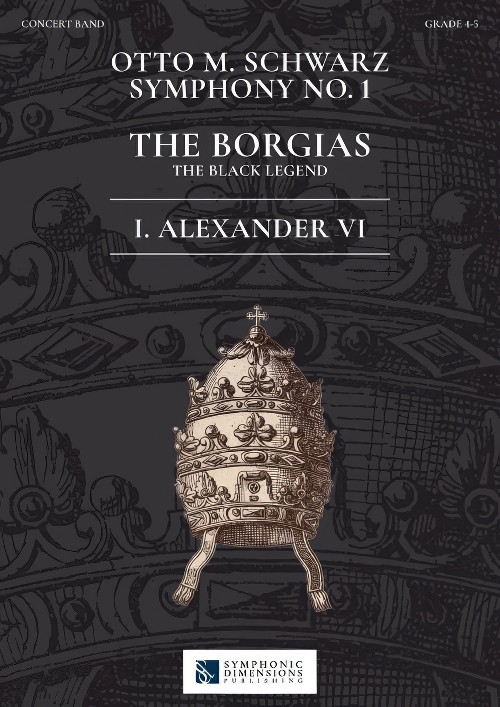
Alexander VI (Movement I from Symphony No.1, The Borgias) (Concert Band - Score and Parts) - Schwarz, Otto M.
The Borgia family is the subject of a so-called black legend, a pejorative term that has been used since the Middle Ages to refer to Spain and Spaniards. The Borgias' black legend is one of corruption, abuse of power, orgies, sex and murder. These rumours spread especially during the reign of Pope Alexander VI, a member of the family. Alexander was even referred to as the Antichrist. According to eyewitnesses, when he died Satan prowled the death chamber and a black dog, an envoy of the Devil, ran up and down the aisles of the Vatican. The brutal rule of Pope Alexander and his family led to a kind of demonization of the Borgia family. But it is precisely the lack of scruples, the brewing of poisons, the incest and various cruelties that continue to hold a certain fascination for us.Alexander VI: Rodrigo Borgia was born in 1431 near Valencia. He studied law in Bologna and, through his uncle Pope Calixtus III, he rose through the church hierarchy. As vice-chancellor of the Holy Roman Catholic church, he became one of the richest men in Europe. As a cardinal he fathered four children who he later legitimised when he became pope. His election to the papacy was funded by the sale of offices, extortion and bribes of all kinds. Through an alliance with Ascanio Sforza he was elected pope on August 11 1492 and named himself from then on Alexander VI, an allusion to Alexander the Great.Duration: 9.30
Estimated dispatch 7-14 working days
 View Music