
Results
-
 £68.00
The Skaters' Waltz - Waldteufel, Emile - Longfield, Robert
This famous melody depicts the familiar winter scene of skaters "waltzing" on a frozen pond. A delightful selection that will please audiences and performers alike. Perfect for your next holiday and/or winter program.
Estimated dispatch 7-14 working days
-
 £113.30
Moderate Dances - Angelo Sormani
This piece is a tribute to dance music, especially passionate, intense and meditative dance music. "Moderate Dances" is divided into three movements: a "Tango", a "Slow Waltz" and a "Bossa Nova". Each movement and each dance has its own particular characteristics but, when combined, these different rhythmic beats and times give the piece a feeling of completeness and uniformity. The Tango started to flourish in the suburbs of Buenos Aires in around 1880. There is still some doubt as to its origins, which may be Cuban (Habanera) but are probably African. It was most popular in Argentina and Brazil: here the male protagonist was originally the "gaucho" with his inseparable guitar, later to be replaced by the proud, elegant "compadre". By around 1910 the Tango had spread to Italy and France. New clubs opened, where the upper classes could watch and dance the Tango. Here the dance also underwent some rapid transformations. The exaggerated and extravagant gestures and body movements disappeared. Slow, gliding steps replaced the old rotational movements. The women's red ankle-boots and the partners "staring into each other's eyes" accentuated the erotic nature and sensuality of this dance. So much so that, in 1913, the German government banned soldiers from dancing the Tango. Those who broke the law were immediately discharged from the army. From a strictly musical perspective, the basic instruments were a flute, a harp (the diatonic harp typically played by the Indians of Paraguay) and a violin, or flute, guitar and violin or even clarinet, guitar and violin. These instruments were easy to transport, ideal for playing at parties, in the streets and in courtyards. The musicians played by ear, frequently improvising: there were no scores, no records, which is the main reason why it is impossible to trace the Tango back to its exact origins. However, the Tango's evolution (and growing popularity) was once again fostered by its fundamental ability to absorb "other" cultures, languages and sounds. And it was the arrival of the "bandoneon" (an accordion-like instrument that was invented in Germany and brought to Rio de la Plata by some immigrant), which replaced the flute, that marked the beginning of the Tango's huge success outside Argentina. A number of talented composers, above all the great Astor Piazzola (1921-1992), transformed the bandoneon from a simple accompanying instrument to a solo instrument that was to become the distinguishing feature of the 20th century Tango. The Slow Waltz originated from the Waltz, the typical dance of the Bavarian and Tyrolese peasants in the 1700s. It was composers like Johann Strauss, father and son, who carried the Waltz to its zenith in the 1800s, creating the sensual and melancholy yet joyful and charming dance we are all familiar with. When the Waltz first became popular in Germany, the members of respectable society were shocked at the closeness of the dancing partners, who had always previously danced apart. The main difference between the Waltz and Slow Waltz is that the latter has a slower, more expressive rhythm: the men wear tails and the women wear ball gowns decorated with beads and feathers and couples dance in graceful rotational movements. "Bossa Nova" is the title of the last movement in the piece. Jobim, the great Brazilian musician, described this musical genre as a combination of modern Jazz and Samba. Bossa Nova means "new wave". This was the name of the artistic and musical movement that evolved in Brazil in the late Fifties and was extremely popular throughout the Sixties. The songs are usually about love or social matters, drawing inspiration from the slums of Rio De Janeiro and the lives of their inhabitants. Bossa Nova, with its original compositions and the artistic talent of its musicians, also became hugely popular in the United States and Europe, and top Jazz musicians (Ella Fitzgerald, Stan Getz, Bob Cooper, Charlie Bird, Sonny Rollins, Dexter Gordon, Dizzy Gillespie) started to include Bossa in their repertoires.
Estimated dispatch 7-14 working days
-
£137.99
Three Onegin Dances - Pyotr Ilyich Tchaikovsky
Tchaikovsky is best known for his purely instrumental compositions. However, we must not underestimate him as a composer of operas. Many of his operas such as Pique Dame and Eugene Onegin are still performed regularly throughout the world. Eugene Onegin (also called Jevgeny Onegin), composed in 1877-1878, was not called an opera by Tchaikovsky himself, but "lyric scenes". The work is entirely dominated by lyricism. However, there are two moments that contrast sharply with this lyricism: two ball scenes, for which Tchaikovsky wrote a waltz and a polonaise.After opening with a less well-known allegro dansant, this arrangement features the aforementioned waltz, which can beconsidered a beautiful Russian equivalent of the Faust Waltz by Charles Gounod. In the opera, this waltz is actually played by a military band. The arrangement concludes with the pompous polonaise (also mentioned above) which opens the last act: the ideal music to characterize high aristocracy in the salon of a palace in St. Petersburg.
Estimated dispatch 7-14 working days
-
£102.99
Valse Sacre - Frédéric Devreese
For Frdric Devreese, a dance, and especially the waltz, is increasingly linked to the person as a dancer, so that a dance becomes an experience, an adventure; and as a result, they in fact waltz to human emotions. Those who follow Devreese's music a little know that, for him, the different facets are not separate from each other. The film scores and the concert pieces strengthen and influence one another. His most famous film score themes, such as the Valse Sacre", belong to the collective memory of Flemish music. This waltz was composed for the Hugo Claus film "The Sacrament". The assignment was to compose a whirling waltz for a dance scene set during an emotional familycelebration."
Estimated dispatch 7-14 working days
-
£104.99
Nocturne - Pyotr Ilyich Tchaikovsky
Tchaikovsky is best known for his purely instrumental compositions. However, we must not underestimate him as a composer of operas. Many of his operas such as Pique Dame and Eugene Onegin are still performed regularly throughout the world. Eugene Onegin (also called Jevgeny Onegin), composed in 1877-1878, was not called an opera by Tchaikovsky himself, but "lyric scenes". The work is entirely dominated by lyricism. However, there are two moments that contrast sharply with this lyricism: two ball scenes, for which Tchaikovsky wrote a waltz and a polonaise.After opening with a less well-known allegro dansant, this arrangement features the aforementioned waltz, which can beconsidered a beautiful Russian equivalent of the Faust Waltz by Charles Gounod. In the opera, this waltz is actually played by a military band. The arrangement concludes with the pompous polonaise (also mentioned above) which opens the last act: the ideal music to characterize high aristocracy in the salon of a palace in St. Petersburg.
Estimated dispatch 7-14 working days
-
 £101.20
Valse de Fleurs - Pyotr Ilyich Tchaikovsky
The 'Flower Waltz' (1892) is a piece of orchestral music from the second act of The Nutcracker, a ballet composed by Tchaikovsky. The waltz is also the last number in his Nutcracker Suite. The 'Flower Waltz' is very popular. It has been frequently arranged for different instrumentations and for different combinations of instruments. Walt Disney Studios animated the waltz for the movie Fantasia. This arrangement for wind orchestra has been arranged very professionally by Geert Schrijversthe harp part is optional
Estimated dispatch 7-14 working days
-
 £60.99
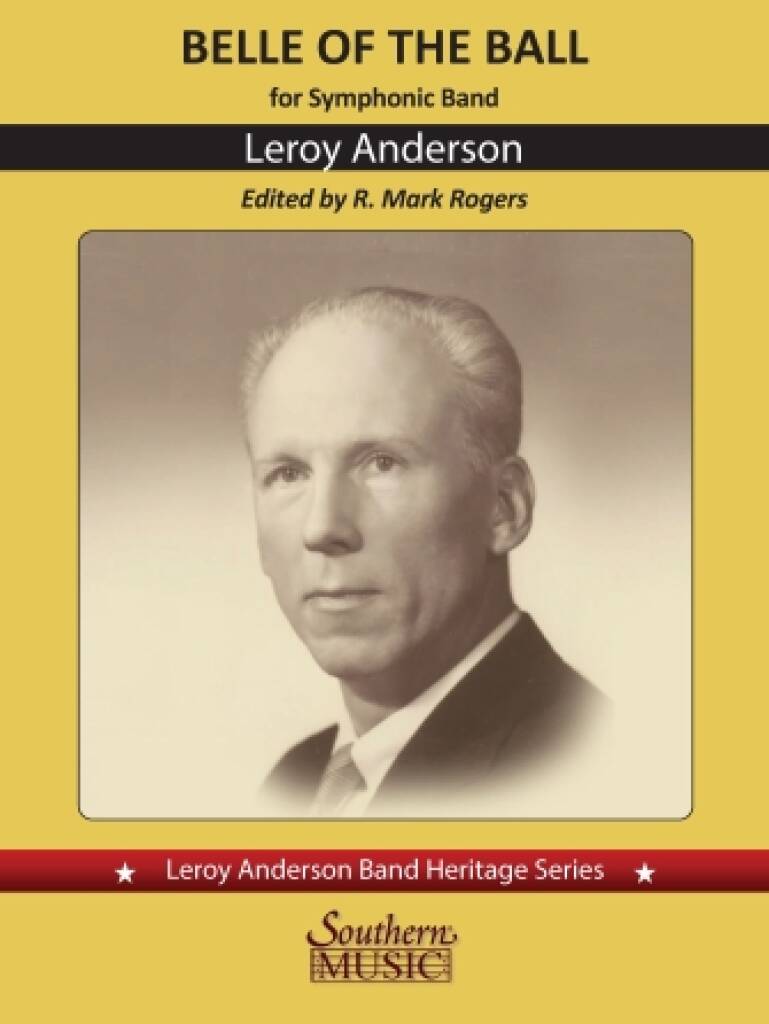
Belle of the Ball - Leroy Anderson
Like most of Leroy Anderson's efforts, Belle of the Ball is light, effervescent, and devoid of conflict or disharmony. Anderson looked upon the piece as a modern-day American revival -- or revitalization -- of the Viennese waltz tradition. Having said that, the main theme sounds rather unlike a Strauss waltz, but the voice of Tchaikovsky is evident in its playful, fantasy-like character. The melody is rhythmic and comes in short groups of notes, beginning with two notes, then three, then expanding further; the music skates along elegantly. The middle section features a delightful variation on the theme, in which Anderson's gentle-belled sonorities impart a playful innocence. This exclusive Southern band edition by Mark Rogers reintroduces Anderson's enchanting work to new generations of audiences.
Estimated dispatch 7-14 working days
-
£121.00
Acceleration - Johann Strauss
From the "Waltz King," Johann Strauss comes this magnificent and lavish concert waltz. Arranged exclusively for BOVACO by master musician Erik Leidzen. Beautiful!
Estimated dispatch 7-14 working days
-
 £60.50
The Gathering - Brooke Pierson
Brooke Pierson's The Gathering is a creepily inspired Waltz in 3/4 time for young bands. A great choice for Halloween performances, this Waltz has plenty of excellent learning opportunities, especially if you want to work on accidentals!
Estimated dispatch 7-14 working days
-
 £159.60
La Derniere Valse - Evzen Zamecník
The Czech composer Evzen Zmecnk, born in 1939, is not only known as adjudicator at the World Music Contest in Kerkrade. He is one of the most important wind band music composers in his country. His music is often inspired by Moravia, the area he is now living in. Here is a waltz with a typical East-European character, expressing a great melancholy. Both the origin and the theme of this 'Last Waltz' are very well rendered by the nostalgic and compelling nature of this composition with some surprising descriptive moments.
Estimated dispatch 7-14 working days
 View Music