
Results
-
 £104.50
Speedway! - Mark Lortz
Commissioned by and dedicated to the Folly Quarter Middle School Band in Ellicott City, Maryland, Andrew Sprang, conductor. This highly programmatic piece gives you a front-row seat in the viewing stands as it depicts a high-speed car race. The opening section starts the engines, sets the pole position, and then the race is on. The action slows briefly for a caution flag, and then its full throttle as the race resumes with a wild dash to the finish line, closing with a triumphant victory lap.
Estimated dispatch 7-14 working days
-
 £82.50
Conquest - Mark Lortz
This programmatic composition depicts a dark and intense journey to conquer an enemy force. A mysterious introduction exudes an ominous tone as the dampened pulse of the bass drum creates the timbre of a resolute heartbeat as opposing forces gather, then collide. Intense brass statements, brisk woodwind ostinatos, and running lines combine with unrelenting percussive parts to depict a fierce battle scene. The action then subsides into a triumphant flourish that ends the piece with the assertive and uncompromising sounds of victory.
Estimated dispatch 7-14 working days
-
 £169.99
Colossus - Thomas Doss
The giant Haymon was a peaceful knight who lived in Inntal (Austria). One day the bloodthirsty giant Thyrsos came and destroyed Haymon's castle. A horrible fight ensued and Haymon, being the better armed, was victorious and slew his adversary. But instead of rejoicing in his success, Haymon felt deep remorse. This remorse led him to seek out a monk and become a Christian, upon which he immediately started building a monastery. Once completed, Haymon joined the monastic order. Two statues at the monastery's entrance stand in remembrance of his victory. A colossal new work for concert band.
Estimated dispatch 7-14 working days
-
 £249.99
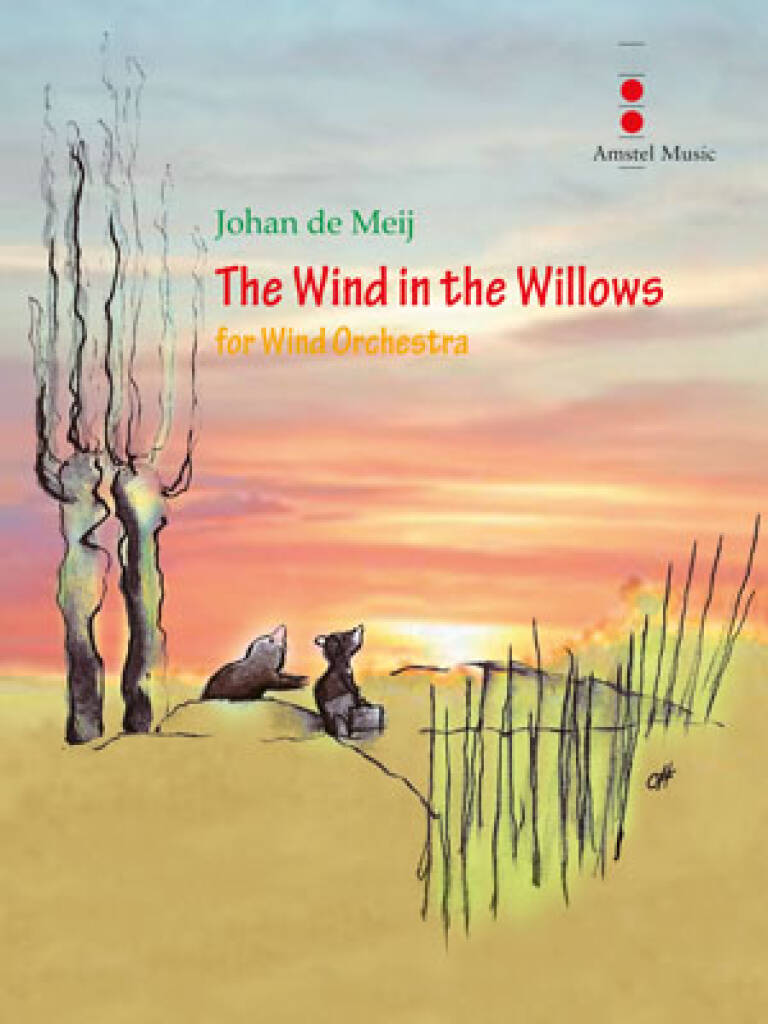
The Wind in the Willows - Johan de Meij
"A book for those who keep the spirit of youth alive in them; of life, sunshine, running water, woodlands, dusty roads, winter firesides" said author Kenneth Grahame (1859-1932) about his children's book The Wind in the Willows. Initially, he wrote the stories about Ratty, Mole, Badger and Toad to read to his visually handicapped son Alistair, but after the publication in book form in 1908, it became a worldwide success. It was later also turned into a film and a television series. What appealed ti the composer most is the friendly, very cosy atmosphere that Grahame has managed to create with his optimistic narrative style full of high spirits, an atmosphere that reminds thecomposer of his own carefree youth. It was therefore a great pleasure to set this book to music! The four movements successively describe:I) The River- The river, which flows through the habitat of the animals like a lifeline, regularly is the scene of pleasant boat trips and picnics. The animals lead their untroubled lives here. The four-tone main motif [A-C-D-C] is extensively presented by the brass section, and returns in the following movements as a countermelody. II) Ratty and Mole -The bright, energetic Rat and the melancholy doubter Mole are inseparable friends and have many adventures. Their opposite characters are illustrated by separate musical themes. III) Mister Toad - The wilful, haughty Mister Toad is indeed a unique case: time after time, he runs into tricky situations, and with his indomitable passion for fast - preferably stolen - cars he causes quite a lot of damage...IV) The Return of UlyssesAfter Toad Hall, the majestic residence of Mister Toad, is recovered from the weasels and stoats of the Wild Wood, who had captured the estate in a cowardly way, our friends get ready for a banquet. They celebrate the victory with a triumphant parade, and so both the book and the music conclude with a happy ending.
Estimated dispatch 7-14 working days
-
 £137.99
An English Sea Song Suite - Philip Sparke
The four tunes used in this suite have been made universally popular in Sir Henry Wood?s Fantasia on British Sea Songs, which is an ever-present ingredient in The Last Night of the Proms.He introduced this colourful suite into the Proms in 1905,to celebrate the centenary of Nelson?s brilliant victory at Trafalgar, when ?Britannia? really did ?rule the waves?. Bring the excitement of The Last Night of The Proms to any concert with this stirring new edition.
Estimated dispatch 7-14 working days
-
 £99.99
A Monmouth Overture - Philip Sparke
A Monmouth Overture was composed in 2007 for the Haberdashers' Symphonic Winds, as part of Philip Sparke's year as composer-in-residence at the Monmouth school. The work is based around the 15th century Agincourt Song, written inhonor of Henry V's victory over the larger but outdated French army. Henry V was born in Monmouth in 1387, giving this wonderful overture its historical title. Bring a piece of history with a modern twist to your concert program.Dur: 4:30
Estimated dispatch 7-14 working days
-
£184.99
Rubicon - Bert Appermont
The Rubicon is a river in Northern Italy which Julius Caesar crossed with his army in 49 BC in defiance of the leaders of Rome, who feared his power. A civil war against rival Pompey ensued, which culminated in Caesar seizing power as the absoluteruler of Rome. The phrase "crossing the Rubicon" therefore refers to any person committing himself irrevocably to a risky, decisive and irrevocable of course of action.The work consists of three parts that deal with this important moment in history.Part 1 (Meditation) symbolises Caesars request to the Gods to assist him in his difficult choice. In a slow introduction we hear the melancholy and beseeching sounds of the duduk (alternatively, this part can be played by a soprano saxophone)and of the soprano solo singer over the bourdon accompaniment. The soprano solo singer then sings "dona tibi pacem" (give him rest) in a melodious and probing theme.In Part 2 (Battle of Pharsalus) trumpets and trombones resound alternately ina stately Roman fanfare, producing a stereophonic effect. This develops into a martial theme in which Caesars impressive army goes to battle against the army of rival Pompey. While the theme of Caesars army fades away, Pompeys theme emerges as anaive dance in six-eight time. His army is definitely in the majority and it believes it can easily defeat the enemy. Suddenly trumpets and trombones clash on two sides of the orchestra: Caesars army advances and attacks. A fierce battle ensues inwhich the two themes are played alternately as well as simultaneously. Thanks to his shrewd battle tactics, Caesar manages to win this legendary battle after all: his theme resounds ever louder in trumpets and horns until everything dies out andchanges into a kind of reconciliation between the soldiers of the two armies. The melancholy "dona tibi pacem" from part 1 now serves as a reconciliation theme.Caesar is now the sole ruler of the New Roman Empire, which would be destined to leave itsmark on our Western civilisation to this day. The third part is a sparkling succession of dance music (Dance) with many Greek and Roman elements in which Caesars victory is praised and celebrated. It is common knowledge that the culture(arts, gods, etc.) of the Romans drew heavily on Greek culture. I have therefore used an authentic Greek theme (the Seikolos song) several times in this part (bar 17 in the euphonium, bar 60 in the base section, bar 68 in the sopranosaxophone) to suggest the music of that era and to evoke the right atmosphere. After a gradual increase in tempo in the entire orchestra, the opening melody gloriously resounds once more, surrounded by virtuoso dance music. The work ends withbombastic brass fanfares in which Caesars theme triumphs once more.NOTE FOR THE CONDUCTOR:The Armenian duduk and the monochord that are used in the introduction give a special tone to the music, but could be substituted (soprano saxophone instead ofthe duduk) or left out (monochord). The soprano solo is also doubled within the orchestra and could therefore also be left out if necessary, although it does provide the work with an extra dimension. The male voices in the introduction and the finalecould possibly be replaced with a synthesizer with choral setting.As a visual and acoustic element in part 2, the trumpets, the e-flat cornet, the small drum and trombones can be stood up and placed at two sides of the orchestra (bar 80).Seen fromthe point of view of the conductor, put the trumpets, the e-flat cornet and the small drum in the left section and the trombones in the right section of the orchestra. This also helps to create a visual contrast between the two themes of the secondpart. The players can be seated again at bar 97 or bar 121. The soprano soloist can be placed in or in front of the orchestra, depending on what gives the best result. For the conclusion of the work the soprano solo can be sung from afar (from thewings) to create additional atmosphere.This work was composed especially for the "St Joseph" brass band from Pey/Echt (Belgium) with conductor Mark Prils.
Estimated dispatch 7-14 working days
-
 £84.99
Tochter Zion - Georg Friedrich Händel
Tochter Zion, also known as See the Conquering Hero Comes, is the most famous chorus from the oratorio Judas Maccabaeus (1746) by the composer George Frideric Handel (1685-1759). The heroic epic based on the Biblical story about commander-in-chief Judas Maccabaeus, was used by Handel to celebrate the English victory over the rebellious Scottish. The first performance of this patriotic work - written in the pleasing, rich baroque style that Handel's music is known for - was conducted by himself; the success was huge. The chorus See the Conquering Hero Comes was added later, in 1748, drawn from another oratorio (Joshua).
Estimated dispatch 7-14 working days
-
 £79.50
The Wellerman Come - Travis J. Weller
Inspired by the wildly popular New Zealand sailing song this outstanding work takes us on an epic journey with the captain and the ship's energetic crew. Moments of peril intertwine with chants of victory as the struggle unfolds. A superb change of pace for any concert, and a fantastic closer as well!
Estimated dispatch 7-14 working days
-
£120.00
The Maid Of Orleans (CB) - Wouter Vercruysse
Domrmy (France), 1412. In turbulent times of war, Joan of Arc is born, the woman who will play a decisive role in the centennial war between France and England. Even during her childhood, she hears a voice, the voice of God. That voice asks her to help the king and break the siege of Orleans. She achieves victory after victory and hence witnesses the king's coronation. Joan is arrested and burned at the stake on suspicion of heresy. It takes centuries, but eventually her name is cleared and Joan of Arc is declared a saint.
Estimated dispatch 7-14 working days
 View Music