
Results
-
£134.99
Recalls - Ben Haemhouts
Recalls obviously refers to memories. This piece of music is in fact a series of flashbacks, however, it does not highlight the actual memories of specific thoughts, people or events.The composition evolves around the late Frans Steurs, who for manyyears was the inspirational artist behind the brass band that is currently commissioning this work. The main theme of the work is based on the name STEURS". E = mi, U = do, R = re and S = "si" which is Dutch for the note "ti". This idea forms themusical theme for the entire composition and different variations are used throughout. The structure of the work is based on the concept of a story which father Steurs is telling his two daughters, who play the flute and the clarinet. Each part ofthe work has a story-like character:1. Introduction: following a short ominous intro, the main theme is presented for the first time.2. The Story: father Steurs has both his daughters on his knee and he tells them stories from the old days. Trumpetsand trombones play variations of the theme. The story gets very exciting (accelerande, poco a poco agitato) until the tale takes a dramatic turn when the father tells an exciting story at the time of the Second World War. He tells of being hunteddown by the occupying army and these adventurous episodes are related to us musically in part3. Danger, with its skilful references to "vor dem Sturm" from "Eine Alpensinfonie" by Richard Strauss.4. called Fugitives, is about how he fled in the nightfrom the enemy and this is reflected in the bass tones of a new theme. The aggression of the war is illustrated from bar 117 onwards, by a harsh brass section. The main theme is repeated once again and this time up-tempo. The second theme is broughtonce again from bar 149 onwards.5. Dialogues, depicts the conversations between the two daughters and their father. Father speaks (bar 155); the daughters answer (bar 164 - flute, bar 166 - clarinet); bar 178: father answers with the tune of the maintheme to the two daughters. The discussions gradually intensify but ultimately end in peace in the last part called Conclusion.The piece of music "Recalls" is a free interpretation by the composer who consulted the letters between the two daughtersof Steurs and their father and in this respect it is not really music for a programme."
Estimated dispatch 7-14 working days
-
 £159.99
Guardian Angels - Kevin Houben
Guardian Angels gives a musical expression to the legend of Reverend Louis Henri Bhler referring to the use of Psalm 34.North-west Veluwe and in particular Oldebroek (The Netherlands) has a very rich religious tradition which is demonstrated by its monumental churches. They tell the story of a stirring history in which Reverend Bhler played a crucial role. Inspired by his arrival as a pastor in 1870 in the neighbouring Oosterwolde, two big religious communities came into existence with their characteristic churches but this rivalry also resulted in great social unrest.This composition reflects on this striking personality and in particular on the story of the Angel Guard.'One evening Reverend Bhler has given a sermon in Oldebroek and he walks over the Church path through the pastures to Oosterwolde. On this dark and stormy evening Bhler's opponents are waiting for the pastor in ambush. They want to drown him in a watercourse near the Church path but abandon their plan because Bhler is accompanied by two men. The next day it comes to an encounter between Bhler and his opponents. They repent their, fortunately unexecuted , plan. Bhler firmly believes that on the previous night he walked alone over the Church path, and was not accompanied by two men. It was concluded that it must have been the angels who had protected Bhler.'Psalm 34 is central to this composition and this because of its powerful melody but also because the lyrics of verse 4 of the rhymed version fit in well with the special legend of Reverend Bhler:The Lord's angel gathered round himAn invincible heavenly guard,Who tries God's will, around himSo he's well guard(ed)A second melodious and harmonic cell is a musical transformation of the name 'Bhler'. This cell is varied in major and minor third chords and sometimes used as the main idea or apotheosis, but also serves as an accompanying cell or as a bridge between other melodic and rhythmic constructions.The composition was made possible by contributions of: Mr Evert van de Poll, owner of the Van Gelder Groep, Het Prins Bernhard Cultuurfonds Gelderland en Het Feteris Oosterbaan Fonds.
Estimated dispatch 7-14 working days
-
£78.99
Side Partners - Claude T. Smith
The era of old-time concerts in the park comes back to life with "Side Partners." Composed by cornet virtuoso, Herbert L. Clarke, for himself and his long-time friend, Sousa Band trombonist Frank Holton, this delightful piece can be played by two cornets/trumpets, two trombones, two euphoniums, or any combination of these instruments. Feature your two outstanding brass players in this charming work. The accompaniment requires a minimum of rehearsal, and the solo parts are flashy without being overly demanding. An excellent choice also for community bands. Delightful music!
Estimated dispatch 7-14 working days
-
£149.99
Jello, The Colours Of My Soul - Ben Haemhouts
Jello...The Colours of my Soul is an assignment that was written to be a lasting memory of the untimely, dramatic death of a young child. The work came about due to various conversations between the father and the composer whereby the final resultmust be seen as an attempt by the composer to musically translate the feelings of the parents.The first part of the title, "Jello", is a combination of the names of the two children of the commissioner, namely Jelle and Lobcke, and "the Colours of mySoul" are the colours of the soul of the parents who despite the loss of one of their children, continue to cherish their two children. The introduction provides the atmosphere of grieving for the loss, whereby use is made of pure fifths in order toportray the solidarity with nature, as we are familiar with in symphonies by Bruckner. A little later a bit of the first theme is suggested, which develops into a real funeral march.The Dies Irae, as this occurs in Berlioz's Fantastic Symphony (F, E,F, D, E, C, D), forms a leitmotiv through the entire work in order to symbolise the constant battle between life and death.Shortly before the storm-passage, (where a wind machine is used) which announces disaster, fragments from children's songs areplayed to the accompaniment of a rising choir piece from behind the stage, which strengthens the imminent confrontation with death.After the introduction of the two themes in the long introduction, a quick passage follows in which all kinds ofbeautiful memories are recalled. There is story telling, laughing, and dancing. One of the previous children's songs is also cited. The Dies Irea is heard once again, this time short and fast.Bit by bit happy elements are steadily distorted untilseriousness breaks through again, like an unavoidable and unstoppable evil. The entire piece becomes evermore stirring, as if a big climax will follow. At this moment a very long fermata makes a sudden end to the hysterical allegro. The crucialmoment in the work follows...How does one deal with something as tragic as the death of one's own child? Does one mourn for what no longer is and what never will be? Or does one try to cherish the beautiful moments and continue to live with thesecolourful memories?A subdued, dignified choir piece captures the beautiful memories and ends in a positive, hopeful tone.
Estimated dispatch 7-14 working days
-
 £159.60
Sculptures Of An Exhibition - Kees Vlak
This composition was commissioned by the village of Midden-Beemster to commemorate the 375th anniversary of the polder of the same name. It was premiered in august 1987 by the Beemster Fanfare Band. On this occasion some twenty sculptors were invited to create a work of art. Those sculptures were set up at the most picturesque areas of the polder. On a 40 km long bicycle route one can admire the curious statues wile enjoying the beautiful scenery as well. The compostition is based on two themes: a main theme and the promenade theme.1.Introduction: After the grandiose presentation of the main theme, on the dominant, we leave the village to the sound of some pretty music.2.Promenade and Watchman: After some time, we discover a dark statue hidden in the bushes; it is shaped like a square standing on one of its corners. It is called "Watchman". We hear the promenade theme as a solo and all next themes will be variations.3.A Building of Willow-trees: Far away on a dike, we discover the huge skeleton of a kind of house. It is a construction of skilfully interwoven willow-branches. The musical themes are also interwoven. The sculpture is called "Construction of wood used by the farmers".4."Die Flsse, ah die Flsse"and Promenade: We continue our trip and see now a horn of plenty, made of brown ceramics and set up on the green slope of an old fortress. The sun shines on the sheep being at pasture under the willow-trees. No doubt, this scene will have something to do with abundance.5.Cardplayers in front of the Nightingale: A statue in cast iron, representing two carplayers, has been erected in front of the windmill called "The Nightingale". This sculpture suggests a rather animate atmosphere. The opponents with the trumpets and the trombones suggest the cardgame. The trumpets are constantly changing from players. At a certain moment the trumpet gets hold of the decisive trick and starts a victorious blow. The trombone, however, repeats this shout of joy with quite some perverse delight and in a completely wrong pitch. The game continues and after a climax all cards are finally thrown on the table.6.Autumn and Promenade: The trip now brings us a white sculpture in ceramics, decorated with some autumn leaves. Is this a seated man or a chair? Anyway, it looks very nostalgic. This is the time for a moment of reflection with the oboe or the saxophone. It is called "Autumn".7. The Powerlifter: Somewhat hidden in a ditch, we discover a small statue in cast iron, representing a powerlifter who is going to give way under the weight. The music uses the main theme with powerlifting euphoniums, saxophones and clarinets.8.The Bull: Here we have another cast iron sculpture, but this time it is a really powerful figure. This "Bull" statue uses the same theme as that of the powerlifter, but it gets a stronger foundation from the bass insturments.9.Mirror and Promenade: While strolling alongside the channel we suddenly see four mirrors. They not only reflect themselves, but also mirror in the water of the channel. These reflections are suggested by the use of tuned percussion. The promenade theme is also used in mirror image.10.Reflictions or...?: On top of the dike we have a nice view on a farmyard with its orchard. A very big net, coverd with sparkling tin plates, has been stretched between the trees. This sculpture is called "Reflections of ...?. Of what? Yes, of course, reflections of the times when the polder was a lake and the sun was reflecting in the wild waves.11.Willpower: Finally we discover a big statue in cast iron. It is not clear whether it is a man or a woman. Anyway the enormous bundles of muscles in the legs and the thighs are striking. This sculpture is called "Willpower". The idea of determination is musically suggested by a very long preamble to the promenade theme in one great stringendo, leading to the conclusion of the trip.12.The beautiful country: Here we have the most beautiful picture. The magnificent Beemster Polder in bloom. We see a nice windmill with decorated wings. We hear the main theme, now on the tonic.
Estimated dispatch 7-14 working days
-
 £113.30
Visions Of Jericho - Daniele Carnevali
The piece, commissioned by the "Banda Orchestra G. Bovo" from Carmignano di Brenta (Padua), was inspired by two paintings by the artist Galeazzo Vigan, which were in turn commissioned to celebrate the anniversary of the founding of the band. The two paintings, entitled "Gerico 1 and 2", their mirror-like arrangement, the alternation between fullness and fineness and the use of numerical symbols (especially the repetition of the number 7) are used as musical material in the formation and subsequent development of the themes. Similarly, the formal mirror-like arrangement of the allegro vivo and the alternation of the monodic and chordal styles (fineness - fullness) seek to create a bond between the pictorial and musical languages.
Estimated dispatch 7-14 working days
-
 £134.99
Winds on Fire - Bert Appermont
This work was commissioned by two fanfare bands from Loksbergen and Kortenaken in Belgium, that have merged to form one single ensemble. This festive work has been constructed using two contrasting elements: a rhythmic, fast theme full of character, combined with a melodic, sensitive and slow theme. The title refers to the enthusiastic, fiery character of the opening passage, the fast section, and the renewed passion and drive that has been created due to the merging of the two bands.
Estimated dispatch 7-14 working days
-
 £74.99
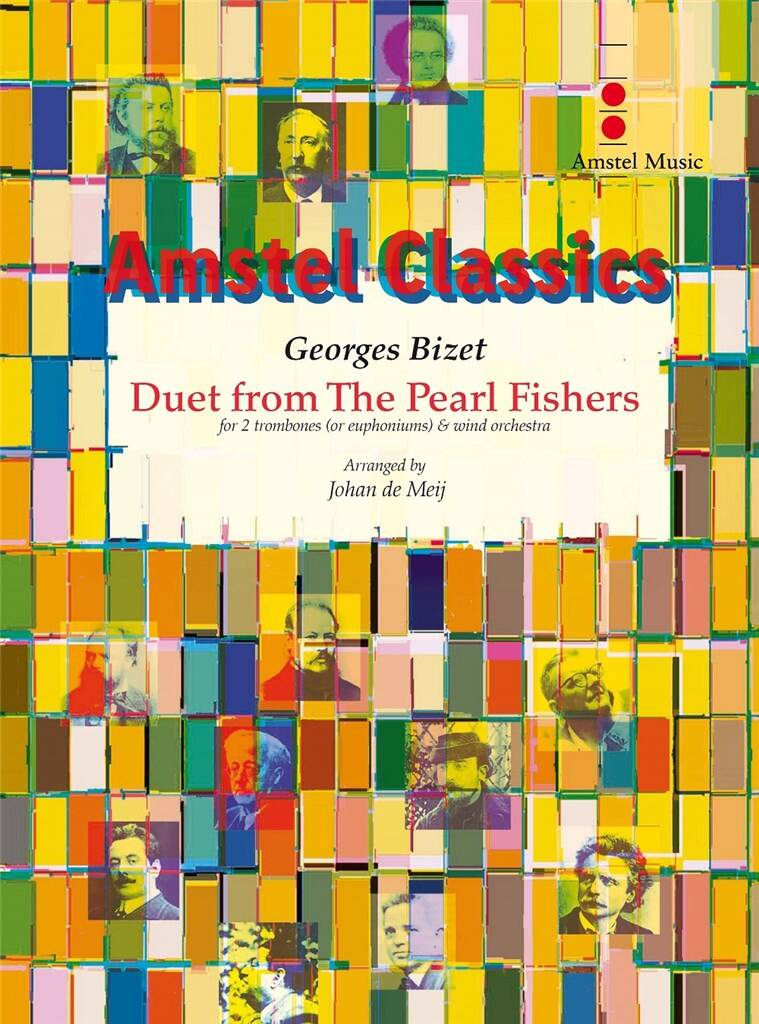
Duet From The Pearl Fishers - Georges Bizet
Les pcheurs de perles (The Pearl Fishers) is an opera in three acts by French composer Georges Bizet, who particularly made his fame with his opera Carmen. The friendship duet Au fond du temple saint, generally known as ThePearl Fishers Duet, is one of the best known in the opera literature. This arrangement for two trombones was written for and dedicated to trombone legends Joseph Alessi and Jrgen van Rijen. It serves as a possible encore piece in combinationwith Two-Bone Concerto, which was also written for them. The duet can also be performed by two euphoniums, or as the original vocal duet for tenor and baritone voice.
Estimated dispatch 7-14 working days
-
 £116.40
Norma Ouverture - Vincenzo Bellini
The composer of some famous operas such as 'La Sonnambula' and 'The Puritans', Vincenzo Bellini (1801-1835) was largely self-taught. Although he wrote eleven operas, only 'Norma' remained popular, not in the least because of its splendid lyrical arias such as Casta Diva (Chaste Goddess) and Mira, O Norma (Hear me, Norma) familiar to all music lovers. The opera 'Norma' is written to a libretto by Felice Romani, based on a French melodrama by Alexandre Soumet and Louis Belmontet dealing with a story of Druids during the Roman rule. The story is neither accurate historically nor convincing dramatically, but the score is full of brilliant melodies of a type calculated to exhibit a singer's virtuosity to the utmost. The Gods order the priestess and fortune-teller Norma to give the signal of revolt against the Romans in Gaul, but she postpones this because of her relationship with the Roman proconsul Pollione with whom she secretly had two children. In the meantime, Pollione has fallen in love with the young priestess Adalgisa and Norma wants to take revenge. Finally both Norma and Pollione die on the pyre. This tragical opera in two acts was first performed at the Scala of Milan on 26 December 1831.
Estimated dispatch 7-14 working days
-
 £90.30
Upside Down - Manfred Schneider
The title of this overture betrays its high-spirited character; it keeps the listener in suspence up to the last strains. The quick and virtuoso introduction Allegro Vivace is followed by a quite melodious Con Moto e Cantabile (written for two parts and in sixths). A Molto Maestoso interludium is followed by two parts Allegro con Fuoco and Moderat, and then the works reaches its only pause with a slowly movement lasting for sixteen bars. The initial tempo Allegro Vivace returns so that the overture can end with the same high-spirited character.
Estimated dispatch 7-14 working days
 View Music