
Results
-
 £137.95
ROYAL WINDSOR PORTRAITS (Prestige Concert Band Set/ w.vocal) - Ellerby, Martin
Score and Parts. A tribute to 'Royal Windsor' consisting of seven sections or cameos that are played as one continuous movement. Includes: Royal Fanfare and Salute; Renaissance Court Dance; Royal Reflection; Regency Ball; Portrait of a Lady; Procession of the Royal Knights; St. George's Hymn and Finale. Duration: 14:00 Instrumentation: Score, Piccolo, Flute, Oboe, 1st Bb Clarinet, 2nd Bb Clarinet, 3rd Bb Clarinet, Bb Bass Clarinet, Bassoon, 1st Eb Alto Sax, 2nd Eb Alto Sax, Bb Tenor Sax, Eb Baritone Sax, 1st Bb Trumpet, 2nd Bb Trumpet, 3rd Bb Trumpet, 4th Bb Trumpet, 1st F Horn, 2nd F Horn, 3rd F Horn, 4th F Horn, 1st Trombone, 2nd Trombone, 3rd Trombone, Euphonium BC, Bb Euphonium TC, Tuba 1 & 2, Double Bass, Piano, Timpani, 1st Percussion, 2nd Percussion, Vocal Part.
Estimated dispatch 7-14 working days
-
 £64.35
Rushmore
A tribute to the four great faces carved in stone, this impressive Alfred Reed piece is an outstanding choice for any performance where a patriotic piece is appropriate. VERY HIGHLY RECOMMENDED!
Estimated dispatch 7-14 working days
-
£47.52
Sol Invictus (Concert Band - Score and Parts)
This shimmering concert opener provides a powerful and exciting way to display your developing band's enthusiasm and talent. Matt Conaway combines driving woodwind flourishes, sensitive chorale statements, and bold brass and percussion writing to create this musical tribute to the "unconquered sun." Perfect for concert or contest!
Estimated dispatch 7-14 working days
-
£43.56
Somerset (Concert Band - Score and Parts)
Somerset County, located in the state of Pennsylvania, is the inspiration for this overture. It is dedicated to the many residents who, over the past several years, have worked tirelessly to create a proper and fitting tribute to the heroes of Flight 93 that went down in a field on September 11, 2001. The music is meant to remind us that we should never forget the brave acts of those citizen soldiers who fought to protect our freedoms. Inspirational!
Estimated dispatch 7-14 working days
-
 £59.95
SUITE SIXTEEN (Prelude Plus Series) - Barry, Darrol
This title refers to the year 1600 - the start of the Baroque period. So much of the English music from this fertile period converts well to wind band and this suite is a tribute to the prolific composers of that period. 1. Basse Dance 2. Pavanne 3. Marc Grade 2.5 Performance time 6'51'
Estimated dispatch 7-14 working days
-
£159.99
Tanczi Wind Band Set (Score & Parts)
This suite was written in the style of traditional Russian folk music, but does not use existing melodies or themes as its basis. The colourful and varied work contains a number of surprising turns, but also familiar sounds. After the introduction, a kind of Trepak follows ? a fairly quick dance with attractive themes. The second movement (Garovot) is predominantly slow and conveys some melancholy, although, during a more dynamic passage the passion flares up again. Finally, the Troika takes us along in a reindeer sleigh through a grand snowy landscape. This is a wonderful tribute to the music of Eastern Europe in the style of some of the great Russian masters. 0:13:30
Estimated dispatch 7-14 working days
-
 £1.75
£1.75THANK YOU, SOLDIERS (2 part Choir) - Souders & Souders - Brubaker, Jerry
"Because of your great sacrifice, your country joins to sing." Patriotism and gratitude prevail in this moving tribute to the men and women of our armed forces. Appropriate for any choir with any combination of concert band, string, or full orchestra accompaniment, or use the professionally-recorded SoundTrax CD. As a special touch, project animated images from the Thank You, Soldiers VideoTrax DVD on a large screen during performance. VideoTrax includes accompaniment-only recording and your choice of with or without overlaid lyrics.
Estimated dispatch 7-14 working days
-
 £1.75
£1.75THANK YOU, SOLDIERS (SAB Choir) - Souders & Souders - Brubaker, Jerry
"Because of your great sacrifice, your country joins to sing." Patriotism and gratitude prevail in this moving tribute to the men and women of our armed forces. Appropriate for any choir with any combination of concert band, string, or full orchestra accompaniment, or use the professionally-recorded SoundTrax CD. As a special touch, project animated images from the Thank You, Soldiers VideoTrax DVD on a large screen during performance. VideoTrax includes accompaniment-only recording and your choice of with or without overlaid lyrics.
Estimated dispatch 7-14 working days
-
 £1.95
£1.95THANK YOU, SOLDIERS (SATB Choir) - Souders & Souders - Brubaker, Jerry
"Because of your great sacrifice, your country joins to sing." Patriotism and gratitude prevail in this moving tribute to the men and women of our armed forces. Appropriate for any choir with any combination of concert band, string, or full orchestra accompaniment, or use the professionally-recorded SoundTrax CD. As a special touch, project animated images from the Thank You, Soldiers VideoTrax DVD on a large screen during performance. VideoTrax includes accompaniment-only recording and your choice of with or without overlaid lyrics.
Estimated dispatch 7-14 working days
-
 £57.50
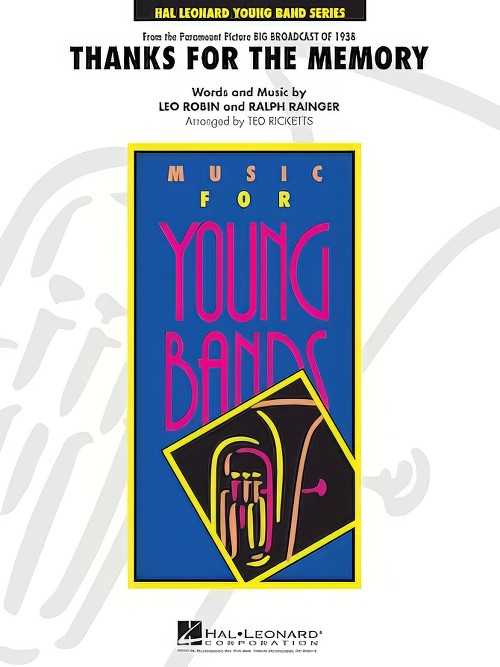
THANKS FOR THE MEMORY (Young Band) - Rainger & Robin - Ricketts, Ted
With the passing of Bob Hope, the world mourns the loss of one of the all-time master entertainers. Pay tribute with this outstanding arrangement of his theme song, Thanks for the Memory
Estimated dispatch 7-14 working days
 View Music