
Results
-
 £57.50
A Lincoln Celebration - Timothy Johnson
Three of Abraham Lincoln's favorite melodies serve to bring the sounds of his generation alive for your concert audience. Colorful orchestration combines with imaginative harmony and counterpoint to make this a strikingly original suite of familiar songs from a time gone by. Expressive, accented, lyrical, delicate, boisterous; you'll discover that A Lincoln Celebration shows off your band in a wide variety of ways and lets all the players thoroughly enjoy the process of performance preparation. Excellent cross-curricular opportunities.
Estimated dispatch 7-14 working days
-
 £140.50
Prelude, Siciliano, and Rhondo - Malcolm Arnold
Taken from Arnold's Little Suite for Brass, Op. 80, John Paynter's splendid arrangement retains the breezy, folk-like quality of the original. Solos highlight the siciliano while the technical brilliance of the rondo features the entire ensemble.
Estimated dispatch 7-14 working days
-
£125.00
Shakespeare Pictures - Nigel Hess
While Music Director and House Composer for the Royal Shakespeare Company, Nigel Hess wrote music for over twenty productions. Hess has taken music from three works to form a 12-minute suite called Shakespeare Pictures. It begins with the boisterous overture to Much Ado About Nothing, followed by a contrasting slow movement depicting the beautiful statue from A Winter's Tale before displaying huge pomp of Caesar's Rome with The Entry to the Senate. This work is ideal for bands that have played and enjoyed Hess's work East Coast Pictures. This wind band suite was commissioned in 2008 by Birmingham Symphonic Winds. The original music is now expanded and re-orchestrated to form a new three-movement suite for symphonic wind orchestra.
In stock: Estimated delivery 1-3 days
-
 £53.95
Hampshire March (Concert Band - Score and Parts) - Holst, Gustav - Wagner, Douglas E.
Based on the original opening of the original introduction for Second Suite in F for Military Band, Holst replaced this section with the now-familiar morris dance tune, "Glory Shears." The 38-measure passage (crossed out in the autograph score) draws upon the English folk song, "Young Reilly," and presents an alluring work in itself for younger players. Serious band literature for your developing band.Duration: 2:15
Estimated dispatch 7-14 working days
-
 £150.00
Behold, Go Forth and Be Joyful! (Concert Band - Score and Parts) - Rutter, John - Noble, Paul
These three separate compositions have been adapted into one suite. The first movement, Behold, the Tabernacle of God, is to be performed with the trumpets and trombones placed in the rear or balcony of the concert hall. The effect is to surround the audience with antiphonal sound, thereby, in effect, placing them in the tabernacle of God. The arrangement is adapted from the original scoring for orchestra and chorus. The choral parts are played by the trumpets and trombones.The second movement, Go forth into the world in peace, is scored for woodwinds, horns, euphonium, tuba, and string bass, in keeping with the original scoring for chorus with strings alone. For the third movement, O be joyful in the Lord, the conductor may determine the placement of the trumpets and trombones, either leaving them in the antiphonal setting, or returning them to the stage.
Estimated dispatch 7-14 working days
-
 £148.00
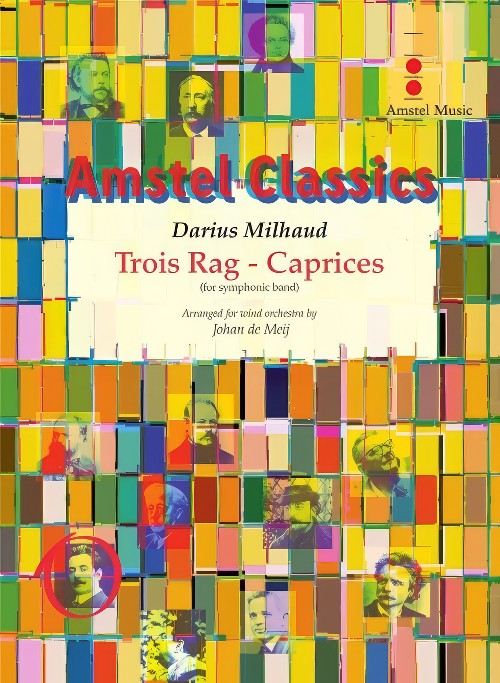
Trois Rag - Caprices (Concert Band - Score and Parts) - Milhaud, Darius - De Meij, Johan
The French composer Darius Milhaud (1892-1974) was a member of the Groupe des Six. This group of six composers gathering Honegger, Poulence, Auric, Durey, Tailleferre and Milhaud, imitated Erik Satie by revolting against the deeply rooted traditional conventions of that time. They reacted against impressionism (Debussy) and romanticism (Wagner, Mahler) and felt very strongly about the music of Satie and Stravinsky. Milhaud's most popular work is undoubtedly the ballet La Creation du Monde, one of the most striking examples of jazz influences in classical music. The premiere at the Theatre des Champs Elysees in October 1923 caused a real scandal with the Paris public. The Trois Rag-Caprices for piano were composed one year earlier, in the summer of 1922, and could be considered as a kind of preliminary sketch for La Creation du Monde. There are indeed clear similarities between both compositions as to the rhythmical and harmonic aspects. The Trois Rag-Caprices were orchestrated for symphony orchestra by Milhaud himself some time later. The same happened to Saudades do Brasil (1920), a piano composition punctuated with Latin-American influences, which was written after his stay in Rio de Janeiro (1917-18) exactly as his ballet Le Boeuf sur le Toit. Johan de Meij's orchestration of Trois Rag-Caprices for symphonic band is a most welcome addition next to the original band works of Milhaud, such as Suite Francaise (1945) and West Point Suite (1951).Duration: 8.00
Estimated dispatch 7-14 working days
-
 £70.00
SEA SONGS (Young Band) - Vaughan Williams, Ralph - Longfield, Robert
Originally the fourth movement of Vaughan Williams' well-known English Folk Song Suite, this setting of folk songs is now considered a separate work on its own. Here for the first time is an arrangement playable by younger bands. Including Princess Royal, Admiral Benbow and Portsmouth, all the original charm and character of the original has been authentically preserved in this outstanding setting by Robert Longfield.
Estimated dispatch 7-14 working days
-
 £194.99
Euphonium Concerto No.2 (Euphonium Solo with Concert Band - Score and Parts) - Sparke, Philip
The original concept for this work was a suite of short movements, each with its own character, but by the time the first movement was complete it was clear that a conventional three-movement format was going to work out better. The opening movement contains much syncopation and is almost rag-like in style. The slower second movement explores the unsurpassable ability of the euphonium to play lyrically, with a theme that is later taken up by the band whilst the soloist weaves a filigree descant. This leads straight into the third movement, which is almost bebop in style and shows off the jazzier capabilities of the euphonium. The concerto was composed for the virtuoso soloist, Steven Mead. A version for euphonium and piano is also available.Duration: 16:30
Estimated dispatch 7-14 working days
-
 £256.99
Clarinet Concerto (Clarinet Solo with Concert Band - Score and Parts) - Sparke, Philip
Clarinet soloist Linda Merrick is a long-time friend of the composer Philip Sparke and is married to fellow composer, Martin Ellerby. As part of a dynamic and forward-looking PhD thesis on works for clarinet and concert band, Linda has researched the existing repertoire in addition to commissioning several new concerti from leading British composers, including Martin Ellerby and Nigel Clarke.The original concept was for a suite of short movements, each with its own character, but by the time the first movement was complete, it was clear that a conventional three-movement format was going to work out better.The opening movement contains much syncopation and is almost rag-like in style. The slower second movement explores initially the chalumeau register of the clarinet in a theme that is later taken up by the band whilst the soloist weaves a filigree descant. This leads straight into the third movement, which is almost bee-bop in style and shows off the jazzier side of the clarinet.Duration: 14.00
Estimated dispatch 7-14 working days
-
 £134.99
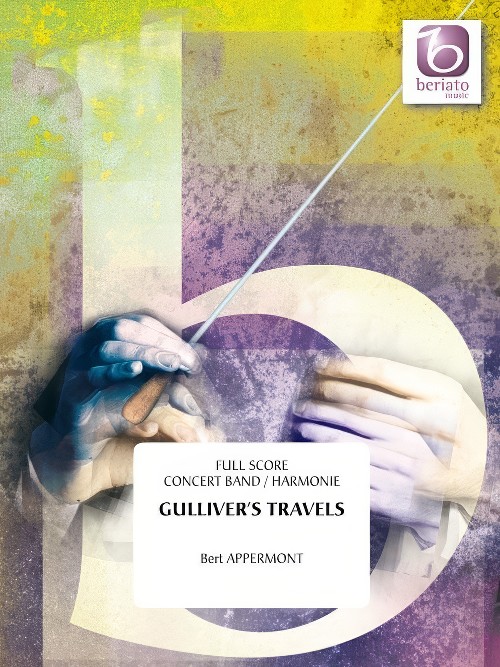
Gulliver's Travels (Concert Band - Score and Parts) - Appermont, Bert
The book Gullivers Travels (1726) by author Jonathan Swift formed the provocation for writing this composition. Even though this composition isnt a literal representation of the original story, a number of elements were still retained. The ships doctor Gulliver finds himself in 4 (fictive) areas, each with their own inhabitants and customs. Each part of this suite also received the name of one of these areas:I. Lilliput The enterprising Lilliputians are represented by a playful, common theme in the first part.II. BrobdingnagIn the land of "Brobdingnag" Gulliver is carried off by gigantic giants, which you hear approaching with the sounds of the bassinstruments. The same theme is constantly repeated and quickened in order to increase the tension.III. LaputaLaputa is an island that floats in the air; its inhabitants are strange people with slanting heads. The dreamy, special atmosphere is especially well conveyed here.IV. The HouyhnhnmsFinally Gulliver finds himself in the land of the Houyhnhnms, where intelligent and noble horses rule over the primitive, undeveloped people (yahoos). The trumpets in the brilliant opening express the galloping horses; the gallant theme that follows (horns and trombones) symbolises the primitive yahoos. The whole composition ends with a big finale.I intentionally tried to limit the degree of difficulty of Gullivers Travels. Despite this I think that this work can appeal to many orchestras due to the colourful orchestration (cues are provided where needed), the simple and clear theme and the highly imaginative breeding ground of a beautiful story around which this composition is built." Duration: 8:00
Estimated dispatch 7-14 working days
 View Music