
Results
-
 £80.99
Rushmore - Alfred Reed
A tribute to the four great faces carved in stone, this impressive Alfred Reed piece is an outstanding choice for any performance where a patriotic piece is appropriate. VERY HIGHLY RECOMMENDED!
Estimated dispatch 7-14 working days
-
 £141.99
Four (4) French Songs Of The 16Th Century
Estimated dispatch 7-14 working days
-
 £57.50
Reach Out, I'll be there
This Motown hit from the Four Tops was originally a #1 hit in 1966, and it's back on the charts now courtesy of a new recording by Michael McDonald. Great rock sounds in an effective setting for concert band!
Estimated dispatch 7-14 working days
-
£39.95
Concerto for Horn No.2 in Eb - Rondo (Last Movement) - Score and Parts - Wolfgang Amadeus Mozart
Mozart's Horn Concerto No. 2 in Eb, completed on 27 May 1783 was possibly the first of the four horn concertos to be written despite its number. It was composed for Mozart’s lifelong friend Ignaz Leitgeb whom he liked to poke much fun as the original manuscript demonstrated in the concertos sub heading ‘Wolfgang Amad? Mozart has taken pity with the Leitgeb ass, ox and fool.' There are also comedic moments in this last movement towards the close where there are gaps in the music and an accelerated coda section.
Estimated dispatch 7-14 working days
-
£7.95
Concerto for Horn No.2 in Eb - Rondo (Last Movement) - Score only - Wolfgang Amadeus Mozart
Mozart's Horn Concerto No. 2 in Eb, completed on 27 May 1783 was possibly the first of the four horn concertos to be written despite its number. It was composed for Mozart’s lifelong friend Ignaz Leitgeb whom he liked to poke much fun as the original manuscript demonstrated in the concertos sub heading ‘Wolfgang Amad? Mozart has taken pity with the Leitgeb ass, ox and fool.' There are also comedic moments in this last movement towards the close where there are gaps in the music and an accelerated coda section.
Estimated dispatch 7-14 working days
-
 £175.00
60 Warm-Up Chorales (Concert Band - Score and Parts) - Cesarini, Franco
During his experience as a band conductor and teacher of wind orchestra conducting at university, Franco Cesarini has dealt with the topic of warm-ups very frequently. Throughout these long years of conducting he has had the opportunity to try many existing methods, evaluating their advantages and disadvantages. After a long time, he has decided to compile a collection of chorales for warm-ups, which are organised according to the criteria that he considers most effective. While working on his60 Warm-up Chorales for Concert Band, Franco Cesarini has always borne in mind that amateur musicians play for pleasure. He feels that it is extremely important that they have satisfaction at every moment of the rehearsal and not to start the rehearsal with needless "punishing" exercises. Nobody is really motivated to start playing with scales, long notes, or tricky rhythmical exercises. There is often a distinguished absentee in band rehearsals, namely music itself! Although this publication does not foresee a specific tempo for the chorales, they should often be performed rather slowly but without dragging. Dynamics are not indicated, so that the conductor has the opportunity to draw the attention of the musicians to his gestures and to make them react according to his indications. Timpani and bell parts have been added with the aim of not leaving the percussionists completely inactive during the warm-up phase, but can also be omitted. The chorales are written in four parts (SATB) and are also playable in smaller groups. The four voices can be played in different combinations of woodwinds or brass quartets or in mixed combinations. The collection includes ten chorales for the following keys: D flat major, A flat major, E flat major, B flat major, F major and C major. With his 60 Warm-up Chorales Franco Cesarini would like to convey the message to play the chorales in a musical way, thus raising the musicians' awareness of phrasing, the right interpretation of cadences, rubato and agogic. Above all, never do anything without putting the musical aspect in the foreground. 60 Warm-up Chorales for Concert Band: A perfect collection to warm-up and improve tuning of a concert band!
Estimated dispatch 7-14 working days
-
 £36.95
Winter (Concert Band - Score and Parts) - Vivaldi, Antonio - Wiffin, Rob
An arrangement of a slow movement from Vivaldi?€s The Four Seasons. Vivaldi?€s The Four Seasons concertos (1723) remain hugely popular. This straightforward arrangement is of the Largo from Concerto No. 4 in F minor, Op. 8, RV 297, L'inverno (Winter). Vivaldi described the feeling of this music as ?€To rest contentedly beside the hearth, while those outside are drenched by pouring rain?€. Duration: 2.35
Estimated dispatch 7-14 working days
-
 £87.50
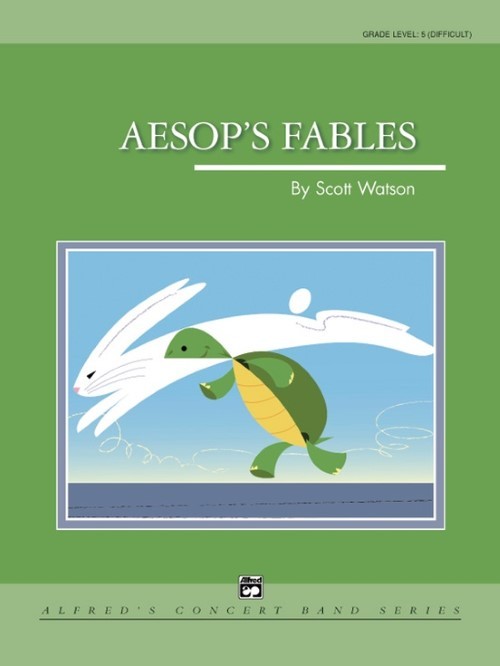
Aesop's Fables (Narrator with Concert Band - Score and Parts) - Watson, Scott
Aesop's Fables, for narrator and band, musically portrays four tales attributed to the ancient moralist. The four movements are based on The Hare and the Tortoise, The Boy Who Cried Wolf, The Dog and the Bone and The Wolf and His Shadow. Dynamic and highly dramatic!Duration: 9:45
Estimated dispatch 7-14 working days
-
 £267.99
Sinfonietta No.3 (Concert Band - Score and Parts) - Sparke, Philip
In each of the four movements of this major work for concert band, the composer has tried to capture in music something of the spirit of this beautiful Swiss town of Rheinfelden, which lies on the banks of the Rhein. The opening movement, Promenade, sees woodwind and brass alternating short melodic fragments leading to a noble melody from the horns. The dreamy Ballad features a saxophone solo and chorale-like melody. This leads, via a four bar Interlude, to the Scherzo which takes the form of a moto perpetuo.Duration: 18:20
Estimated dispatch 7-14 working days
-
 £239.99
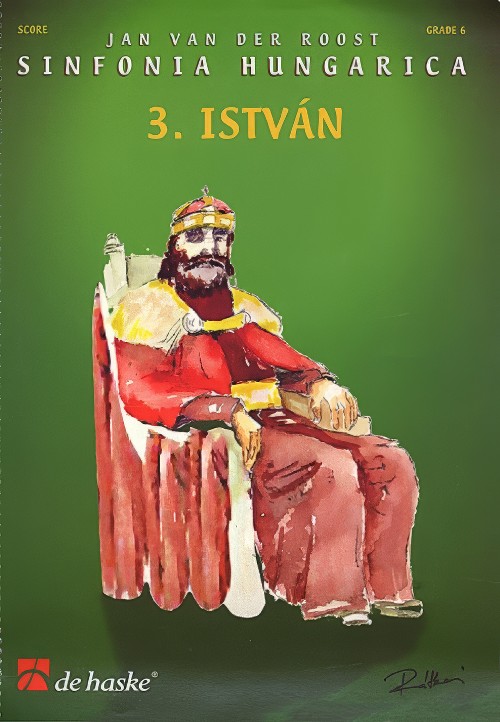
Istvan (Part 3 from Sinfonia Hungarica) (Concert Band - Score and Parts) - Van der Roost, Jan
Sinfonia Hungarica is a three-movement symphony that depicts the history of Hungary. All three movements were inspired by historical key figures, wars, and other important events from this country. This symphony is a celebration of Hungary's millennium in 2001.The final movement is named after Istvan, the King who introduced Christianity into Hungary and who was crowned by Pope Silvestro II on January 1, 1001. A rather solemn start leads to another war-like passage, ending with some loud crashes. This symbolizes the fact that the body of the pagan Koppany was cut into four pieces, and sent to the four castles of the country as an example. After a quiet, almost religious intermezzo, the National Hymn of Hungary is introduced. This broad "grandioso" ending also has a symbolic meaning: after ten centuries, Hungary has many reasons to look back on the past with pride, and to look forward to the future with optimism and confidence.Duration: 14:30
Estimated dispatch 7-14 working days
 View Music