
Results
-
 £16.95
A Fugal Concerto (Flute, Oboe And Small Wind Band) (Concert Band - Score Only) - Holst, Gustav - Brand, Geoffrey
This work was originally written for flute, oboe (or two violins) and String Orchestra in 1923. This arrangement was premiered by the Stockholm Symphonic Winds in September 1993, conducted by the arranger. The style of A Fugal Concerto is very much neo-classical - all the rage at the time, although whether Holst had heard Stravinsky's examples is not known. In so far as the work is fugal, the adjective applies more to the texture than the form, although the second movement is canonic. The contrapuntal texture is not straightforward as phrases are displaced across barlines and cross rhythms are a feature. Nothing is allowed to settle until the folk tune is introduced toward the end. Yet, within this musical web, fascinating patterns and cross references reveal themselves.
Estimated dispatch 7-14 working days
-
 £60.00
Santa Loves To Cha-Cha! (Flexible Ensemble - Score and Parts) - Huckeby, Ed
If you have a group with severe instrumentation issues or just a very small band, this entertaining Ed Huckeby arrangement will provide an impressive sound for your holiday or Christmas program. Playable with any instrumentation as long as you have the four main parts covered by the instruments of your choosing. Includes optional piano and percussion parts. It's lots of fun and sure to be a hit with your students and audiences alike!Duration: 2.15
Estimated dispatch 7-14 working days
-
 £57.50
It's a Small World (Concert Band - Score and Parts) - Sherman & Sherman - Christensen, James
Former Disney arranger James Christensen takes us on a musical adventure around the globe with this entertaining setting of one of the world's most recognizable songs. Opening with a traditional march style and traveling through such musical regions as the Oriental, a tropical island, a Viennese Waltz, Calypso, and finally a rousing 6/8 march, this production number will delight all audiences.
Estimated dispatch 7-14 working days
-
 £42.50
It's a Small World (Concert Band - Score and Parts) - Sherman & Sherman - Vinson, Johnnie
Originally written for the 1964 New York World's Fair, this song has been reported as the most publically performed song of all time.
Estimated dispatch 7-14 working days
-
 £108.10
IT'S A SMALL WORLD (Intermediate Concert Band) - Parson, Ted
Duration: 3:30
Estimated dispatch 7-14 working days
-
 £66.95
In tantum lux - Todd Stalter
In tantum lux (The only light) was written as a memorial and celebration honoring the life of a music educator and her faith, who taught in a small school her entire career and persevered through the challenges and unique demands that teaching small school bands present. The piece also serves as a celebration of every band student and teacher in small schools everywhere who may not have the resources to have a full ensemble, yet strive every day to experience the joy of making music to the fullest just the same. (4:00)
Estimated dispatch 7-14 working days
-
 £78.20
Cloud(iu)s ... der Wolkenmann - Thiemo Kraas
4 Miniatures for Winds: 1. Wind 2. Storm 3. Rain 4. Sun and Snow There was a little child who enthusiastically told a story ... and a composer who was equally inspired by the child and its story to write these miniatures. At the premier performance of my composition "Arcus" in March 2011, when I explained how a piece about the rainbow came into being, a little girl came up to me and asked: "Thiemo, what about the man in the clouds?" I obviously had forgotten to include him, though he is as the little girl informed me of extreme importance in the sky: "He sits in the clouds and is responsible for the weather. He shakes rain, wind, storm or snow out of the clouds, he pushes them aside to let the sunshine through or he models them into funny figures, making people on earth smile." Fascinated by the girl's ingenuous ideas I created this small composition, sitting in my study and letting my mind wander into the sky. As the man in the clouds naturally has to have a name, I decided to call him "Cloud(iu)s ... man in the clouds". I dedicate this piece to the children of my beginner's band, who show me again and again how wonderful and precious it is to delight in the small things in life ...
Estimated dispatch 7-14 working days
-
 £104.99
Bliss - Jacob de Haan
Bliss: Impressions of a Village contains three impressions of a village in the beautiful Brabant province in the Netherlands. The fi rst movement is in a very 'classical style' and, appropriately, captures the village's history. Saxophones and a glockenspiel follow the path of a small, playful river. The entire band join in as the small river approaches an ancient castle. The third movement contains lots of interesting rhythms portraying the hustle and bustle of everyday life in the village.
Estimated dispatch 7-14 working days
-
 £99.99
Hidden Light - Kevin Houben
Hidden Light - Loyalty Among Friends, was composed on the occasion of the 75 year membership of Mr Leo Knoben at the Royal Brass Band 'Eendracht Waubach'. (NL)From pride and admiration for this exceptional jubilee , but also out of gratitude for his many years of commitment as musician and member of the board, the association chose to have a memorable work written.That assignment resulted in the wonderful choral Hidden Light, for which composer Kevin Houben based himself on the following emotions and oppositions: small vs majestic, submissive vs royal and simplicity vs glory.The work starts in a very modest, dark atmosphere, after which the composition develops into a grand and lofty sound with broad melodies, exploring the full richness and colors of the 'symphonic' wind band.The interesting variety in orchestration - the small , intimate setting at the beginning and the following broad, majestic tutti passages - makes the work very varied, grateful to perform and to listen to.With Hidden Light Kevin Houben has again created an expressive and powerful composition that is highly reflective in nature. This emotional work is a tribute to an exceptional man who has been there for 'his' orchestra all his life, with a warm heart for 'his' musicians. Each musician will recognize the connection and the passion for music in this piece.
Estimated dispatch 7-14 working days
-
 £309.99
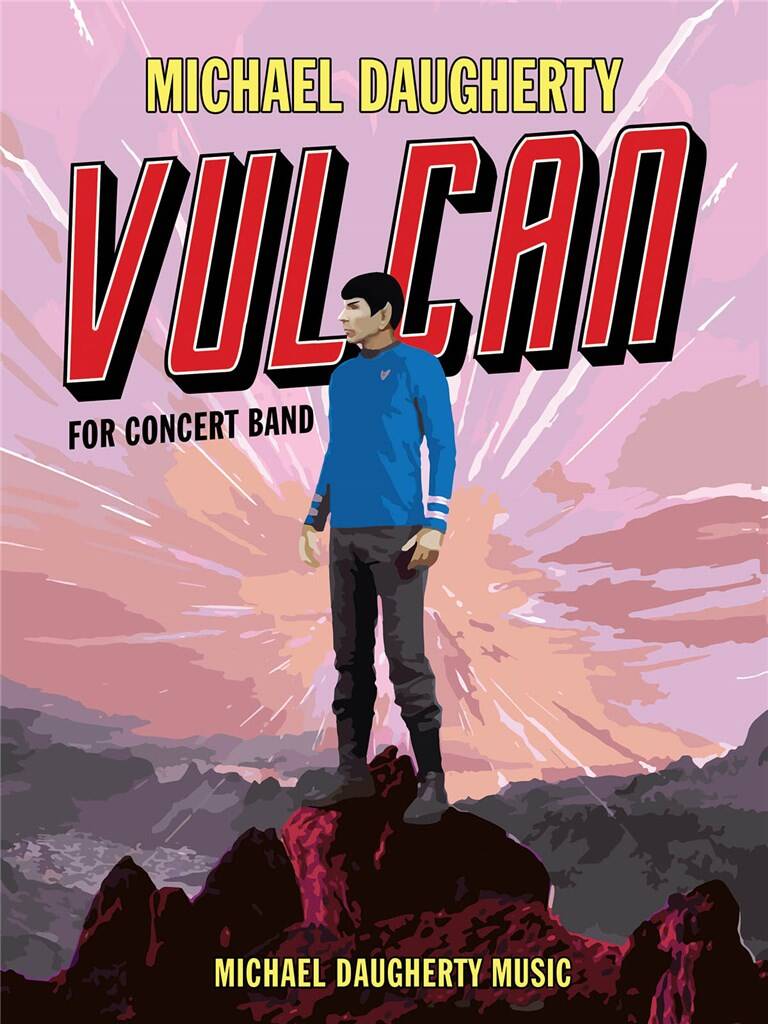
Vulcan - Michael Daugherty
(2014) Vulcan for Concert Band is Grammy award winning composer Michael Daugherty's first work for the high school and intermediate level college band. The work is a colorful homage to Gene Roddenberry's interstellar universe as depicted in the classic American television series Star Trek (1966-69). The title refers to the fiery planet Vulcan, home world of half-human, half-Vulcan Mr. Spock. As the rational-minded science officer aboard the starship Enterprise (commanded by the hot-blooded Captain James T. Kirk), Mr. Spock grapples with the fascinating predicament of making decisions predicated on human emotion versus Vulcan logic. Daugherty has composed stirring, yet highly structured music that alludes to the Vulcan Pon Farr ritual, Vulcan telepathic mind-melds, and the volcanic planet itself. At the the Ann Arbor, Michigan world premiere (utilizing the combined forces of the Pioneer, Huron and Skyline High School bands), Vulcan was an immediate hit and will surely become one of Daugherty's most performed works. Instrumentation The number of players doubling each part is at the conductor's discretion, but should be in keeping with a balanced sound. Piccolo 2 Flutes 2 Oboes English Horn (optional but recommended) 3 Bb Clarinets (minimum 2 players per part) 2 Bb Bass Clarinets Eb Contralto Clarinet or Bb Contrabass Clarinet and Bb Bass Saxophone (optional but recommended) 2 Bassoons 2 Eb Alto Saxophones Bb Tenor Saxophone Eb Baritone Saxophone 3 Bb Trumpets (straight metal mutes, harmon mutes-stem out) 2 F Horns 2 Trombones (straight metal mutes) Euphonium 2 Tubas Contrabass or Electric Bass (optional but recommended) Timpani (4 drums recommended) Percussion (instruments are not shared): 1. Glockenspiel, Xylophone 2. Vibraphone, Small Anvil (metal beater) 3. Shakaray, Marimba, Chimes, Suspended Cymbal (yarn mallets) 4. Two Tam-Tams (small, medium), Tambourine, Mark Tree, Finger Cymbals, Vibraslap, Piccolo Snare Drum 5. Tenor Drum, Maracas, Snare Drum 6. Large Bass Drum Movement I (YouTube) Movement II (YouTube) Movement III (YouTube)
Estimated dispatch 7-14 working days
 View Music