
Results
-
 £84.99
The Ketchup Song (Asereje) - Francisco Manuel Ruiz Gomez
The Ketchup Song was a big 2002 summer hit for the Munoz sisters. The band is made up of three sisters, Lol, Lucia and Pilar who are the daughters of a famous Spanish flamenco musician called Tomate (hence Ketchup!). This fabulous arrangement will bring a taste of summer on the Costa to any concert.
Estimated dispatch 7-14 working days
-
 £152.99
Morning Song - Philip Sparke
Morning Song features the horn quartet mostly in a soloistic role - indeed there is an accompanied cadenza towards the end of the piece - but there are moments where the horns assume their conventional concert band role as harmonic support or playing the counter melody. This expressive composition shows all the versatility of the horn quartet and gives them the chance to be in the spotlight.
Estimated dispatch 7-14 working days
-
 £191.99
The Song of the Bell - Philip Sparke
The piece is based on Friedrich Schiller's epic 1798 poem Das Lied von der Glocke (The Song of the Bell), which is one of the most famous in all German literature. The poem draws a close parallel between human life and the process of casting a bell. It has three movements: Life Celebration, Sound the Alarm and Journey's End.
Estimated dispatch 7-14 working days
-
 £56.99
Folk Song Variants - Robert W. Smith
Based on an Appalachian melody, "Folk Song Variants" is welcome addition to the young band repertoire. Beginning with a lyrical melodic statement, the piece moves to a celebration of American folk songs featuring melodic interplay throughout sections of the band. Suitable for concert and festival performance, this work by Robert W. Smith is destined to be part of the young band standard repertoire.
Estimated dispatch 7-14 working days
-
 £107.50
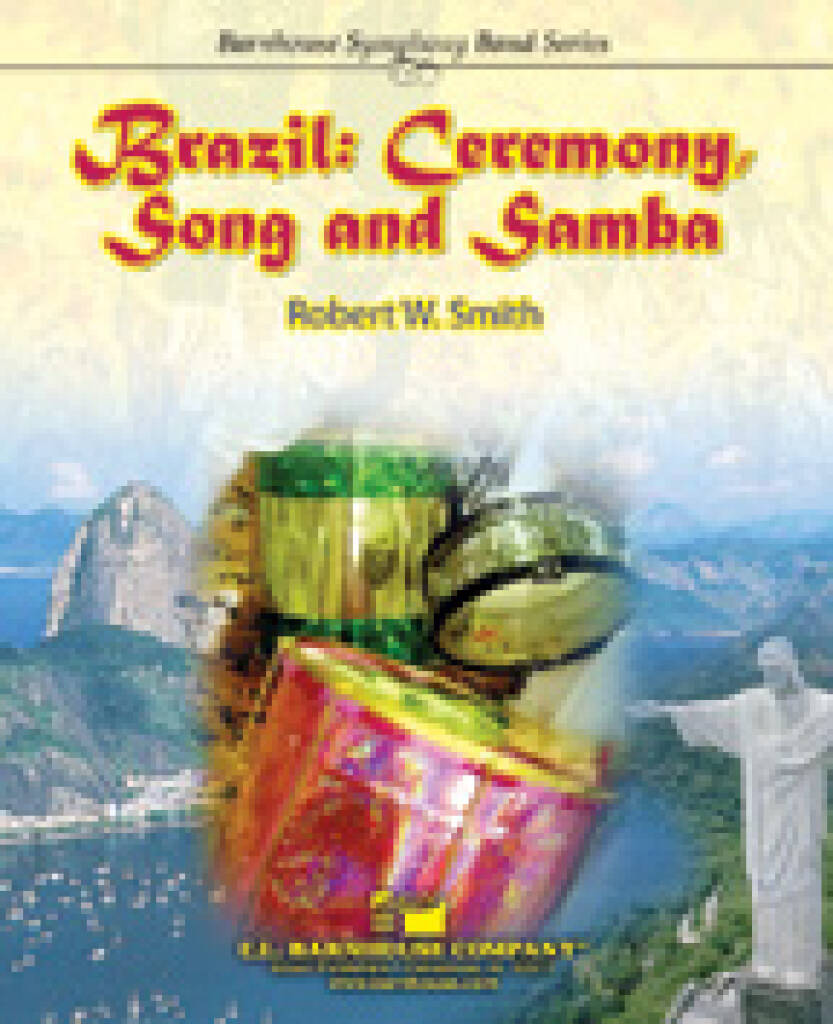
Brazil : Ceremony, Song and Samba - Robert W. Smith
At long last, Robert W. Smith continues his musical journey that began in western Africa years ago and now takes us to Brazil. Based upon authentic Afro-Brazilian percussion grooves, "Brazil: Ceremony, Song and Samba" is comprised of three musical sections illustrating the impact of the African experience on music of this part of the world. Beginning in northern Brazil with the Ceremony, the piece transitions to Rio di Janiero and the smooth sounds of the bossa nova that has become so popular throughout the world. The piece concludes with the exciting sounds of Carnaval and the Samba Schools that fill the streets during the annual celebration. Exciting, musically rewarding and extremely effective in any concert setting!
Estimated dispatch 7-14 working days
-
 £54.99
Angela's Song - Ed Huckeby
Ed Huckeby's Build-A-Band arrangement of Angela's Song is arranged for solo and small band. Solo parts are included for all of the usual band solo instruments plus the usual Build-A-Band instrumentation which allows it to performed with Soloist plus other instruments so that the four essential band parts are covered. Optional Percussion and keyboard parts can add to the overall effect. A great way to show off your best player even with a very small band.
Estimated dispatch 7-14 working days
-
£71.50
Italian Street Song - Victor Herbert
Victor Herbert was a master of American operetta, and his "Naughty Marietta" is a grand example of his genius. The "Italian Street Song" is a perfect solo or encore selection of soprano. Vocal solo with concert band accompaniment.
Estimated dispatch 7-14 working days
-
£89.99
The Last Song - Ben Haemhouts
The Last Song is a beautiful and sad choral that begins very slowly and calmly. Gradually the instrumentation increases leading to a big climax. After this Grandioso ma con moto the instrumentation gets smaller and the piece comes to an end with the initial theme, but this time even slower than in the opening.
Estimated dispatch 7-14 working days
-
£264.99
Diferencias on an Old Spanish Song - Yasuhide Ito
I am immensely happy that my Gloriosa, symphonic poem for band (1990), has been performed by so many bands in the last thirty years.During this period, the growth of the internet has made it much easier to access information.When I composed Gloriosa, I only had limited information about the period when Christianity and Western music was first introduced to Japan, and had to rely a lot on my imagination.However, nowadays, it is easy to obtain various source materials and to read interesting studies on the music of the past.In recent years, the music of Luis de Narvez (born ca.1500 - died between 1555-1560), Spanish composer and vihuela player, has become increasingly known, and several CDs of his music are now available.Narvez composed the earliest-known set of diferencias, a forerunner of the variation form. One of his works is Seys diferencias sobre el himno "O gloriosa domina" [Six diferencias on the hymn "O gloriosa domina"] (1538), based on the Spanish Marian hymn, and it was this melody I used in the first movement of my Gloriosa.Western music has been my musical roots since childhood, and throughout my career as a composer, it has continued to fascinate me. One could say that this has provided the inspiration for Diferencias on an Old Spanish Song, my own take on the diferencias form.Actually, such music from the early sixteenth century could sound fresh to our modern ears. So I decided to quote the melody from Narvez's Sey diferencias at the beginning and end of the piece, in order that people can get the feel for the period.The main section (bars 42-390) is formed of 13 diferencias, similar to the first movement of the Gloriosa.In the middle section, which begins after the eighth diferencia(from bar 187), one should be totally absorbed in the tranquility and the beauty of the music. Although it's in the style of a sarabande, it should be taken slower and played as pianissimo as possible.This is followed by folk-style dance music. (As only standard percussion instruments are used, try to be creative with tonal colours and sense of rhythm).The structure of the work is simple, but be aware of the connection between the sections when constructing the whole.Also, think about the tonality. Overall, the work is in F minor. The main section is basically in D minor, but from bar 102, it modulates to A flat minor and G minor, and then in the middle section it suddenly switches to A flat major (which is the furthest key from D minor, and the relative major of F minor). From bar 219, it modulates to F minor and then to C minor, then back to F minor by way of A minor.N.B. The Oboe II part can be substituted by the English Horn (as indicated in the parts). One can choose according to the player's skills or preference.Recent new compositions for wind band are often full of rhythm, dynamism, and tonal colour, and compositional techniques and orchestration have also evolved greatly. Yet on the other hand, they tend to feature fewer melodic or expressive elements. Since this work is the test piece for WMC Kerkrade 2022, I had to think about what "tests" or "challenges" to set, and I decided to compose something that doesn't involve a lot of technical display, but requires beautiful sounds and harmonies, and above all, musical expressivity. I didn't put many expression markings in the score, because I wanted the performers to think about how best to express this music. If it is played merely as notated, it's not going to sound very interesting.Christianity was introduced to Japan in the mid-16th century, but it was subsequently banned and Japan entered a period of national isolation, which meant that there was hardly any international exchange for two hundred years. As a result, the Christian hymns that were introduced prior to the isolation became almost unrecognizable over the centuries. This was the theme I explored in my Gloriosa thirty years ago.Now, in 2021, the whole world has been forced to "isolate" due to the Covid-19 pandemic. In such times, it seems pertinent that I've written a work using this melody again. I sincerely hope that people will be able to gather in Kerkrade in 2022.(English Translation:Nahoko Gotoh)
Estimated dispatch 7-14 working days
-
 £64.99
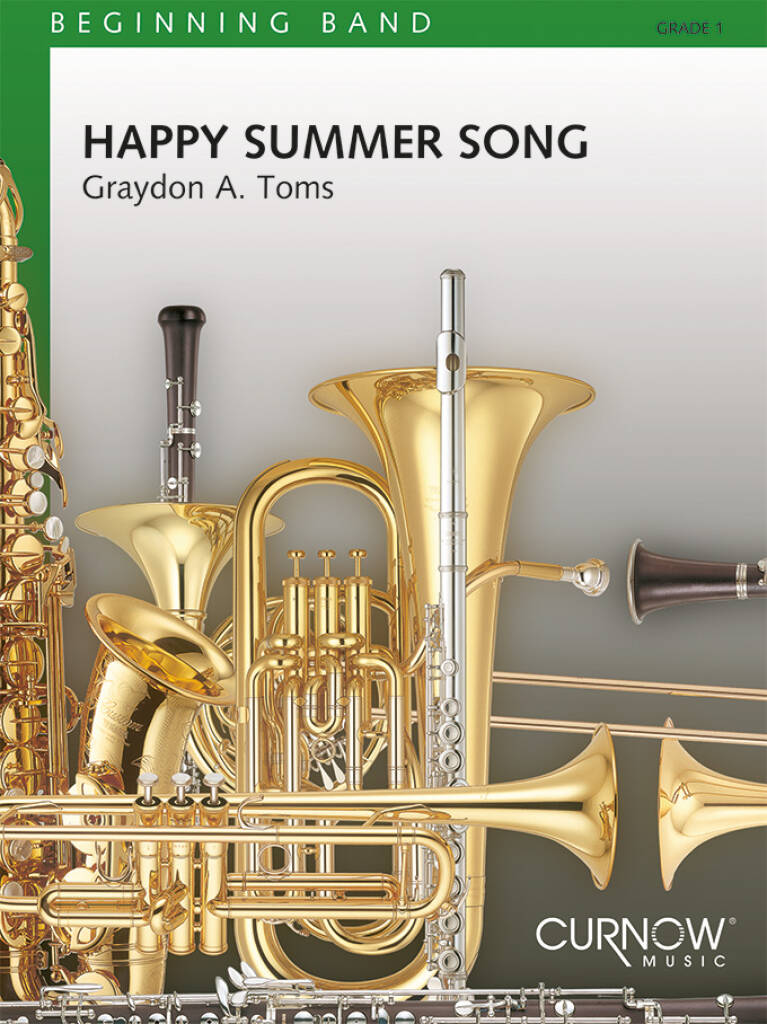
Happy Summer Song - Graydon A. Toms
This lighthearted piece is ideal for the Grade 1 band. Repeated notes in a sequential melody, simple counterpoint between the Woodwinds and Trumpets, interesting use of common Auxiliary Percussion instruments, a limited palette of rhythms and easy Low Brass/ Low Woodwind parts all combine so that you can program HAPPY SUMMER SONG with confidence. Whether you have a full complement of players or your instrumentation is a little "sketchy"; whether you have plenty of rehearsal time or that precious commodity is a bit rare, you can count on having this one ready in time for the show.
Estimated dispatch 7-14 working days
 View Music