
Results
-
 £77.50
Der Lehrmeister (Concert Band - Score and Parts) - Sheldon, Robert
The title of this piece translates from German to "The Master Teacher." Commissioned by the Florida Bandmasters Association in memory of Jack Crew, this piece serves to honor the memory of one of the all-time great teachers and musicians in our world of band music. The piece is written in a style reminiscent of Richard Strauss, one of Jack's favourite composers. Duration: 5:10
Estimated dispatch 7-14 working days
-
 £183.99
Five States of Change (Concert Band - Score and Parts) - Sparke, Philip
Five States of Change was commissioned by Kunstfactor for the 4th section of the Dutch National Brass Band Championships (NBK) 2011. It is dedicated to Jappie Dijkstra and the Music Information Centre (MUI), Arnhem, Holland, in acknowledgement of their outstanding work in developing band repertoire.The composer writes:The idea for the piece came when I was reading an article about a branch of Chinese philosophy which is abbreviated as Wu Xing*, which has no exact translation but can mean, for example, five elements, five phases or five states of change. It is central to all elements of Chinese thought, including science, philosophy, medicine and astrology, and in simple terms tries to create various cyclic relationships between five elements in all walks of life. An example is: Earth - Metal - Water - Wood - Fire - (Earth) etc. where (in one cycle) earth bears metal, metal changes to liquid (water) when heated, water helps trees grow, wood burns to create fire, fire produces ash (earth) and the cycle continues. I was particularly interested in the cycle of emotions:- Meditation - Sorrow - Fear - Anger - Joy - (Meditation) etc. and thought this cyclic principle would provide an effective emotional journey for a piece of music. So Five States of Change has five equal sections which loosely characterise this emotional cycle. I have tried to make the music grow organically, with minimal repetition, and each movement evolves from the musical elements at the end of the previous one, with the opening material appearing, transformed, at the end of the piece to complete the cycle.*in full Wu zhong liu xing zhi chi or the five types of chi dominating at different times.- Philip SparkeDuration: 12:15
Estimated dispatch 7-14 working days
-
 £149.99
Moses and Ramses (Concert Band - Score and Parts) - Yagisawa, Satoshi
This piece was commissioned by Matsudo Citizen Wind Orchestra for their 30th anniversary concert and premiered by the band conducted by Kenichiro Hasunuma in July 2009. This piece is typical of Satoshi Yagisawa in that it depicts a magnificent spectacle. This one is set in ancient Egypt and is based on the story depicted in the famous film "The Ten Commandments" (1956, directed by Cecil B. DeMille). One day Moses, who was raised by the rich royal family, found out that he was originally Hebrew. The Hebrews had been forced to live as slaves. Ramses, the prince directly descended from the Pharaoh, envied Moses' strength and popularity. After internal argument Moses decides to deliver the Hebrew from the Pharaoh's tyranny and escape from Egypt with them.The music starts with brilliant royal fanfare and depicts magnificent architecture, the Hebrew people forced into hard labour, and the slaves escaping from the Pharaoh's tyranny. At the climax they are at crisis point, trapped by the sea. Moses waves his staff and the miracle happens; the sea parts and Hebrew people successfully escape. Following on from Perseus - A Hero's Quest in the Heavens, this work Moses and Ramses is another piece written in the dramatic style favoured by Satoshi Yagisawa.Duration: 9:30
Estimated dispatch 7-14 working days
-
 £164.95
Amphibiosity (Concert Band - Score and Parts) - Ellerby, Martin
Amphibiosity was commissioned by the Royal Marines Band Service with funds made available by the Royal Navy and Royal Marines Charities for the 2014 Mountbatten Festival of Music held at the Royal Albert Hall in London.The work was written in celebration of the 350th Anniversary of the Royal Marines Corps and utilises many familiar tunes associated with them. Although the piece is cast in one continuous movement it falls into an introductions, ten sections and a coda.The Introduction sets the tone with the Amphibiosity mofif - a call to attention, it is of serious intent. During the course of the work it returns as a point of reference. The first section makes use of The Globe and Laurel (Original Regimental Slow March of the Royal Marines, the tune (Early One Morning) making an apt appearance, it has been played in the minor and like much of the quotational material in the piece is of a referenced nature being symbolic in meaning. However it soon turns to the major to provide a less sombre aspect to the introduction proper. There follows an interlude, the Amphibiosity motif returning rather like a ritornello to give cohesion to the structure and act as a point of change.Section two presents Sarie Marais (Regimental March Past of the Royal Marine Commandoes), the first half of the tune used as a fugal subject (placed in the minor) and as such providing the impression of a building up of activity. The ensuing third section is light-hearted commencing with an original hornpipe leading into the fourth section, Seascape, representing the fleet at sea. Another interlude follows, the Amphibiosity motif reappearing as a woodwind fanfare making way for the fifth section. Anticipation, serious matters lie ahead, there is trouble in the papers, the Corps will be placed on standby.Section six is subtitled Preparation, all hands-on deck, time to get set: A Life on the Ocean Wave (Regimental March of the Royal Marines) is alluded to. On reaching section seven, Assault, the landing goes ahead. Within this section there is an internal interlude reflecting on things past: other men have been in this position before. It is a taut and trying situation, training must pay off!Section eight is named Victory, but not gung-ho, and here the Seascape music is revisited. The penultimate ninth section is called Rememberances, although all made it this time, it was not always the case in times past and the Naval Hymn (Eternal Father) provides a moment of tribute to the fallen of previous generations.The Finale (section ten) delivers By Land and Sea (Slow March of the Royal Marines) in a bright and positive orchestration, the mood being celebratory. In a brief Code, the Amphibiosity motif makes a last triumphant appearance.Duration: 10.30
Estimated dispatch 7-14 working days
-
 £32.95
Amphibiosity (Concert Band - Score only) - Ellerby, Martin
Amphibiosity was commissioned by the Royal Marines Band Service with funds made available by the Royal Navy and Royal Marines Charities for the 2014 Mountbatten Festival of Music held at the Royal Albert Hall in London.The work was written in celebration of the 350th Anniversary of the Royal Marines Corps and utilises many familiar tunes associated with them. Although the piece is cast in one continuous movement it falls into an introductions, ten sections and a coda.The Introduction sets the tone with the Amphibiosity mofif - a call to attention, it is of serious intent. During the course of the work it returns as a point of reference. The first section makes use of The Globe and Laurel (Original Regimental Slow March of the Royal Marines, the tune (Early One Morning) making an apt appearance, it has been played in the minor and like much of the quotational material in the piece is of a referenced nature being symbolic in meaning. However it soon turns to the major to provide a less sombre aspect to the introduction proper. There follows an interlude, the Amphibiosity motif returning rather like a ritornello to give cohesion to the structure and act as a point of change.Section two presents Sarie Marais (Regimental March Past of the Royal Marine Commandoes), the first half of the tune used as a fugal subject (placed in the minor) and as such providing the impression of a building up of activity. The ensuing third section is light-hearted commencing with an original hornpipe leading into the fourth section, Seascape, representing the fleet at sea. Another interlude follows, the Amphibiosity motif reappearing as a woodwind fanfare making way for the fifth section. Anticipation, serious matters lie ahead, there is trouble in the papers, the Corps will be placed on standby.Section six is subtitled Preparation, all hands-on deck, time to get set: A Life on the Ocean Wave (Regimental March of the Royal Marines) is alluded to. On reaching section seven, Assault, the landing goes ahead. Within this section there is an internal interlude reflecting on things past: other men have been in this position before. It is a taut and trying situation, training must pay off!Section eight is named Victory, but not gung-ho, and here the Seascape music is revisited. The penultimate ninth section is called Rememberances, although all made it this time, it was not always the case in times past and the Naval Hymn (Eternal Father) provides a moment of tribute to the fallen of previous generations.The Finale (section ten) delivers By Land and Sea (Slow March of the Royal Marines) in a bright and positive orchestration, the mood being celebratory. In a brief Code, the Amphibiosity motif makes a last triumphant appearance.Duration: 10.30
Estimated dispatch 7-14 working days
-
 £160.00
DANCE SUITE (Concert Band) - Muldowney, Dominic
Includes:1. Hey2. Pavane/Waltz3. Polka4. Waltz/Galliard5. Tangos6. Break-DanceDance Suite displays a variety of historical dance forms from a twentieth century viewpoint. The six dances move forward historically from the ancient Hey, through Waltz and Polka, to the sophisticated Tango and the jazz tradition. The rhythm that typifies each dance is constantly under attack, sometimes from a different dance style altogether. These intrusive elements are most obvious in the final dance and prompts the double meaning of the title.I. HEYHey is constructed like a mediaeval motet, where the main blocks of material are rhythmically unconnected to one another. The percussion is the most disconnected of all and seems to have arrived from a Chinese carnival. The scoring alludes to the eight, four and two foot pipes of a baroque organ.I. PAVANE/WALTZAfter a nod in the direction of Dowland's Lachrimae Pavan, the piece seems to wander to and fro between the 16th century and the 19th century world of the Lehr waltz.I. POLKAThe Polka is derived from a four bar fragment found in Stravinsky's sketchbook for The Rite of Spring above which is written: "Dieppe Polka".I. WALTZ/GALLIARDThis is a reversal of the date-shift process in the second movement, in that the wandering goes backwards rather than forwards, particularly to the William Byrd of the Fitzwilliam Virginal Book.I. TANGOSA slow sentimental tango is sandwiched between an abstract deconstructed one, both of which are developed in Dominic Muldowney's opera The Voluptuous Tango.I. BREAK-DANCEBreak-Dance is the fastest, hardest and strangest movement. Its exuberance fractures the texture, which slowly crumbles midway through the movement, only to be resurrected mirror fashion. The piece is a species of palindrome with no true centre, hence: "Break-Dance".Conductors are free to make a selection from these dances for festival or competition programmes, when limited performance time is available.
Estimated dispatch 7-14 working days
-
 £137.99
Odyssee Wind Band Set (Score & Parts)
The Odyssee tells the story of Odysseus, the undaunted hero. In times long ago the blind poet Homer wrote this famous epic. The "Odyssey" follows the "Iliad", the story of the bloody war between the Greek and the Trojans. This battle ends after ten years thanks to the Odysseys famous trick. the Trojan Horse. The Odyssey is not a war epic, but a story about perseverance, loyalty, adventure, and the survival instinct of its ingenious hero. In The Odyssey, Homer describes how Odysseus, the king of Ithaca, had to endure another ten years of affliction after the ten years of war in Troy before he could finally return to his home land. During those years, his wife, Penelope, had to try and keep her many admirers away. These men not only wanted het hand but also the kingship. To prove her husbands worth, she played a trick: "As soon as I have finished weaving this shroud for my father-in-law, Laertes, I will choose one of you to become my husband", she promised them. But during the night, she secretly loosened what she had woven during the day, prolonging the time until Odysseus would finally return. After twenty long years, when he finally stood at the door, she wondered: Is this really my husband? Is he an imposter? Cunningly, she asked him to move the bed, because only she and her husband know that the bed was immovable and was build around an old three trunk! Odysseus was deeply moved: this really was his wife, his Penelope! Nearly three thousands years later, the loyalty and strength of this character, and all the dangerous adventures that Odysseus survived thanks to courage and intelligence, still moves us today. Odyssee by Jan Bosveld is not just an adventure story, but rather a characteristic piece in which memories of Homers story can be heard. The composition opens with a firm, stirring theme describing our hero, Odysseus, in detail: This man is not to be taken lightly. The further development of this short introduction completes this character sketch: trustworthy, perseverant, and a genius. After that we can picture Odysseus on the lonely beach of Ogygia. Do the trumpets depict his memories of the war of Troy? Does he think of his wife, as we recognise the weaving loom of Penelope in the murmuring eighth? In the solemn, plaintive part that follows, we can imagine Penelope feeling lonely, sitting in the womens room with her servants.One of the girls plays the harp, but that does not clear the sombre atmosphere. Then we can imagine seeing the sorceress Circe, who changed Odysseus men into swine. After she gives a simple magic sign something follows that reminds us of the sound of pigs grunting. Then the Odysseus theme resounds: the hero comes to savi his comrades. Assisted by Hermes, he forces Circe to lift the spell. The piece ends the same way as it began, with an animated theme: Odysseus is still the same, undefeated and not to be taken lighty! 07:45
Estimated dispatch 7-14 working days
-
 £122.20
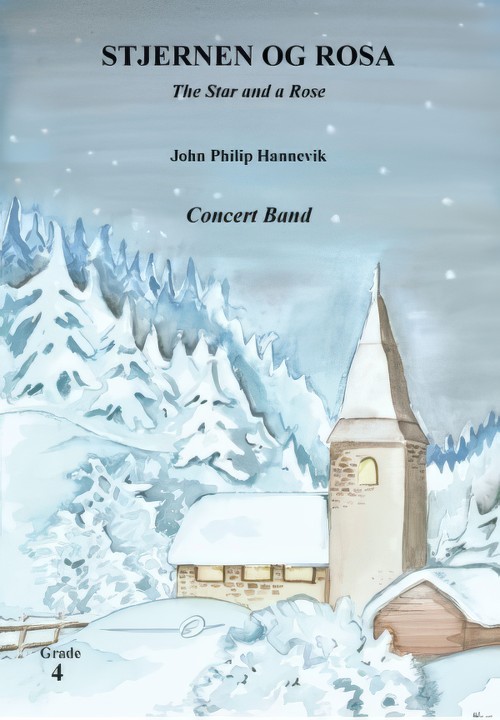
Stjernen og Rosa (The Star and a Rose) (Concert Band - Score and Parts) - Hannevik, John Philip
The Star and a Rose is a big-scale Christmas piece for band, featuring four seasonal chorales.The first is a Gregorian-like chant Hodie Christus natus est.In this section of the piece, a soloist can be placed away from the band, maybe on a gallery. The soloist can be a tenor instrument, maybe trombone, or you can feature a vocal soloist. After this, the music leads us on to the old German Christmas chorale Lo, how a rose e'er blooming. This song is given a fairly rhythmical treatment, but make sure that the melody is presented in a cantabile style. An interlude follows, before the piece presents one of the most used and loved Scandinavian Christmas chorales, Mitt hjerte alltid vanker (My Heart will always wander), composed by the Danish bishop Hans Adolph Brorson around 1732. This song is building towards a climax, before the solo horn brings it all down to the Stable view described in the lyrics. Then comes a transition that brings us in to the final section of the piece, which presents the international Christmas Carol Adeste Fideles. As many will notice, I have borrowed a section from David Wilcocks majestic harmonization towards the end.The title of the piece has its background form the lyrics in My heart will always wander, where the text speaks about the stars in the sky. But also in the Latin text for Adeste Fideles: Stella duce, Magi, Christum adorantes. The Rose is of course from the lyrics in the chorale Lo, how a Rose.Duration: 10.30
Estimated dispatch 7-14 working days
-
 £65.00
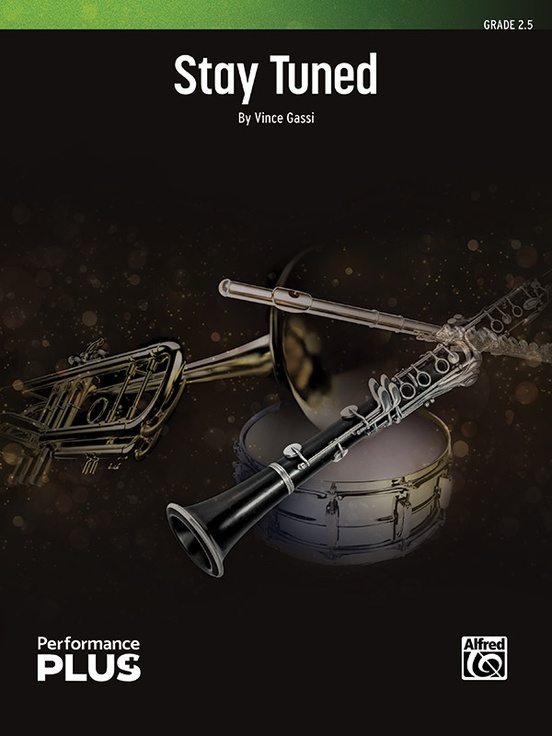
Stay Tuned (Concert Band - Score and Parts) - Gassi, Vince
What would a piece for band entitled Stay Tuned sound like? How about one part tune up, one part driving energy, one part tuneful melody. Add to this that the tuning note is always present somewhere throughout (even in the lyrical section) whether sustained or rhythmically varied. Stay tuned with this great Vince Gassi original for audience fun! Duration: 3.00
Estimated dispatch 7-14 working days
-
 £89.99
The Pageant of London (Concert Band - Score and Parts) - Bridge, Frank
Frank Bridge was one of the finest English composers of the first half of the 20th century. The Pageant of London is his only work for wind band, comprising of two marches, one scored from Bridge's best known organ piece and including the chimes of Big Ben, plus three short renaissance pastiche items, one arranged from Playford (later used by Peter Warlock in Capriol Suite). The music is tuneful, approachable and makes a fine alternative to Holst's two suites, which were composed around the same time. Duration: 15.00
Estimated dispatch 7-14 working days
 View Music