
Results
-
 £64.99
SALUTE TO OL' BLUE EYES (Young Band) - Moss, John
For over 60 years the life and music of Frank Sinatra touched millions with many of America's most popular songs forever connected with his indelible style. Here are several of his most notable hits, captured brilliantly for band by John Moss. Includes: I've Got You Under My Skin, Strangers In The Night, That's Life, and The Lady Is A Tramp
Estimated dispatch 7-14 working days
-
 £110.00
Portsmouth Point (Concert Band - Score and Parts) - Walton, William - Noble, Paul
Portsmouth Point is an overture originally composed in 1925 for orchestra by the English composer William Walton. The work was inspired by the well-known painting depicting Portsmouth Point by Thomas Rowlandson. Portsmouth Point depicts in musical form the rumbustious life of British 18th century sailors. Commentators have noted the influence of Igor Stravinsky's music and of jazz in the rhythms of the score, as well as the rhythm of the Catalan sardana dance. This arrangement brings a challenging addition to the repertoire of the Concert/Wind Band, with its pointillistic rhythm and dissonances, somewhat typical of Walton in this period of his life.
Estimated dispatch 7-14 working days
-
 £139.99
Story of a Village (Concert Band - Score and Parts) - Waignein, Andre
This work relates the story of Maasbracht, a town on the banks of the Meuse River in the Dutch province of Limburg. Like all fairy tales, the story begins serenely with ?Once upon a time?? The music evokes the atmosphere of this very pleasant region, where the gentle way of life is the key to happiness. A lively and joyful passage depicts the cheerfulness of the people of Maasbracht. Maasbracht, like many other towns, suffered during World War II: sound colours darken and pictures of destruction run through our mind. In the midst of despair there is hope, from grief comes new life. The future looks promising. The work leaves Maasbracht, looking forward to the 21st century with confidence. A highly descriptive work that is suitable for any concert or contest situation.Duration: 10:00
Estimated dispatch 7-14 working days
-
 £60.99
Dolce Vita (Concert Band - Score and Parts)
The old German fishing village of Hartheim is situated on the river plain of the Rhine between the mountain Kaiserstuhl and the countryside Markgr?flerland. Its inhabitants enjoy life, and they know how to celebrate and have a good time. Wim Laseroms has captured the relaxed atmosphere of the village in this cheerful march. Dolce Vita is an expression of thanks to the band's most loyal fans for their support in the past, and it expresses how music can have a positive effect on the quality of life in a village. 03:00
Estimated dispatch 7-14 working days
-
£71.28
In the Winter of 1730: A River's Journey
This dramatic composition, crafted into four continous movements, is a musical portrait that reflects nearly 300 years of Ohio history. Shawnee Village, 1730: represented by a haunting recorder solo (or flutes) accompanied by clarinets and a variety of percussion sounds. 1812 Era: Powerful drums introduce The Battle of Thames where Chief Tecumseh lost his life. Portsmouth, 1903: A Copland-like introduction is followed by a lively rendition of original folk music, bringing to life the city of Portsmouth, Ohio at the turn of the 20th century. The Beauty of the River (For All Time): A beautiful and expressive theme brings this work to a glorious and highly impressive finish. SUPERB!
Estimated dispatch 7-14 working days
-
£209.99
La Terre Wind Band Set (Score & Parts)
In the composition 'La terre' several aspects of Earth have been translated into sounds in an associative manner. The first part depicts Nature, Mother Earth, stability, the soil which is the source of life. Earth symbolizes tradition, rituals, fertility. In the music of the composition this can be heard in tonic and ostinato passages. Furthermore, human emotions such as gladness, sorrow, wonder, resignation, hope and despair, indissolubly connected as they are to mankind's life on earth, are musically reflected in sudden gusts of expression. Earth for us human beings is the solid ground on which everything in life takes place. In the second part different moods are evoked in a sort of toccata. Now and then the music sounds fragmented, at other times as a solid whole. The robustness of the music in this part has its roots in the earth, originates from it. It reflects stability and strength, but love and nostalgia are also present in soft and fragile tones. 'La terre' is a musical narrative about Earth, in which music has been given ample room to show its many-sided beauty. 14:00
Estimated dispatch 7-14 working days
-
 £137.99
The Baltic Way (Concert Band - Score and Parts) - De Haan, Jan
In 1989, the demonstration named the Baltic Way, also known as the Baltic Chain, was held in the Baltic states of Estonia, Latvia and Lithuania by its citizens in a call for independence from the Soviet Union. On 23rd August 1989, some two million participants formed a human chain, hand-in-hand all the way from the Estonian capital of Tallinn its Latvian counterpart, Riga, through to the Lithuanian capital of Vilnius - six hundred kilometres long. It became the longest human chain ever created and turned out to be the final push needed for much sought-after independence. This historic event became the source of inspiration for this composition. The introduction of the first movement, 'Struggle for Independence', is based on a nocturne for piano by the renowned Lithuanian composer and painter Mikalojus Konstantinas Ciurlionis (1875-1911), thematic material from which has been incorporated throughout the whole composition. The melancholic beginning is followed by a powerful theme which reflects the resolve of the Baltic people. The sudden aggressive, dissonant chords and a dominant and, in rhythmic terms, contrary bass drum announce that the resistance is not going smoothly. Just for a moment, we hear the anthem of the Soviet Union in the lower brass, but this is relentlessly pushed to the background by the rest of the band playing the Lithuanian national anthem, 'Tautiska giesm?' (Lithuania, our homeland). The second movement, 'Decades of Suffering', echoes life under the Soviet Union's thumb. In the pursuit of independence, a peaceful protest is planned in which a human chain is formed across the Baltic states of Estonia, Latvia and Lithuania. This 'Chain of Freedom' is depicted in the final movement of the work. Duration: 10.30
Estimated dispatch 7-14 working days
-
 £242.50
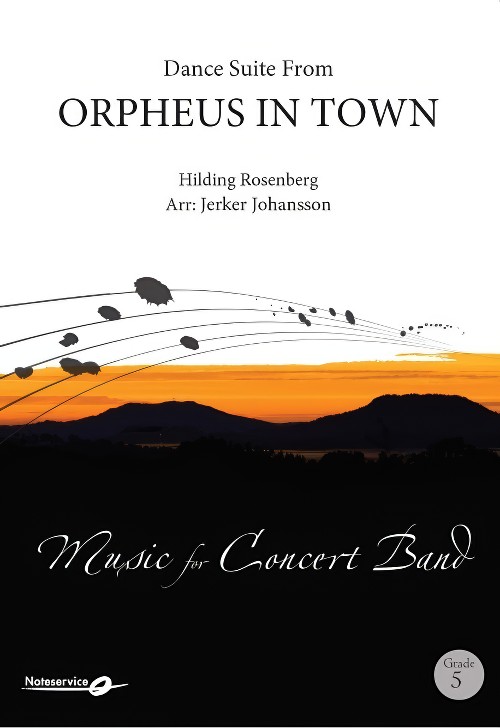
Orpheus in Town, Dance Suite from (Concert Band - Score and Parts) - Rosenberg, Hilding - Johansson, Jerker
Dance Suite in Seven Movements. Op.75. Orpheus In Town. In 1936 the Stockholm Concert Hall was given its most distinguished artistic adornment, Carl Milles' Orpheus fountain. A Greek god lets his voice and the sounds of his lyre float over the rush and bustle of the big city far up in Ultima Thule. Two choreographers at the Stockholm Opera, Julian Algo and Vera Sager, had a brainwave. Why should Orpheus merely be a statue, a symbol of the beauty and inspiring power of music, why not give the myth about him its special Stockholm chapter as well? This is what happened: On the stage we see the columned facade of the Concert Hall and in front of it the statue group with Orpheus and the eight enraptured listeners. Suddenly the figures come to life, jump down from their pedestal and dance into the crowd at the marketplace. Orpheus, who is consumed by longing for Eurydice, begins looking for his beloved, first among other well-known sculptures in town, then in restaurants and nightclubs. At last he thinks he recognises her in a fashionable society woman and brings her to the Concert Hall. However, faced with the threat of having to spend her life in bronze at Orpheus' side, she runs away. She wasn't Eurydice after all. Or was she? For this ballet, which had its first performance at the Stockholm Opera in 1938, Hilding Rosenberg wrote vital and entertaining music in a style which is unusually to the point, and with a bright and strong orchestration. The music in the Dance Suite from Orpheus in Town is taken from the dance scenes at the nightclub: guests and a bartender perform, finally also Orpheus and his entourage. The suite consists of: 1. Rhythm of the Times (2.00); 2. Bartender's Dance (1.30); 3. Girl's Dance (1.00); 4. Dance of the Negress (2.30); 5. Trio Dance (1.30); 6. Tango (2.00); 7. Finale (1.30). Total duration: 14.00.
Estimated dispatch 7-14 working days
-
£75.24
Curtain Call
"Curtain Call" was originally composed for the Dallas Brass as part of a collection of works entitled Brass Grooves. Though originally written for 5 brass players and percussionist, it really comes to life in this sparkling concert band setting! Every section in the band is featured and it is also an excellent choice for community bands. Conceived as a tribute to all the great finales, encores and reprises written for the stage, "Curtain Call" is a flashy, energetic flag-waver that is sure to be the perfect ending for your concert!
Estimated dispatch 7-14 working days
-
£179.99
Outback (Concert Band - Score and Parts)
This work was commissioned by the "?sterreichische Blasmusikjugend" (Austrian Brass Band Association - Young Musicians).The Aboriginal indigenous people of Australia are among the oldest surviving human cultures. The arrival of the Europeans marked their decline and endangered their existence. The many secrets the Aborigines hold served as inspiration for this work. Aboriginal SpiritOver many centuries, the Aboriginal people have cultivated a unique ability to live in harmony with the world around them. Maintaining the deli?cate balance between their trinity - nature, man, and creation - is an important factor for bliss and happiness.Primeval Sound and Dreamtime The tens of thousands-year-old stories from the era called Dreamtime - the Aborigines' creation myth - play an important role in not only their be?liefs, but their everyday lives and laws as well. Ancestral worship and various other rituals and ceremonies are still held in high regard to this very day.Running HunterThe Aborigines are extremely skilful hunters and are able to run for extended periods of time when chasing their prey. Hunting weapons, such as the boomerang, exemplify their abilities.Uluru (Red Rock)Uluru, also known as Ayers Rock, is a natural sandstone "inselberg" rising 348m above Australia's plains, and is one of the country's most recognisable icons. Uluru is also a sacred place for the local Aborigines. Its history stretches back to Dreamtime, although it did not exist in its current state at that time.Encounter with the White MenUnfortunately, the "White Men" did not realize the significance and importance of the Aborigines and their culture until the end of the 20th century. Before then, they were unaware that the Aborigines were quite possibly one of the oldest known cultures on earth, with a seamless history stretching back to creation itself; Dreamtime. BushfireFire has been present on the Australian continent for millions of years. Many of the indigenous flora and fauna have needed to adapt to fire, and evolution has led to unique solutions for survival. Over time, a complex symbiotic relationship has grown between life and the continually returning bushfire. 11:55
Estimated dispatch 7-14 working days
 View Music