
Results
-
 £211.80
Karneval i Paris - Johan S. Svendsen
Johan Svendsen (1840-1911) composed "Carnival in Paris" in 1872, inspired by the energy and vibrancy of the Parisian carnival celebrations. The piece showcases a variety of moods and orchestral colours, ranging from jubilant and playful sections to more lyrical and elegant passages. It is a lively and colourful work that reflects Svendsen's skill in orchestration and his ability to capture vivid, festive atmospheres in music. In "Carnival in Paris", his Nordic musical roots meet the cosmopolitan influences he encountered while living and working in major European cities. The work has become one of Svendsen's most popular and is frequently performed in concert halls and festivals. About My Transcriptions for Wind Bands Ever since I started playing the clarinet at 8 or 9 years old in the school band "Blveisene" in my hometown of Gjvik, playing transcriptions of orchestral music has been a natural part of the repertoire. In regional bands, Norway's National Youth Band, and during my 10 years in a Military band, I played many such transcriptions. These transcriptions often included handwritten parts, masterfully crafted by colleagues in a time when music notation software didn't exist. Similarly, the scores were often incomplete, typically featuring just a solo clarinet part and condensed score in Bb. The transcriptions also contained parts for instruments like the Eb cornet and multiple tenor horns, but no saxophones, which made them less suitable for modern wind bands. The rise of many skilled Concert Bands and the increasing demands for scores and accessibility made me realize that someone needed to preserve this tradition. The reason I've transcribed these works is to ensure that you can play or conduct a repertoire that I believe has a rightful place in Norwegian Wind Band tradition. These transcriptions are my contribution to preserving some of the unique works in Norwegian music literature. Creating a transcription is a complex task, and I believe the score of "Carnival in Paris" is one of the most intricate I've undertaken. The first part of the process involves entering the entire orchestral score into music notation software. This is time-consuming and requires meticulous work. The next step is to check several editions to see if there are any discrepancies. Mistakes are often found in orchestral material, which can lead to further errors in the transcription. After that, I listen to many different recordings while following along with the score, paying attention to how different conductors emphasize balance and timbre. Gradually, I begin to note down passages I believe will work well for wind bands. One particular challenge in this piece is that the woodwinds and strings operate in the same register. In the original, the tonal difference between the strings and winds helps to clarify the individual musical lines. In the transcription, I've tried to address this by separating the lines, for example through octave adjustments, and highlighting them without compromising other aspects. I've also used some mallet percussion to broaden the tonal palette. There are countless decisions to be made to create a product that will hopefully allow future generations of wind band musicians to play this repertoire. - Stig Nordhagen -
Estimated dispatch 7-14 working days
-
 £435.40
Goldberg 2012 - Svein H. Giske
The first time I heard Bach's Goldberg Variations was in the movie Silence of the lambs, in the early 1990s. I noticed the beautiful background music in one of the scenes, but at that time I didn't know what it was. A few years later, when I was studiying at the Grieg Academy, I got to know the entire piece. For me, this is a piece of music which I can listen to countless times. I think it sounds as fresh today as it did more than 15 years ago and it never ceases to inspire me. Both Bach's composition and Glenn Gould's famous 1955 recording (which was the first one I heard) still makes a great impression on me. Before Gould recorded it at age 22, it wasn't a highly ranked piece amongst pianists and Bach was by many viewed as a bit old-fashioned. The young Canadian turned all this around. He managed to portray Bach in a reformed way, producing fine nuances in phrasing and making the many layers in Bach's music more transparent than anyone before him. Thus he plunged both himself and Bach (back) onto the international music scene. When The Norwegian Band Federation (NMF) asked me to write the test piece for NM in 2012, it was only natural for me to use the Goldberg Variations as a starting point and inspiration for my work. Since I was a teenager at NMF's summer courses in the mid eighties I've always listened to many different styles of music. Growing up in Sunnmre with the Brazz Brothers as teachers and mentors, jazz-, pop/rock- and folk music were early on a natural part of my musical background. I also have my classical education from the Grieg Academy on trumpet. As the title of my piece implies, I've wanted to bring Bach to the present and put his music into various modern musical landscapes. I think you can bring about a special kind of energy when music from different genres are mixed and I've tried to do this by mixing Bach with artists and musical styles from the present. In Goldberg 2012, the music is often constructed by several layers, which in a way are living parallel musical lives. They are seemingly moving or floating freely, almost unaware of each other, but bound together by the same basic pulse. The rythms, however, are often notated on a different rythmic subdivision level than the usual 8th- or 16th note levels. By doing this, I hope to achieve transparent sounds that rythmically are perceived as more free and detached from each other. In large sections of the piece, pop/jazz is fusioned with elements from Bach. I guess you could have this little scene as a synopsis for the piece: picture a group of musicians meeting: some are classical performers, some are jazz. They start to improvise together, each in their own voice or musical dialect and I'm sort of in the middle, trying to write down what they are playing. This is what I feel much of Goldberg 2012 is about. The foundation of the piece, in addition to Bach and references from pop/jazz music, lies also in my own material. This material, basically two chords, is heard in it's purest form in the 1st movement. I use these chords to create scales, new chords and different motifs which contribute to blend together the different moods of the piece. It has not been my intention to copy Bach's form (theme and 30 variations), but rather to use the bits and pieces that I like the most as an inspiration for my own variations. The 1st movement, Aria 2, is for my 3rd son, Olav, who was born on the 21st of April 2011, and the 5th movement, From long ago, is dedicated to the memory of my father, Svein J. Giske, who passed away on the 6th of June 2011. -Svein H. Giske, January 2012-
Estimated dispatch 7-14 working days
-
 £183.20
Fest - Polonaise - Johan Svendsen
Johan Svendsen (1840 - 1911) was the first great Norwegian symphonic composer, as well as one of the leading conductors of his time. Next to Edv. Grieg, he was the most prominent figure in Norwegian music life at the end of the 1800's. Although he came from humble beginnings in Chistiania (now Oslo), he was to become a cosmopolitan who felt at home all over Europa. Svendsen spent most of his adult life abroad, living in Copenhagen for 25 years as maestro for the Royal Theatre Orchestra. Nonetheless he retained contact with Norway troughout these years and was a frequent and popular guest in his native country. He wrote his Festival Polonaise for a ball in 1873. This polonaise ina big ABA style
Estimated dispatch 7-14 working days
-
 £244.00
Anemoia - Gauthier Dupertuis
Gauthier Dupertuis wrote Anemoia as part of his master's thesis at the Lausanne University of Music. It is dedicated to the most significant figure in his musical life: his teacher Jean-Claude Kolly.Anemoia is the name given to the feeling of nostalgia that one feels for a time that has never known. This emotion often translates into the uneasy sensation of having lost something important or of not living at the right place or time. Fascinated by this concept, Gauthier Dupertuis tried to translate it into music oscillating between exaltation, anguish and nostalgia.The piece is formed by two movements: (Un)desired sorrow and Behind the glass of time. The first movement initially evokes the feeling of unease one feels when suddenly struck by anemoia. It then evolves into majestic atmospheres, marking our admiration for times gone by. The second movement treats anemoia in a more melancholic way.The premiere took place on 6th December 2024, during Jean-Claude Kolly's last concert as a conductor of the Concordia de Fribourg, marking thirty years spent conducting this wind orchestra.
Estimated dispatch 7-14 working days
-
 £137.70
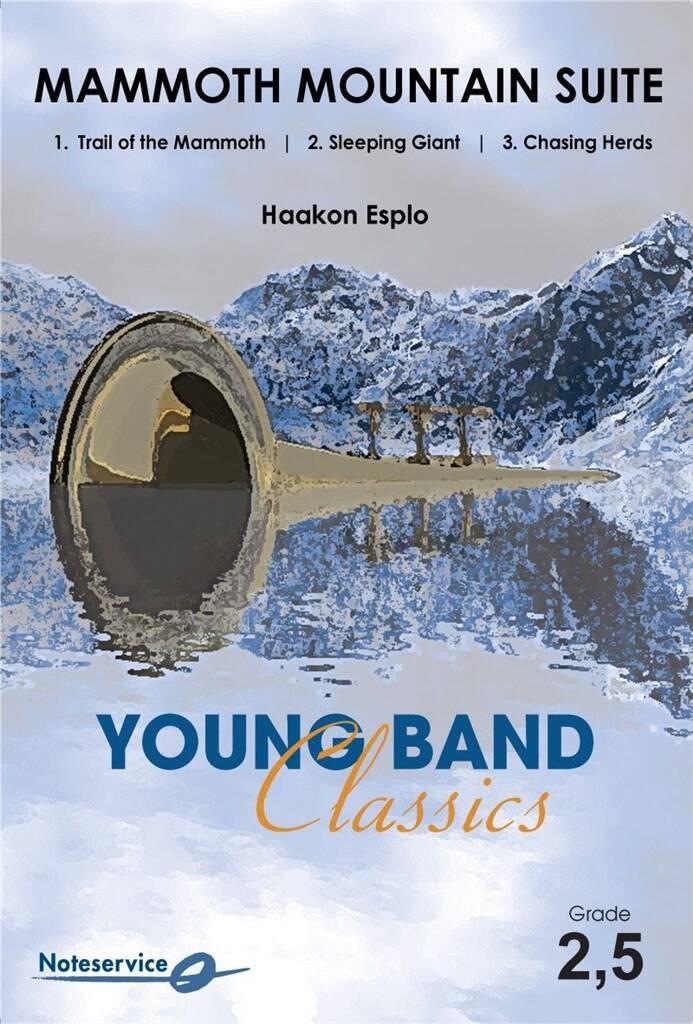
Mammoth Mountain Suite - Haakon Esplo
Mammoths were a family of elephants that, with one exception, died out at the end of the last ice age. Their closest living relative is the Asian elephant. In many places in the world one can find mammoth remains. In Norway (especially in Gudbrandsdalen), 20 discoveries of teeth and skeletal remains have been made after mammoths that lived here between 40,000 and 50,000 years ago. On cave paintings and carvings you can see many pictures of mammoths with other animals. Pictures of killed mammoths have also been found with humans. Mammoth Moutain Suite describes a bunch of hunters looking for mammoths. Imagine the majestic animals, what it felt like to see the herd in themountains and what it sounded like when the 6 ton heavy and 3.5 meter tall mammoths were on the run.
Estimated dispatch 7-14 working days
-
£87.00
Chant of the Phoenix - Fisher Tull
Chant of the Phoenix is based on the legend of the sacred bird in Egyptian religion. After living for 500 years, the Phoenix would build a nest of herbs, fan the nest with its wings to set it afire, and burn itself to death. Fromthe ashes would emerge a new bird which, after maturing and testing its strength in flight, would soar off to the sun. (9:00)
Estimated dispatch 7-14 working days
-
 £118.99
Jacques Brel Toujours! - Jacques Brel
The French-speaking Flemish singer, composer and lyricist Jacques Brel was born in Brussels in 1929. In the 1950s, he broke away from his bourgeois social background of his family and started an artist's life in Paris, where he initially wrote chansons and earned a living by performing in small cabarets and bars. Over the following years he achieved worldwide fame with his chansons, which were alternately harsh and melancholic Roland Kernen has selected a number of the wonderful chansons written by this most creative artist to produce this unforgettable chanson medley.
Estimated dispatch 7-14 working days
-
 £94.99
Czardas (Xylophone solo) - Monti
Vittorio Monti was born on January 6, 1868 in Naples (Italy). His musical education (violin and composition), he enjoyed at the conservatory there. Around his 30's Monti went to Paris. He earned a living as a conductor and wrote several ballets and operettas. In his last years, Monti died in 1922, he devoted himself to teaching and composing. His famous "Czardas" has made his name known even today. Initially the czardas was a Hungarian folk dance , but after the mid-nineteenth century it was even a dance for the upper-class. Czardas begins with a slow introduction, the Lassan (slow and sad), and then the fast part, Friska, follows. Czardas is not, as somany people think typical gypsy music.
Estimated dispatch 7-14 working days
-
 £94.99
Czardas (Clarinet solo) - Monti
Vittorio Monti was born on January 6, 1868 in Naples (Italy). His musical education (violin and composition), he enjoyed at the conservatory there. Around his 30's Monti went to Paris. He earned a living as a conductor and wrote several ballets and operettas. In his last years, Monti died in 1922, he devoted himself to teaching and composing. His famous "Czardas" has made his name known even today. Initially the czardas was a Hungarian folk dance , but after the mid-nineteenth century it was even a dance for the upper-class. Czardas begins with a slow introduction, the Lassan (slow and sad), and then the fast part, Friska, follows. Czardas is not, as somany people think typical gypsy music.
Estimated dispatch 7-14 working days
-
£115.00
The King of Siam (CB) - Pimpanit Karoonyavanich
Many foreigners who travel to Thailand for the first time always wonder why Thai people love their king so much, even more than their own life. However, that question is quickly answered after they realize how much our king sacrifies his life to develop Thai people's way of living especially the poor ones. He proves that the "love" from his people doesn't come from his birth as the royal family, but from his hard-working. As a Thai composer, Pimpanit wrote this piece out of her love and gratefulness she has to her beloved king of Thailand, His Majesty King Bhumibol Adulyadej, in the occasion of his 88 years old birthday. At this moment he already marks 70 years on the throne and he is also the world's longest-reigning living monarch, ascended to the throne. "Siam" was the name of Thailand before 1948.
Estimated dispatch 7-14 working days
 View Music