
Results
-
 £309.99
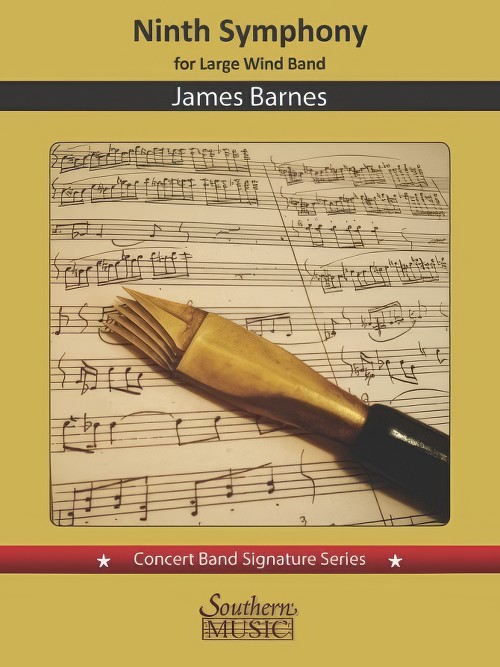
Ninth Symphony (Concert Band - Score and Parts) - Barnes, James
Premiered on 21 September, 2018 in Lawrence, Kansas by The University of Kansas Wind Ensemble (Dr. Paul Popiel, conducting), James Barnes' Ninth Symphony was composed between January and late June of that same year. This large work was commissioned by a consortium of twenty-one college bands, community bands, professional bands and individuals to help mark the 70th birthday of the composer (b. 1949). It is an expansive forty-minute work in four movements, of which the composer writes, "This is my last symphony...this work represents a compendium of all that I have learned during the fifty years of composing and scoring for this wonderful new medium: the modern wind band." The first movement, subtitled Elegy, is based around G minor. It is the longest movement of the symphony. Tragic and despondent in character, it is cast in sonata-allegro form. The second movement is entitled Scherzo. Barnes claims that "I have always wanted to write a waltz," and that is how this movement is cast, in a modified rondo form in D minor. In contrast to the mood of the first movement, the scherzo is a delightful posy of expansive melody, splashy color, humor and rhythm. The third movement, which is in a modified tertiary form, is entitled Night Music. In contrast to the scherzo, this movement begins with a mysterious incantation, first displayed by solo Alto Flute. The music becomes even darker and more mysterious, while overall the movement effectively expresses an "otherworldly" mood, ending with a solo soprano offstage which suddenly emerges, eerily singing a modified version of the opening incantation. Cast in sonata-allegro form, the fourth movement is most definitely a rousing Finale, beginning with a brilliant fanfare and undergoing several mood transformations before emerging into the final coda, ending the symphony with an energetic splash of color. Duration: 40.00
Estimated dispatch 7-14 working days
-
 £89.99
Slavonic Dances (Concert Band - Score and Parts) - Dvorak, Antonin - Curnow, James
This monumental suite is one of the most impressive transcriptions ever published. Every note comes from the original Dvorak work, including the transitions from one dance to the next. Written for Dr. Harry Begian's last tour with the University of Illinois Symphonic Band, this powerful concert work lets every section of the band shine ... a must for mature groups.
Estimated dispatch 7-14 working days
-
 £57.50
The Stars and Stripes Forever (Concert Band - Score and Parts) - Sousa, John Philip - Curnow, James
Here, at last, is a very playable verion of John Philip Sousa's best-known march which has been declared the National March by Congress. It's a great addition to any young band's library.
Estimated dispatch 7-14 working days
-
 £84.99
Morgens um Sieben (ist die Welt noch in Ordnung) (Concert Band - Score and Parts)
German band leader, composer, arranger and music producer James Last has created many hits during his long career. Particularly memorable are the theme tunes and soundtracks that he composed for television programs and films. Gilbert Tinner has arranged Last's award-winning melody from the 1968 TV-film Morgens um sieben (ist die Welt noch in Ordnung) for concert band. 03:40
Estimated dispatch 7-14 working days
-
£64.35
The Home Town Boy - Swearingen, James
In 1962, Karl King composed his last great march and dedicated it to his long time friend Meredith Willson of "The Music Man" fame. All the wonderful components of a classic march are evident throughout this toe tapping selection. His long list of popular marches continues to be performed around the world and, hopefully, this new and exciting edition will find its way into the music folders of your students. A real crowd pleaser!
Estimated dispatch 7-14 working days
-
£86.00
-
£25.00
DER EINSAME HIRTE (Partitur/Score) - Last James - Tuor Corsin
Estimated dispatch 7-14 working days
-
 £110.00
I Was Glad When They Said Unto Me (Choir with Concert Band - Score and Parts) - Parry, Hubert C. - Noble, Paul
I Was Glad is an introit commonly used in the Anglican Church, and also used as an anthem traditionally sung at the coronation of the British monarch. Its most famous setting was written in 1902 by Sir Hubert Parry. Parry's version was composed for the coronation of King Edward VII in 1902, and revised in 1911 for that of King George V, when the familiar introduction was added. This setting employs antiphonal choir effects and brass fanfares. Apart from the imperial splendour of the music, the chief innovation is the incorporation in the central section of the acclamations Vivat Rex... or Vivat Regina... (Long live King/Queen...) with which the King's or Queen's Scholars of Westminster School have traditionally greeted the entrance of the monarch since the coronation of King James II in 1685. This section is generally omitted when the anthem is performed on other occasions. At the last coronation, that of Elizabeth II in 1953, the acclamation took the form of Vivat Regina Elizabetha. Parry's setting of I Was Glad was performed on 29 April 2011 at the Westminster Abbey wedding of Prince William, Duke of Cambridge and Catherine, Duchess of Cambridge (formerly Kate Middleton) as the processional music for the bride and her father and the bridal attendants. It had previously been performed at the wedding of the Duke's parents, Charles, Prince of Wales and Diana, Princess of Wales in 1981.
Estimated dispatch 7-14 working days
-
 £125.00
EINSAMER HIRTE Lonely Shepherd (Flexible Solo with Intermediate Concert Band) - Last, James
Solo parts included: Pan Flute; Flute; Clarinet; Trumpet. Duration: 3:40
Estimated dispatch 7-14 working days
-
 £100.00
GAMES THAT LOVERS PLAY (Easy Concert Band) - Last, James - Parson, Ted
Duration: 3:00
Estimated dispatch 7-14 working days
 View Music