
Results
-
 £132.95
Music for Arosa (Concert Band - Score and Parts) - Sparke, Philip
This work was commissioned in 1996 by the Arosa Cultural committee and first performed in Arosa in that year. The majestic introduction opens with trombones and euphonium, heralding a legato theme, chorale-like in character. A pair of flutes introduce a new theme. A trumpet introduces a series of highly syncopated solos, which feature many metre changes, and the tempo increases when playful motifs are exchanged between various sections of the band. A solo clarinet introduces an expressive tune. A brass chorale follows, with interruptions from the flute and bassoon, until the clarinet tune is played by the whole band. This reaches a climax and the mood subsides to reach a quiet horn chord. The broad legato tune returns and the excitement increases until the march theme triumphantly returns to full band. This leads to the coda which is based on the opening fanfare and closes the work emphatically. (Grade 5) Performance time 11'01" (Recorded on QPRM138D BREAKING THE CENTURY, Central Band of the Royal Air Force)
Estimated dispatch 7-14 working days
-
£37.95
Music for Arosa (Concert Band - Score only) - Sparke, Philip
This work was commissioned in 1996 by the Arosa Cultural committee and first performed in Arosa in that year. The majestic introduction opens with trombones and euphonium, heralding a legato theme, chorale-like in character. A pair of flutes introduce a new theme. A trumpet introduces a series of highly syncopated solos, which feature many metre changes, and the tempo increases when playful motifs are exchanged between various sections of the band. A solo clarinet introduces an expressive tune. A brass chorale follows, with interruptions from the flute and bassoon, until the clarinet tune is played by the whole band. This reaches a climax and the mood subsides to reach a quiet horn chord. The broad legato tune returns and the excitement increases until the march theme triumphantly returns to full band. This leads to the coda which is based on the opening fanfare and closes the work emphatically. (Grade 5) Performance time 11'01" (Recorded on QPRM138D BREAKING THE CENTURY, Central Band of the Royal Air Force)
Estimated dispatch 7-14 working days
-
 £169.99
Olympica (Concert Band - Score and Parts) - Van der Roost, Jan
This "Grand Overture" was commissioned by the "Nagano Community Band" - Japan- on occasion of its jubilee in 1992 and is dedicated to the band's conductor, Ikuo Inagaki. The work is based upon three main themes, each symbolising a certain theme. The first part is characterized by its bright themes played mainly by the brass, accompanied by the woodwinds and festive percussion. This part symbolizes the jubilee which is the origin of the composition. This is followed by a bouncing allegro, in which each register of the band displays brilliant techniques. Especially the woodwinds come to the fore! This movement depicts the industriousness and enthusiasm shown by the members of the "Nagano Community Band" in the carrying out of their hobby. A third, main theme, is choral-like in character and is displayed both in the (soft) brass as well as in the warm medium register of the reeds. Here, nature's beauty in and around the city of Nagano is musically celebrated. Following a "chamber-music episode" (featuring the flute, oboe, clarinet, alto-saxophone and horn) the initial allegro re-occurs, weaving its way towards a grandiose finale, in which the two previous themes are once again apparent. Due to its very colourful scoring and the enormous diversity of musical thoughts and ideas, this composition is a fascinating and memorable piece, worthy a jubilee overture!Duration: 10:15
Estimated dispatch 7-14 working days
-
 £209.99
Dunamis (Concert Band - Score and Parts) - Waignein, Andre
Major Yvon Ducene wanted a new lush and colourful composition for his Guides military band, with Andr Waignein as its composer. Early in 1979 the composer began his assignment and in October of the same year, the finished full score was on the music stands of this prestigious military band of the Belgian Army.The introduction (Grave) mirrors an atmosphere full of serenity in which the theme, played by the oboes and the English horn is predominant and immediately holds the listener spell-bound. It is taken up again as central element of the slow movement.The Allegro breaks away from the quiet passion of the introduction. Here, the band can really show its capabilities to the full. Based on a very precise rhythm, an idiom of sudden desperation and adversity develops which, fused with a crushing aggression, culminates in a kind of eruption, soon calmed down by a Lento : peace and quiet has returned thanks to a melody by the horns and soon taken over by the clarinets. In the meantime, the saxophone - an instrument full of human emotion - express the main spatial dimension in contemporary psyche. Following a harmonic transition the brass-players take up the theme again in forte whilst the basses and the woodwinds intertwine in technical arabesques.The movings of the mind and the heart get an audible and almost touchable shape in the ensuing Allegro, a movement characterised by a rhythmic dialogue in which the whole orchestra participates and where the exposition contains a wealth of sound and technical contrasts. The Lento finally uses the central theme of the slow movement again, with some occasional references to the two allegros. The last page is of unprecedented grandeur. All the instruments display their most beautiful sound which were named by Jacques Ferschotte, when speaking about Honneger, "harmonies d'intensits" harmonies of the unmeasurable.Duration: 14:30
Estimated dispatch 7-14 working days
-
 £115.00
DIVERTIMENTO FOR BAND (Concert Band) - Woolfenden, Guy
Includes:I. ToccataII. AubadeIII. ScherzoMany of the principal musical ideas for Divertimento for Band are derived from music composed for a documentary film called Country Camera, which celebrated the work of the earliest photographers who recorded a way of life which vanished at the outset of the first World War.The three movements are played without a break. The Toccata pits a four-note motif (which always appears with its mirror image) against several other derived ideas, including a sour horn (later trumpet) figure, a tiny lyrical passage initiated by a solo alto saxophone, and a more gentle, but still staccato episode. Many polytonal devices keep the four-note motif active. The Aubade contrasts a lyrical pastorale, initiated by a solo flute, with a more intense central section on the brass. The Scherzo finale has three main ideas; a tune for principal bassoon and euphonium of a playful child-like nature, a rushing figure for the woodwinds later developed by the full band, and a solo for trumpet and clarinet, involving a descending scale and a lyrical wide-leaping recovery. The exuberant coda is derived from themes from the previous two movements.The world premiere of Divertimento for Band was given at the conference of the World Association for Symphonic Bands and Ensembles in Killarney on 13th July 2007 conducted by the composer, and is affectionately dedicated to Keith Allen, Jayne Rollason and Birmingham Symphonic Winds. -GW
Estimated dispatch 7-14 working days
-
£124.95
SWORD AND THE CROWN, The (Prestige Concert Band - Score and Parts) - Gregson, Edward
In 1988 I was commissioned by the Royal Shakespeare Company to write the music for The Plantagenets trilogy, directed by Adrian Noble in Stratford-upon-Avon. These plays take us from the death of Henry V to the death of Richard III. Later, in 1991, I wrote the music for Henry IV parts 1 and 2, again in Stratford. All of these plays are concerned with the struggle for power (the crown) through the use of force (the sword) and they portray one of the most turbulent periods in the history of the British monarchy.This work quickly became established in the mainstream repertoire and has received performances worldwide as well as five commercial recordings and many broadcasts. In 2002 I was approached by the Parc and Dare Band regarding their summer festival and commissioned to do a version for brass band. This was given its first performance in Treorchy Hall by the combined bands of Black Dyke and Parc and Dare conducted by Nicholas Childs.When the Royal Air Force Music Services commissioned me to write a work especially for their British tour in 1991 I immediately thought of turning to this music and transforming some of it into a three-movement suite for symphonic band.The first movement opens with a brief fanfare for two antiphonal trumpets (off-stage), but this only acts as a preface to a Requiem aeternam (the death of Henry V) before changing mood to the English army on the march to France; this subsides into a French victory march, but the English army music returns in counterpoint. Finally, a brief reminder of the Requiem music leads to the triumphal music for Richard Plantagenet, Duke of York, father of Edward IV and Richard III (the opening fanfare transformed).The second movement takes music from the Welsh Court in Henry IV (part 1) which is tranquil in mood; distant fanfares foreboding battles to come are heard, but the folktune is heard three times in different variations and the movement ends as it began with alto flute and gentle percussion.The final movement starts with two sets of antiphonally placed timpani, drums and tam-tam, portraying the 'war machine' and savagery of battle. Trumpet fanfares and horn calls herald an heroic battle theme which, by the end of the movement, transforms itself into a triumphant hymn for Henry IV's defeat of the rebellious forces.- Edward GregsonPerformance time 13'54"Recorded on QPRM117D FESTIVAL OF MUSIC 1991, Massed Bands of the Royal Air ForceRecorded on QPRM120D THE SWORD AND THE CROWN, Central Band of the Royal Air Force'Finale' recorded on QPRM142D FESTIVAL OF MUSIC 2002, Massed Bands of the Royal Air Force)
Estimated dispatch 7-14 working days
-
 £44.55
The Gladiator (Concert Band - Score and Parts)
An outstanding new composition for the solo instrument of your choice with band accompaniment. The Band Set includes solo parts for F Horn, Alto Saxophone, Tenor Saxophone, Bb Clarinet, Oboe and a piano reduction of the score so that the soloist can rehearse without the band being present. Besides being a great way to show off your young players, it's also a charming program number. Tremendous appeal!
Estimated dispatch 7-14 working days
-
 £122.20
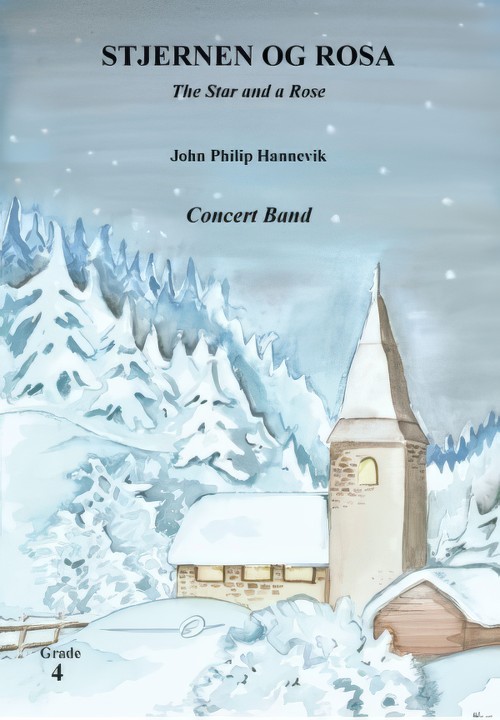
Stjernen og Rosa (The Star and a Rose) (Concert Band - Score and Parts) - Hannevik, John Philip
The Star and a Rose is a big-scale Christmas piece for band, featuring four seasonal chorales.The first is a Gregorian-like chant Hodie Christus natus est.In this section of the piece, a soloist can be placed away from the band, maybe on a gallery. The soloist can be a tenor instrument, maybe trombone, or you can feature a vocal soloist. After this, the music leads us on to the old German Christmas chorale Lo, how a rose e'er blooming. This song is given a fairly rhythmical treatment, but make sure that the melody is presented in a cantabile style. An interlude follows, before the piece presents one of the most used and loved Scandinavian Christmas chorales, Mitt hjerte alltid vanker (My Heart will always wander), composed by the Danish bishop Hans Adolph Brorson around 1732. This song is building towards a climax, before the solo horn brings it all down to the Stable view described in the lyrics. Then comes a transition that brings us in to the final section of the piece, which presents the international Christmas Carol Adeste Fideles. As many will notice, I have borrowed a section from David Wilcocks majestic harmonization towards the end.The title of the piece has its background form the lyrics in My heart will always wander, where the text speaks about the stars in the sky. But also in the Latin text for Adeste Fideles: Stella duce, Magi, Christum adorantes. The Rose is of course from the lyrics in the chorale Lo, how a Rose.Duration: 10.30
Estimated dispatch 7-14 working days
-
 £118.99
North Hills Fantasy (Concert Band - Score and Parts) - Sparke, Philip
North Hills Fantasy was commissioned by the North Hills High School Bands, Pittsburgh, Pennsylvania (director: Len Lavelle) as part of a commissioning programme that has run since 1965 - the longest of its kind in the USA. The work opens with a reflective, unaccompanied solo for alto saxophone which develops into a chorale for horns and saxes. This is taken up by the trumpets and subsides to a change of key and mood, with highly decorated folk-like solos for clarinet, bassoon and saxes. These solos build to a climax for full band, which heralds a triumphant return of the horn chorale, accompanied by florid woodwind figuration. But the mood soon winds down; fragments of earlier melodies return calmly to peacefully close the work. Duration: 5.30
Estimated dispatch 7-14 working days
-
 £106.00
Det hev ei rose sprunge (Lo, How a Rose e'er Blooming) (Flugel Horn Solo with Concert Band - Score and Parts) - Praetorius, Michael - Gudim, Lars Erik
The melody for this German Christmas carol is believed to be written around the year 1400. Michael Praetorius wrote the 4-part choral setting around 1609. This setting has been widely used since them. This arrangement feature a flugelhorn soloist and will be a perfect choice both for the church concert and entertainment. Duration: 4.30
Estimated dispatch 7-14 working days
 View Music