
Results
-
 £76.80
Dance of the Clowns - Pyotr Ilyich Tchaikovsky
After the overwhelming success of his 'Second Symphony' Pjotr Tschaikowsky (Votkinsk 1840 - Saint-Petersburg 1893) got a request of the Imperial Theatre in Moscow early in 1873 to compose the stage music to the play 'Snegourotchka' (translated as 'The Snow Maiden', 'Snow White' or 'Snowflakes') which was to be written by Alexander Ostrovski, the greatest Russian playwright of that period. The wage of 350 rubles was particularly welcome to the young composer who completed the work in only three weeks time (between the middle of March and the 6th of April) before Ostrovsky finished his libretto. The first performance was given at the Moscow Bolshoi Theatre on 23rd May, 1873 was very successful and since then the work remained on the Russian orchestral repertoire as a concert suite. The suite consists of 19 parts that incorporate twelve authentic Russian folksongs. The 'Dance of the Jesters' (sometimes called 'Dance of the Buffoons') is number 13 and appears in Act 3 as part of the carnival music; it suggests the joyful atmosphere of popular festivals.
Estimated dispatch 7-14 working days
-
 £130.10
Boudewijn Harmonie (Drijvers) - Boudewijn de Groot
With this medley 'Boudewijn' arranger Gerhart Drijvers pays a tribute to one of the greatest composers of original Dutch songs. Indeed, in collaboration with Lennaert Nijgh, Boudewijn de Groot wrote numerous fine songs for other artists as well as for himself. In this medley you can hear successively the songs 'Strand' (Beach), 'Beneden alle peil' (No level at all), 'Mijnheer de President' (Mister President), 'Tante Julia' (Aunt Julia) and, of course, 'Avond' (Evening). Thanks to these great successes 'Boudewijn' will not only be an extremely popular concert piece for all Dutch speaking audiences, but any audience.
Estimated dispatch 7-14 working days
-
 £59.80
Alte Kameraden - Carl Teike
It is the greatest tragedy in the life of a young composer if he happens to write his most successful piece at the beginning of his musical career. This holds true for Carl Teike, as the unsurpassed success at the beginning of his musical life was his march "Old Comrades". It is a sparkling piece that may well be labeled to be the German "march of marches". Carl Teike was born on Feb. 05, 1864 in Altdamm. After his parents had moved to Stettin, he had early contacts with military music as a youngster. The enthusiasm for this kind of music never left him throughout his life. He began a musical apprenticeship with City Music Director Bttcher in Wollin and already played in the spa orchestra of Bad Misdroy, which Bttcher conducted. Upon completing his apprenticeship, he enlisted as a volunteer in the band of the (5th Wrttemberg) King Karl Grenadiers No. 123 in Ulm. The musical and military environment there proved to be ideal for the ambitious young musician, who hoped to eventually study band music at the University of Music in Berlin. Above all, his military superior, bandmaster Julius Schreck supported young Teike wherever he could. Unfortunately the time in Ulm took a very unhappy turn, as Schreck's successor was extremely resentful towards Teike, and musical support was replaced by sheer harassment. On account of this, Teike retired from the military towards the end of 1889. Short employments in Ravensburg and Ulm evidently did not suit Teike, who was of northern German descent. This is why he applied for the Royal Police Force in Potsdam. Teike was accepted and entered service in 1895. The royal capital of the Hohenzollerns obviously stirred Teike to write a number of brilliant marches. He even became known abroad as the "musical policeman". Unfortunately he contracted a severe pneumonia while on duty, which eventually forced him to retire from the Royal Police Force in Potsdam. On February 01, 1909 he and his family moved to the prosperous provincial city of Landsberg on the Warthe (which is located east of Berlin in present-day Poland). There, Count Clairon d'Haussonville proved to be an understanding superior who paved the way for modest Carl Teike to continue composing, as his creativity had not suffered from this move. The disease which he had caught in Potsdam evidently was more severe than he was inclined to accept. In spring 1922, his state of health became worse, and in May of that year he passed away. Much too early - as many people felt. Teike's marches constitute an enrichment of the German concert march, as he never composed any street marches. Clear structures, musical ingenuity and a multitude of tone colors distinguish his works and shape them into something really new. It is this type of the march in particular that became the bedrock of the universal appeal of the German march. Even today Teike's marches stand unrivaled for musical quality and content - and they never are aggressive. Toward the end of his tour of duty in Ulm, Teike handed a new march to his superior, which, at the time, did not have a title yet. He in turn told Teike to "put it in a stove and burn it". As we know today, this was a classic misappraisal, as Teike subsequently named his march "Old Comrades" in view of his impending retirement. We do not even need to discuss the acceptance the march has met and still meets all over the world, as "Old Comrades" simply always has been a march of universal appeal. In his new arrangement, Siegfried Rundel did not change the essence of Teike's music, he rather sensitively adapted it to modern musical practice and to the instrumentation of the symphonic band on the basis of his deep respect for the works of Carl Teike.
Estimated dispatch 7-14 working days
-
 £50.60
Gershwin Portrait - George Gershwin
George Gershwin is one of the greatest composers of the 20th century. His works include classical compositions, musicals and soundtracks which often employ elements of jazz. Many of his melodies have became jazz classics. In this enjoyable GERSWHINPORTRAIT Luigi di Ghisallo assembled three of Gershwin's most popular melodies: "Rhapsody in Blue", his best-known classical work, "Summertime", a famous song from the opera "Porgy and Bess" and "Nice Work If You Can Get It" from the soundtrack of "ADamsel in Distress".
Estimated dispatch 7-14 working days
-
 £115.60
Hard to Say I'm Sorry - Peter Cetera
"Hard to Say I'm Sorry" is one of the greatest hits by US rock band Chicago. It was the first single record from the "Chicago 16"-album (1982). The song went to no. 1 on the Billboard charts and stayed there for two weeks. Produced by David Foster, the song was given a typical early 80's sound with synthesizers and heavy guitars dominating the sound. The album-version of the song included a part two of the song, "Get Away", a up-tempo song featuring the famous horn-section of the band.
Estimated dispatch 7-14 working days
-
 £252.10
Rhapsodie Norvegienne Nr.2 - Johan Halvorsen
This arrangement was written for Dragefjellets Musikkorps Bergen for their performance at the Norwegian Wind Band Championships in 2019.The original orchestral work is one of our country's greatest national works for symphony orchestra.It combines Norwegian folk music with the symphonic tradition, but on a slightly different way than Edvard Grieg.Compared to the original score, I have made parts of the work more chamber-music like by making the instrumentation a bit thinner. By doing this, I hope the span in dynamics will benefit the tutti sections as well. Unlike the symphony orchestra, concert bands do not have the large string section to enrich the soundscape.- Svein H. Giske -
Estimated dispatch 7-14 working days
-
 £77.90
La matita di leonardo - Luciano Feliciani
2019 coincided with the 500-year anniversary of the death of Leonardo Da Vinci, one of the greatest men of genius in history, a universal genius who was a scientist, philosopher, architect, painter, musician, engineer, anatomist, botanist, designer, and planner. This composition entitled La Matita di Leonardo (Leonardo's Pencil), represents an ideal journey into the mind of the Tuscan genius: in the first part of the piece, percussion instruments underline the ticking of the passage of time that anticipates the birth of the idea, while short thematic cells in various instruments alternate, drawing the rhythmic melodic line. On this background, we hear the main theme entrusted to the dark tones of trombone and euphonium. The music proceeds with a growing pace and an adventurous character to represent the genesis of Leonardo's machines, which are in fact the result of the drawings of his pencil. In the second, more animated part, a new theme is introduced, varied, and elaborated, thus giving life to a vigorous movement meant to describe the drawings that come to life, leaving the pages of Leonardo's codes. In the coda the two themes overlap, transporting the listener towards a resolute and rhythmically energetic conclusion in an enthralling and engaging finale.
Estimated dispatch 7-14 working days
-
 £109.50
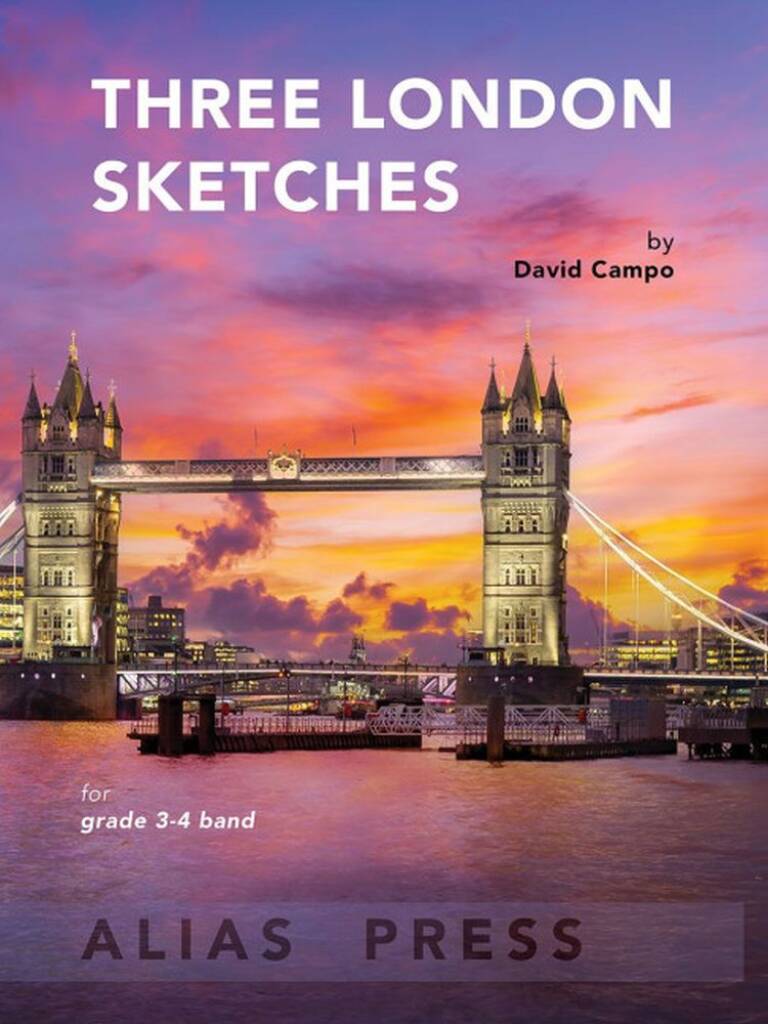
Three London Sketches - David Campo
London is one of my favorite cities in the world, and in 2016 I was invited there to serve as an adjudicator for the London New Year's Day Parade and Gala Concerts. While I was there, I was fortunate to meet and spend time with The Lord Mayor of Westminster Councillor Steve Summers. While his title sounds formidable and intimidating, I found Steve to one of the nicest, most easygoing people I've ever met. And boy, does he love London! He was fond of saying that he had "the best job in the greatest city in the world." He spoke passionately about London and his favorite places in the city, and his enthusiasm was contagious. Some of his favorite places became some of my favorite places, and the inspiration for this piece. I hope that this work not only conveys the beauty and history of these iconic places, but Steve's deep and abiding love for them as well. I. Tower Bridge - The Tower Bridge was built over 120 years ago to ease road traffic while maintaining river access to the busy Pool of London docks. Its giant moveable roadways lift up for passing ships, making it a true engineering marvel. It is also one of the most iconic sites in London, and was used to display the Olympic Rings during the 2012 Olympics. II. St. Paul's (The Whispering Gallery) - The history of St. Paul's Cathedral goes back well over a thousand years, but construction on the current St. Paul's began in 1669 after a fire destroyed the earlier structure. The dome of St. Paul's Cathedral is a whispering gallery; you can whisper against the wall on the inside of the dome and it can be clearly heard on the other side of the dome over 100 ft. away. Imagine the secrets that have passed there... III. Trafalgar Square - The name commemorates the 1805 naval Battle of Trafalgar and is marked by Nelson's Column, a monument to Admiral Horatio Nelson, the hero of the Battle of Trafalgar. It is the heart of London; full of life and constant energy and home to iconic buildings including the National Gallery, St. Martin-in-the-Fields, Canada House and South Africa House. Londoners say that all roads in London lead to Trafalgar Square.
Estimated dispatch 7-14 working days
-
 £71.50
Military March - Ludwig van Beethoven
Beethoven wrote this work for a military band, and its popularity continues today. This scoring provides a unique opportunity for young band students and their audiences to experience an original work by one of the worlds greatest composers.
Estimated dispatch 7-14 working days
-
 £121.00
Looking Upward Suite - John Philip Sousa
This new definitive edition of one of the "March Kings" greatest compositions is a welcome addition to the historic legacy of the modern concert band. Meticulously researched and studied, and based on the actual parts and materials used by the Sousa Band on their legendary tours, this is a tour de force that will be enjoyed by fine bands for many years.
Estimated dispatch 7-14 working days
 View Music