
Results
-
 £84.99
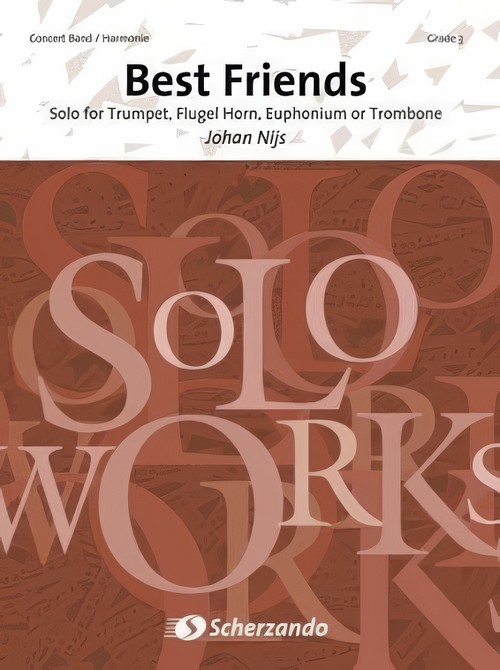
Best Friends (Flexible Solo with Concert Band - Score and Parts) - Nijs, Johan
Solo for Trumpet, Flugel Horn, Euphonium or TromboneFriends are of the utmost importance in any person's life. True friends can always count on one another, even if they don't meet up as often as they might wish. With Best Friends, the Belgian composer Johan Nijs portrays this theme in a wonderful ballad that can be played on the trumpet, euphonium or trombone. A great chance to put one of your players in the spotlight.Duration: 3:15
Estimated dispatch 7-14 working days
-
 £89.99
The Last Centaur - Rossano Galante
Composed in the style of a grand and descriptive film score, The Last Centaur is a musical depiction of a centaur who is separated from his family by war, the ensuing adventures, and ultimate reunion with hisfamily and friends. The music begins with a stately, lyrical theme in the horns followed by solo Oboe. This main theme is then woven throughout the work as it develops and grows with intensity. Sweeping woodwind lines and majesticBrass fanfares capture the excitement of the drama and ultimate joyous resolution. Powerful and evocative writing! Dur: 6:00 (Recorded by the West Genesee (NY) High School Wind Ensemble - Andrew Perry, conductor)
Estimated dispatch 7-14 working days
-
 £51.60
Sakura Variations - Kees Vlak
The blooming of the cherry trees each spring is a great event in Japan. In the evening friends meet under the pink and white cherry blossoms for a picnic. It is a striking sight, especially in big cities. Vendors sell Japanese food, entertainers andclowns perform, and the typically cautious Japanese seem to be more relaxed during the cherry blossom, or "Sakura". Kees Vlak captured this atmosphere with his "Sakura Variation"; its theme employs a subtle drum rhythm. The first variation is titled"clowns" and opens with three bass drum strikes. The theme appears in 3/4 time and is repeated several times with surprising changes. An impetuous tempo with dissonant elements suggests a clown's mischievous behaviour. The second variation in a minormode sounds very sad and dramatic. Is this the sadness when thinking of the end of the cherry blossom, as all the petals "snow" down from the trees? The cherry trees will bloom again next year, so the finale celebrates a joyful "Sakura".
Estimated dispatch 7-14 working days
-
 £84.99
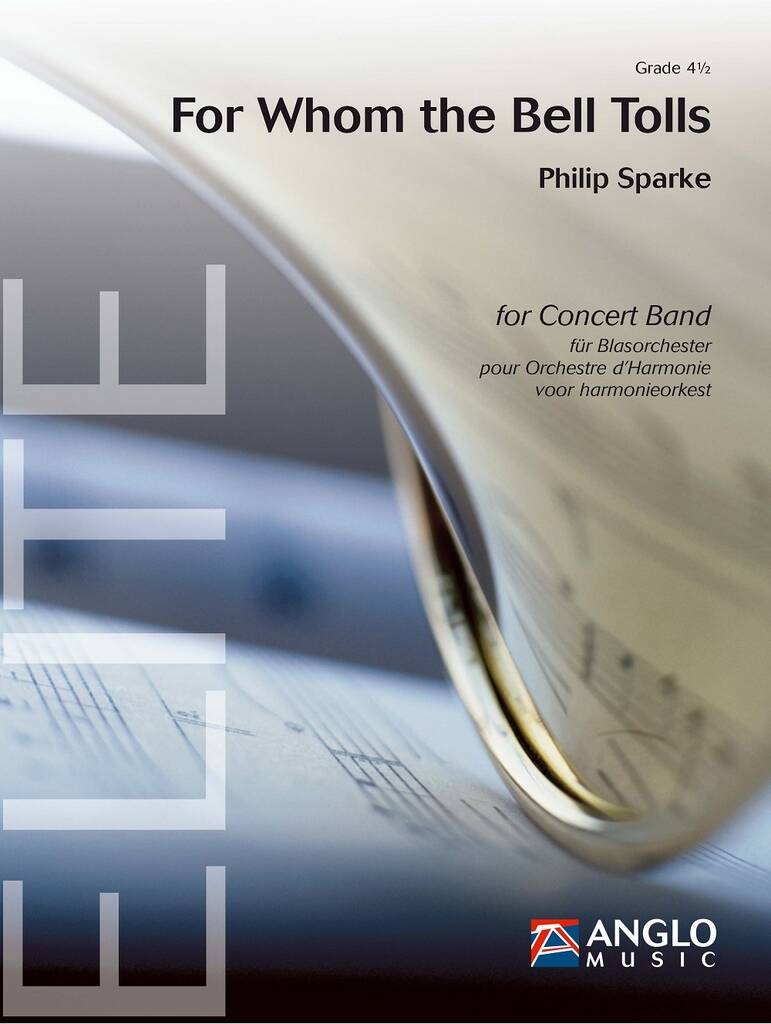
For Whom the Bell Tolls - Philip Sparke
For Whom the Bells Tolls was commissioned by the Irish Symphonic Wind Orchestra, who gave the premiere in their 10th anniversary concert, held in the Artane School of Music, Dublin, on the 31st August 2024.The commission was funded by money raised to provide a piece which commemorated friends and members of the orchestra who had recently passed away. This prompted the choice of title, taken from the famous poem by English writer John Donne (1572 - 1631), which reminds us that the death of anyone affects us all.The work opens with an enigmatic duet between oboe and clarinet. This is taken up by the full band and leads to the work's main theme, a lyrical chorale, which builds to a passionate climax. A central section, introduced by the English horn (cue clarinet), eventually leads back to a triumphal return of the chorale on full band. The mood subsides to introduce an echo of the opening material, which brings the work to a peaceful close.
Estimated dispatch 7-14 working days
-
 £74.00
Nimrod - Edward Elgar
Nimrod is the name given to the ninth and best-known variation inEdward Elgar's Enigma Variations, an orchestral work of 14 variations on an original theme composed between 1898 and 1899. Each variation is also a portrait of one of 14 members of Elgar's family and circle of friends. A celebrated work, Nimrod is a portrait of Augustus Johannes Jaeger, who in addition to being his best friend was also Elgar's editor.The variations all represent a series of portraits and as such are entitled with a name or initials that identify the person. Biblically, Nimrod is a great hunter of the Old Testament, thus representing his muse through a play on words: Jger in German means 'hunter'. The melody appears to represent a nocturnal stroll during which the two discuss Ludwig van Beethoven's slow movements; the first eight bars, in fact, recall the beginning of the second movement of the Pathtique Piano Sonata.An arrangement of classical music signed by Franco Cesarini which stands out for its skilful and careful instrumentation.
Estimated dispatch 7-14 working days
-
 £78.20
Enjoy Your Weekend - Peter Goosensen
Enjoy your Weekend! is a fun and varied composition that offers lots of playing pleasure for both youth and smaller bands. The composition is based on a simple and pretty theme. The first part, Lazy Sunday, is built around a relaxed swinging tune. The second part, Close Friends, is more melodic and serious in nature. In Party Rock, the third part, the drummer plays a central role and the band can play their hearts out. Enjoy your Weekend!
Estimated dispatch 7-14 working days
-
 £119.60
Saga Imperiale - Michael Geisler
The legend "The Schnackler and the Koasabacha" is the theme of the "Imperial Saga". The story is set in the Kaiserbachtal, a stunningly beautiful place in the Kitzbheler Alps in Austria. Long ago a young and happy shepherd lived in a place named "The Schnackler". He got his nickname due to his habit of clucking his tongue and then snapping his fingers. The "Koasabacha" saved his life after a fall and the two became friends.
Estimated dispatch 7-14 working days
-
 £59.95
Variations VIII & IX (From Enigma) (Concert Band - Score and Parts) - Elgar, Edward - Brand, Geoffrey
Elgar's Variations for orchestra were written during 1898-9; they are dedicated "To my friends pictured within" Each of the 14 variations is a musical portrait to one of the composer's friends. Over the 17 bar theme which inspired the Variations, Elgar wrote the word ENIGMA. Later he said, "The ENIGMA I will not explain - its "dark saying" must be left unguessed" In Variation VIII W.N. is Winifred Norbury. In 1897 local friends organised a choral and orchestral society for Elgar to conduct. The secretaryship of The Worcester Philharmonic, as the society was called, was shared by two ladies, of whom W.N.. was one She has been described as "very sedate and calm, rather like a kind governess with Elgar, but had a sense of humour - and a laugh, rather like a deep bell". Variation IX Nimrod is Elgar's deeply felt tribute toA.J.Jaeger, his German-born friend who worked for the publisher Novello and Co. His sincere support meant a great deal to Elgar. Jaeger, in German, means "hunter". Elgar concealed this in the nickname Nimrod. The variation has become extremely popular and is often played on thoughtful occasions. In this arrangement, either W.N. or Nimrod can be played alone. However, in the Variations they are linked by Elgar in an inspired manner.
Estimated dispatch 7-14 working days
-
£11.95
Variations VIII & IX (From Enigma) (Concert Band - Score Only) - Elgar, Edward - Brand, Geoffrey
Elgar's Variations for orchestra were written during 1898-9; they are dedicated "To my friends pictured within" Each of the 14 variations is a musical portrait to one of the composer's friends. Over the 17 bar theme which inspired the Variations, Elgar wrote the word ENIGMA. Later he said, "The ENIGMA I will not explain - its "dark saying" must be left unguessed" In Variation VIII W.N. is Winifred Norbury. In 1897 local friends organised a choral and orchestral society for Elgar to conduct. The secretaryship of The Worcester Philharmonic, as the society was called, was shared by two ladies, of whom W.N.. was one She has been described as "very sedate and calm, rather like a kind governess with Elgar, but had a sense of humour - and a laugh, rather like a deep bell". Variation IX Nimrod is Elgar's deeply felt tribute toA.J.Jaeger, his German-born friend who worked for the publisher Novello and Co. His sincere support meant a great deal to Elgar. Jaeger, in German, means "hunter". Elgar concealed this in the nickname Nimrod. The variation has become extremely popular and is often played on thoughtful occasions. In this arrangement, either W.N. or Nimrod can be played alone. However, in the Variations they are linked by Elgar in an inspired manner.
Estimated dispatch 7-14 working days
-
 £137.95
Sinfonietta No.1 (Concert Band - Score and Parts) - Sparke, Philip
Sinfonietta No.1 was commissioned by the Foundation of Friends of the Marine Band of the Royal Netherlands Navy. It was first performed by them in 'De Doelen', Rotterdam on the 13th November 1990 (in a joint concert with the Royal Marines Band from Great Britain) which celebrated the 325th anniversary of the Netherlands Marine Corps and coincided with the 45th anniversary of the band and the 175th anniversary of naval music in the Netherlands.The work is in three, linked movements:I: OvertureSeveral contrasting motivic ideas open the work, but none manage to develop into a theme of any sort. Eventually a short theme appears on clarinet, alto saxophone and horn but it is swept away by runs of triplets from the woodwinds. The theme returns, accompanied by the triplets from the woodwinds. The theme returns, accompanied by the triplets, and this leads to a return of the opening material to close the movement.II: AriaThe second movement opens with violent outbursts from the timpani until a simple, mournful tune is presented by flute and bassoon over a sparse accompaniment by the lower brass. Trumpets introduce a quicker, turbulent central section but this leads back to a brief repeat of the original tune, bringing the movement to a peaceful close.III. ScherzoThe final movement is a fast and furious scherzo which bursts into life with a flurry of notes. The vivacious main (woodwind) theme is first played by the flutes and then by the whole woodwind section. A cornet then takes centre stage with a fanfare-like theme which is then taken up by the brass. A bridge passage then leads to a version of this theme for full band. The original flute tune is then developed until the horns introduce a chorale tune which is taken up by saxes and then full band until the opening material reappears. The woodwind and brass themes are then combined and lead to a forceful version of the chorale which becomes more and more dissonant until the opening of the Overture returns to bring the work to a rousing finish.Recorded on QPRM134D THE KINGS GO FORTH, Central Band of the Royal Air Force
Estimated dispatch 7-14 working days
 View Music