
Results
-
 £89.99
Czardas - Vittorio Monti
This lively Hungarian folk dance, originally set for solo violin and piano by Italian composer Vittorio Monti, has been arranged for solo instrument and concert band for the Barnhouse "Spotlight" series by Andrew Glover. This rhapsodical work allows the soloist to display great lyrical skills as well as technical virtuosity! Includes solo parts for violin or flute, b-flat clarinet (or any b-flat instrument in similar range), e-flat alto saxophone, or euphonium (bass clef). Band accompaniment parts grade 3; solo part grade 4+. A great way to feature your outstanding soloist or guest artist, and guaranteed to astonish your audience!
Estimated dispatch 7-14 working days
-
 £96.40
The Elephant and the Fly - Henri Kling
This newly revised edition of perennial favorite "The Elephant and the Fly" is based on the original parts published in 1918. This updated version includes a full score, in addition to a few adaptations/transpositions to accommodate modern band instruments. Lastly, each of the solo parts is transposed into a variety of keys, such that a variety of soloist combinations are now possible. Instrumentation: Solo Piccolo (or Flute/Clarinet/Trumpet), Solo Trombone (or Bassoon/Bass Clarinet/Tuba), Flute 1, Flute 2, Oboe 1/2, E-Flat Clarinet, Clarinet 1, Clarinet 2/3, Bass Clarinet, Soprano Saxophone (or alternate Alto Saxophone), Alto Saxophone, Tenor Saxophone, BaritoneSaxophone, Bassoon, Horn 1/3, Horn 2/4, Solo Cornet, Cornet 1, Cornet 2/3, Trombone 1/2, Bass Trombone, Euphonium, Tuba, Percussion
Estimated dispatch 7-14 working days
-
£184.99
Rubicon - Bert Appermont
The Rubicon is a river in Northern Italy which Julius Caesar crossed with his army in 49 BC in defiance of the leaders of Rome, who feared his power. A civil war against rival Pompey ensued, which culminated in Caesar seizing power as the absoluteruler of Rome. The phrase "crossing the Rubicon" therefore refers to any person committing himself irrevocably to a risky, decisive and irrevocable of course of action.The work consists of three parts that deal with this important moment in history.Part 1 (Meditation) symbolises Caesars request to the Gods to assist him in his difficult choice. In a slow introduction we hear the melancholy and beseeching sounds of the duduk (alternatively, this part can be played by a soprano saxophone)and of the soprano solo singer over the bourdon accompaniment. The soprano solo singer then sings "dona tibi pacem" (give him rest) in a melodious and probing theme.In Part 2 (Battle of Pharsalus) trumpets and trombones resound alternately ina stately Roman fanfare, producing a stereophonic effect. This develops into a martial theme in which Caesars impressive army goes to battle against the army of rival Pompey. While the theme of Caesars army fades away, Pompeys theme emerges as anaive dance in six-eight time. His army is definitely in the majority and it believes it can easily defeat the enemy. Suddenly trumpets and trombones clash on two sides of the orchestra: Caesars army advances and attacks. A fierce battle ensues inwhich the two themes are played alternately as well as simultaneously. Thanks to his shrewd battle tactics, Caesar manages to win this legendary battle after all: his theme resounds ever louder in trumpets and horns until everything dies out andchanges into a kind of reconciliation between the soldiers of the two armies. The melancholy "dona tibi pacem" from part 1 now serves as a reconciliation theme.Caesar is now the sole ruler of the New Roman Empire, which would be destined to leave itsmark on our Western civilisation to this day. The third part is a sparkling succession of dance music (Dance) with many Greek and Roman elements in which Caesars victory is praised and celebrated. It is common knowledge that the culture(arts, gods, etc.) of the Romans drew heavily on Greek culture. I have therefore used an authentic Greek theme (the Seikolos song) several times in this part (bar 17 in the euphonium, bar 60 in the base section, bar 68 in the sopranosaxophone) to suggest the music of that era and to evoke the right atmosphere. After a gradual increase in tempo in the entire orchestra, the opening melody gloriously resounds once more, surrounded by virtuoso dance music. The work ends withbombastic brass fanfares in which Caesars theme triumphs once more.NOTE FOR THE CONDUCTOR:The Armenian duduk and the monochord that are used in the introduction give a special tone to the music, but could be substituted (soprano saxophone instead ofthe duduk) or left out (monochord). The soprano solo is also doubled within the orchestra and could therefore also be left out if necessary, although it does provide the work with an extra dimension. The male voices in the introduction and the finalecould possibly be replaced with a synthesizer with choral setting.As a visual and acoustic element in part 2, the trumpets, the e-flat cornet, the small drum and trombones can be stood up and placed at two sides of the orchestra (bar 80).Seen fromthe point of view of the conductor, put the trumpets, the e-flat cornet and the small drum in the left section and the trombones in the right section of the orchestra. This also helps to create a visual contrast between the two themes of the secondpart. The players can be seated again at bar 97 or bar 121. The soprano soloist can be placed in or in front of the orchestra, depending on what gives the best result. For the conclusion of the work the soprano solo can be sung from afar (from thewings) to create additional atmosphere.This work was composed especially for the "St Joseph" brass band from Pey/Echt (Belgium) with conductor Mark Prils.
Estimated dispatch 7-14 working days
-
 £140.00
Elegy & Scherzo - Johan de Meij
Elegy & Scherzo was written at the request of cellist Yuki Ito, to commemorate the 150th birthyear in 2023 of Russian composer Sergei Rachmaninoff (1873 - 1943). Composer Johan de Meij used some hints and quotes from Rachmaninoff's 2nd Symphony (opus 27) and the Symphonic Dances (opus 45), to embrace the sound world of the Russian master. Elegy & Scherzo was premiered on October 27, 2023, in the Cankarjev Dom in Ljubljana, Slovenia by the Band of the Slovenian Armed Forces, with Yuki Ito as the cello soloist. Soon after the premiere, the work was adapted for solo euphonium and wind orchestra. It received its premiere during the ITEC, the International Tuba- and Euphonium Conference 2025 in Valencia, Spain, with Shoichiro Hokazono as the soloist, and the composer conducting.
Estimated dispatch 7-14 working days
-
 £106.99
Summer Isles - Philip Sparke
The Summer Isles are a group of islands located off the North West coast of Scotland which are famous for their wildlife. This piece, written for solo euphonium and brass band, reflects the natural beauty and relaxing atmosphere of the islands. The wonderful melodious nature of the euphonium is displayed in this piece and the opening theme is followed by melodic interplay between the soloist and cornets. This piece will surely be enjoyed by any audience.
Estimated dispatch 7-14 working days
-
 £204.99
Bliss - Hermann Pallhuber
Bliss is one of the most spectacular euphonium solos around. It was commissioned by the euphonium virtuoso, Steven Mead. This two-part concerto brings all the characteristics of the instrument into the spotlight: it contains a slow, colourful section that resembles a typical English air, in which the full round warmth of the instrument is revealed, followed by an extremely virtuoso, dynamic fast movement. A great one for any soloist looking for a challenge!Solo: grade 6
Estimated dispatch 7-14 working days
-
 £104.99
Divertimento - Roger Boutry
Divertimento is an outstanding composition by Roger Boutry for Alto Saxophone and Wind Orchestra. This great work is really nice to play and will enlighten the audience. The Orchestracomposition required is: 2 Flutes, 2 Oboes, 2 Bassoons, 2 small Clarinets, Clarinet I, Clarinet II, 1 Bass Clarinet, 2 Alto Saxophones, 2 Tenor Saxophones, 1 Baritone Saxophone, 4 Horns, 4 Bb or C Trumpets, 4 Trombone or 3Trombone and an Euphonium, 1 Bb or C Bass, 1 Double Bass, 1 Harp, Timpani, Drum and a Celesta. It is divided into three parts: I. "Allegro ma non troppo", is strongly rhythmic and syncopated.Itincludes a Cadenza by the Solo Saxophone and is written as a tribute to Jazz music. II. "Andante", also includes a Cadenza by the Solo Saxophone but at the end of the section. It is reminiscent of slowerblues ballads. III. This part features few sections by the Solo Saxophone but is specially highlighted its ending, in a bright and fast finale. This volume features the score and parts for all theinstruments. Born in France in 1932, Roger Boutry received numerous prizes, including those for Piano, Composition and Conducting. He received the Grand Prix de Rome in 1954. His career was quite successful,alternating between Harmony professor, composer and conductor. He also received numerous prizes for his incredible compositions.
Estimated dispatch 7-14 working days
-
 £60.50
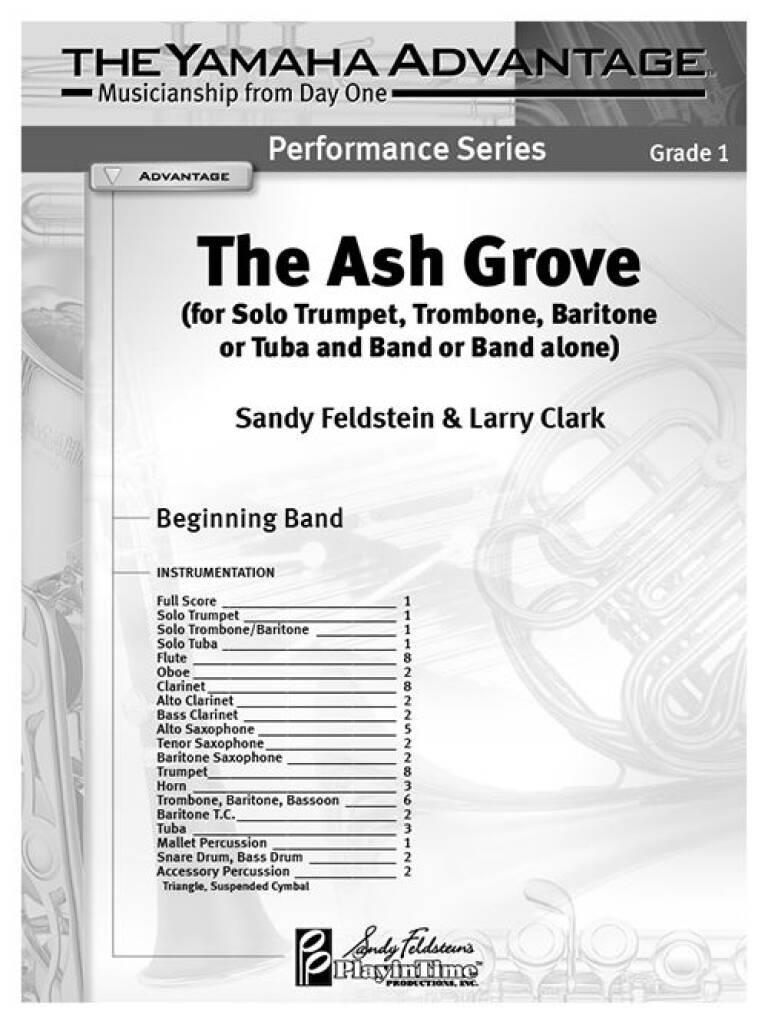
The Ash Grove - Sandy Feldstein
Designed to give your best Trumpet, Trombone, Euphonium, or Tuba player an opportunity to play a solo with Band accompaniment. It should serve as the culmination of study for the soloist upon completion of "The Yamaha Advantage" Book 1, or any comparable method. The piece has all of the solo material cued in the Band, so if a soloist is not available, the piece can be performed with Band alone.
Estimated dispatch 7-14 working days
-
 £228.70
Prelude Festivo - John Brakstad
Prelude Festivo is intended to be performed in concerts and in competitions as well. The work includes solo passages for most instrument groups. Duration 7 minutes. Form: Fast slow fast. The piece is built around two themes. Theme 1 (Allegro con spirito) is the first one presented as a clarinet solo after a fanfare-like opening. Theme 2 is hinted at in the opening bars, but presented fully in the slow (Andante) section (bar 141). This theme is developed and also appears as melodic and rhytmic fragments throughout the composition. In the concluding section (bar 196) both themes are played in conjunction before the piece concludes with the fanfare theme from theopening bars. The solos for cornet and euphonium may be played by saxophone soli cued in at bars 114 and 128. Parts that are marked piu mosso ed leggiero should be played in a cheerful light staccato style in contrast to Andante cantabile.
Estimated dispatch 7-14 working days
-
 £59.80
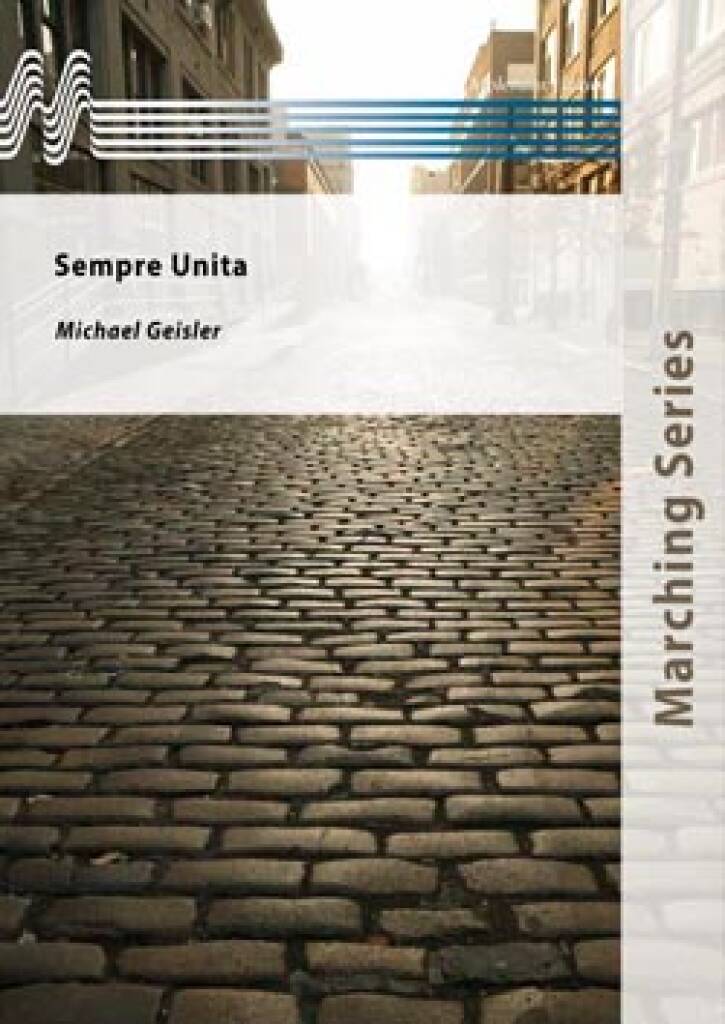
Sempre Unita - Michael Geisler
The concert march Sempre Unita, which means Always United is a musical tribute to a united Europe. The composition is in a traditional form and is characterized by a grandiose tuba solo, a euphonium/oboe solo in the Trio, and closes in a big tutti Finale.
Estimated dispatch 7-14 working days
 View Music