
Results
-
 £214.80
Virtual Visions - Hans Kox
This monumental work of the Dutch composer Hans Cox had it's premiere in 2004. The original title of Virtual Visions was 'Laarbeek Suite'. Laarbeek, a community in Holland of the former places; Lieshout, Beek and Donk and Aarle-Rixtel. The composer was inspired by the surroundings and people that lives in Laarbeek. Characteristic windmills, wide views, poplars, but also the religious habitans and culture of this inspiring area are beautifully translated into music.Hans Kox received several prices. Preludium and fugue have been rewarded in 1954 at the international organ competition in Haarlem. In 1956 he received the cultural price of Arnhem and the Music award of Amsterdam. In 1959, the 'Visser-Neerlandiaprijs' for its first symphony. In 1970, the Prix Italia for 'in Those Days' and in 1974, the first price of the Rostrum of Composers for 'L' Allegria'.
Estimated dispatch 7-14 working days
-
 £88.00
Campinos Scalabitanos - Samuel Pascoal
Horses and bulls have transformed the landscape and culture of Ribatejo (Portugal) and created the natural character of the Campino, guardian of the flatlands and the animals that roam. It is, no doubt, one of the most typical characteristics of Santarem, Ribatejo. Campinos Scalabitanos is a pasodoble which pays a tribute to this tradition. It starts with impressive and colourful chords suggesting the bulls and then comes a gentle melody with a totally different character. A Campino on horseback watches the cattle and suddenly a bull runs away, but the Campino drives it back to the herd. The paso doble concludes with a Portuguese march with taurine music characteristics turning Campinos Scalabitanos into typical Portuguese bullfighting music.
Estimated dispatch 7-14 working days
-
£159.60
Suite for Wind Band - Bob Vos
The "Suite voor Harmonieorkest"was written in 1962 commissioned by the Ministry of Culture at that time. The rave reviews Bob Vos got for his "Concertino for Eb Clarinet and wind band led tot his commision. In this fourfold suite the composer succeeded to build a bridge between a, at that time, modern idiom and more traditional styles. Ton van Grevenbroek was commissioned by "Kunstfactor" to revise this wonderful suite and to modernize the instrumentation.
Estimated dispatch 7-14 working days
-
£68.99
Celtic Fantasy - Keiichi Kurokawa
"Celtic" is a widely used term. Its history and culture expands to modern day Spain, Portugal, and North America.However, in this piece, I have based my music on the typical "Celtic" areas of Ireland and Scotland.The Bagpipe drone at the beginning reappears several times.After the introduction, the music transitions to an Irish Reel, The Wind That Shakes The Barley. Reel is a fast tempo dance, often in 4/4 or 2/2 time.Next is the Scottish folksong Auld Lang Syne, known as "Hotaru no Hikari" in Japan.The third movement is called Scotland the Brave. It is often performed by military bagpipe ensembles. Once air is blown into the bag, there is a constant reservoir of sound for Great Highland Bagpipes.A Part (advanced) is a grade 2.5-3 in American grading system. B Part (beginner) is 1-1.5.B Part is accessible for elementary school and junior high school beginning band students in Japan. However, the drone-sounding sections require a certain technique to hold the sound steady.It is my sincere desire that beginning musicians understand the importance of fundamentals through performing good music.Keiichi Kurokawa
Estimated dispatch 7-14 working days
-
 £202.99
Gloriosa - Symphonic Poem for Band Movement 1 - Yasuhide Ito
A new acquisition by Bravo Music, this fresh printing of the 1990 masterwork by Yasuhide Ito features a newly engraved score, improved parts, good availability and value. This stirring and powerful homage to early Christianity in Japan profoundly and eloquently states the case of cross-cultural conflict and resolution.I. OratioThe Gregorian chant "Gloriosa" begins with the words, "O gloriosa Domina excelsa super sidera que te creavit provide lactasti sacro ubere." The first movement Oratio opens with bells sounding the hymn's initial phrases. The movement as a whole evokes the fervent prayers and suffering of the Crypto-Christians.II. CantusIII. Dies FestusCommissioned in 1989 and premiered in 1990 by the Sasebo Band of the Maritime Self-Defense Force of Kyushu, southern Japan.Gloriosa is inspired by the songs of the Kakure-Kirishitan (Crypto-Christians) of Kyushu who continued to practice their faith surreptitiously after the ban of Christianity, which had been introduced to that southern region in the mid-16th century by Roman Catholic missionary Francisco Xavier. The worship brought with it a variety of western music.Though Christianity was proscribed in 1612 by authority of the Tokugawa Shogunate in Edo (today Tokyo), Kakure-Kirishitan continued advocating sermons and disguised songs. Melodies and lyrics such as Gregorian chant were obliged to be "Japanized". For example, the Latin word "Gloriosa" was changed to "Gururiyoza." This adaptation of liturgy for survival inspired Ito to write this piece in order to reveal and solve this unique cultural mystery.The composer explains:"Nagasaki district in Kyushu region continued to accept foreign culture even during the seclusion period, as Japan's only window to the outer world. After the proscription of Christianity, the faith was preserved and handed down in secret in the Nagasaki and Shimabara areas of Kyushu region. My interest was piqued by the way in which the Latin words of Gregorian chants were gradually `Japanized' during the 200 years of hidden practice of the Christian faith. That music forms the basis of Gloriosa."Gloriosa, fusing Gregorian chant and Japanese folk music, displays the most sophisticated counterpoint yet found in any Japanese composition for wind orchestra.
Estimated dispatch 7-14 working days
-
£209.99
Gloriosa - Symphonic Poem for Band Mvt 2 & 3 - Yasuhide Ito
A new acquisition by Bravo Music, this fresh printing of the 1990 masterwork by Yasuhide Ito features a newly engraved score, improved parts, good availability and value. This stirring and powerful homage to early Christianity in Japan profoundly and eloquently states the case of cross-cultural conflict and resolution.I. OratioThe Gregorian chant "Gloriosa" begins with the words, "O gloriosa Domina excelsa super sidera que te creavit provide lactasti sacro ubere." The first movement Oratio opens with bells sounding the hymn's initial phrases. The movement as a whole evokes the fervent prayers and suffering of the Crypto-Christians.II. CantusIII. Dies FestusCommissioned in 1989 and premiered in 1990 by the Sasebo Band of the Maritime Self-Defense Force of Kyushu, southern Japan.Gloriosa is inspired by the songs of the Kakure-Kirishitan (Crypto-Christians) of Kyushu who continued to practice their faith surreptitiously after the ban of Christianity, which had been introduced to that southern region in the mid-16th century by Roman Catholic missionary Francisco Xavier. The worship brought with it a variety of western music.Though Christianity was proscribed in 1612 by authority of the Tokugawa Shogunate in Edo (today Tokyo), Kakure-Kirishitan continued advocating sermons and disguised songs. Melodies and lyrics such as Gregorian chant were obliged to be "Japanized". For example, the Latin word "Gloriosa" was changed to "Gururiyoza." This adaptation of liturgy for survival inspired Ito to write this piece in order to reveal and solve this unique cultural mystery.The composer explains:"Nagasaki district in Kyushu region continued to accept foreign culture even during the seclusion period, as Japan's only window to the outer world. After the proscription of Christianity, the faith was preserved and handed down in secret in the Nagasaki and Shimabara areas of Kyushu region. My interest was piqued by the way in which the Latin words of Gregorian chants were gradually `Japanized' during the 200 years of hidden practice of the Christian faith. That music forms the basis of Gloriosa."Gloriosa, fusing Gregorian chant and Japanese folk music, displays the most sophisticated counterpoint yet found in any Japanese composition for wind orchestra.
Estimated dispatch 7-14 working days
-
 £84.99
Scherzpolka - Thomas Doss
In the somewhat sarcastic Scherzpolka (Joke Polka), the composer does not intend to make fun of Alpine traditions and music but rather of the typical social attitude that does not always do justice to the valuable folk music and culture. Imagine a band that has to play in a beer tent for hours. During the performance the guests treat the musicians to one beer after another. Gradually, the players and the conductor lose control over their instruments and their interpretation of the music. Finally, the performance comes to an end: the Scherzpolka is actually the last piece. There are no limits to the creativity in both the visual and musical aspects during a performance of theScherzpolka!
Estimated dispatch 7-14 working days
-
 £104.99
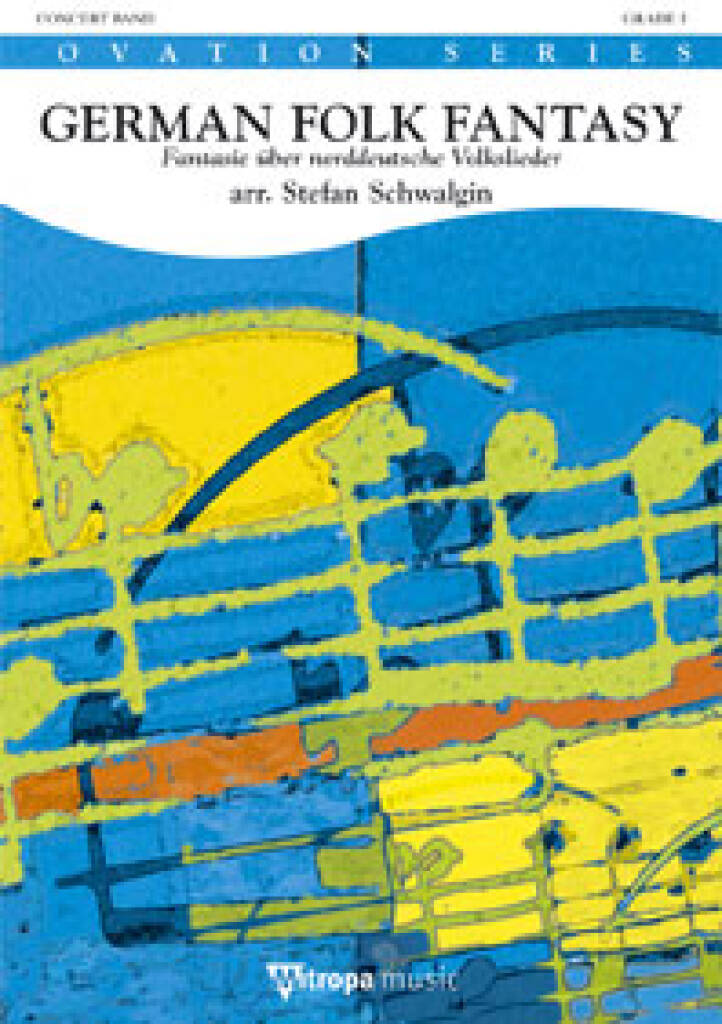
German Folk Fantasy
Take a musical tour of the North of Germany with sailors' music from the coastal areas combining with the authentic traditional folk music culture of the region. This colourful blend of many different styles of the North German music folklore are given a unique twist being wrapped in a grand big band sound, ensuring these fine melodies appeal not only to North German people but to a worldwide audience.
Estimated dispatch 7-14 working days
-
£154.99
Romanian Dances I - Romanian Overture - Thomas Doss
Romania boasts an endless wealth of folk music and culture. Whilethe music of the north still sounds familiar to West-European ears,it becomes gradually faster and fierier towards the south. The sixmovements of Romanian Dances consist of various folk songs, whichthe composer collected and arranged, and represent a cross sectionof styles from dances with stomping and drumming to dancesassociated with prayer. Each movement can be performed separatelyensuring you will find something for all occasions.
Estimated dispatch 7-14 working days
-
 £454.99
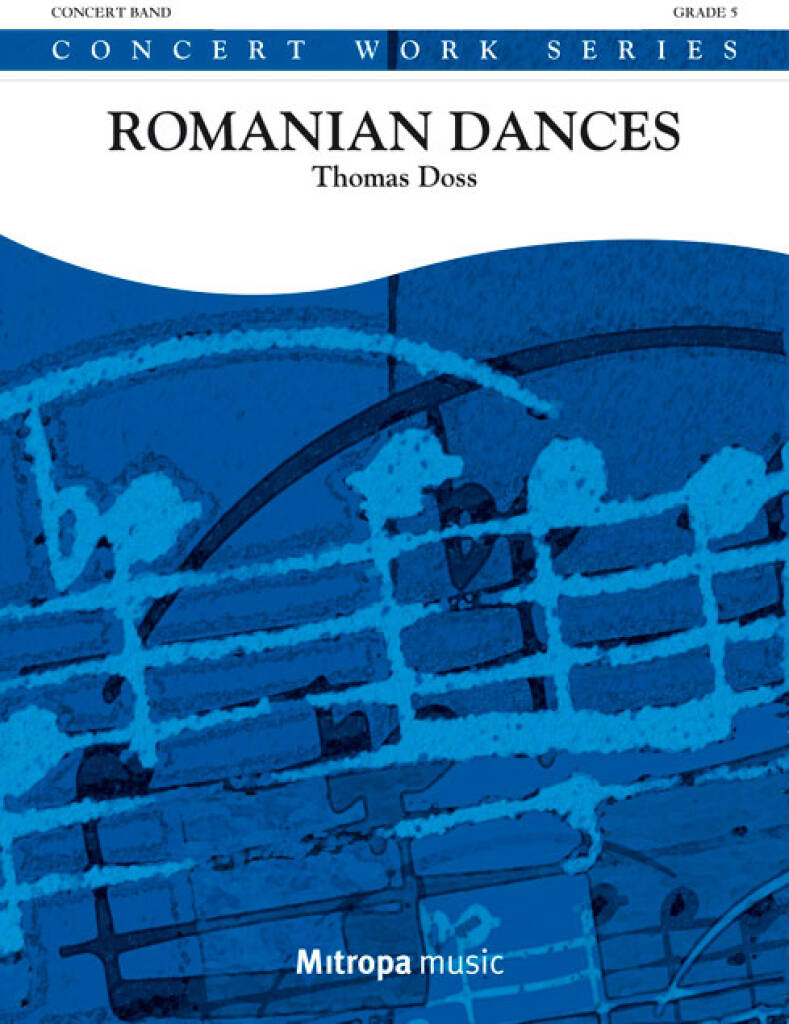
Romanian Dances (complete edition) - Thomas Doss
Romania boasts an endless wealth of folk music and culture. Whilethe music of the north still sounds familiar to West-European ears,it becomes gradually faster and fierier towards the south. The sixmovements of Romanian Dances consist of various folk songs, whichthe composer collected and arranged, and represent a cross sectionof styles from dances with stomping and drumming to dancesassociated with prayer. Each movement can be performed separatelyensuring you will find something for all occasions.
Estimated dispatch 7-14 working days
 View Music