
Results
-
 £149.40
Cradle Hymn - Kim André Arnesen
Cradle Hymn, a Christmas lullaby with imagery of Mary and her infant, was written for the Nidaros Cathedral Girl's Choir and conductor Anita Brevik in 2010, and later arranged for SATB and TTBB chorus. The Lyrics were written by Isaac Watts (1674-1748).This arrangement was written by Christian Aftreth Eriksen in 2021, commissioned by Bunberry High School, Australia. It is scored for large concert band, but is playable for smaller forces through clever cross cuing: Eb clarinet, Contrabass Clarinet, Baritone Saxophone, Contrabassson and Double Bass can all be considered ad lib. All Oboes, Bass Clarinet, Bassoons and all Horns are cross cued.A Soprano Saxophone part is provided to cover the Oboe solos, and should only be used if no Oboes are available.The choice of Vibraphone or Marimba is left up do the conductor. Vibraphone will provide more resonance in the ensemble, if needed.
Estimated dispatch 7-14 working days
-
 £53.50
Palladio - Karl Jenkins
Although this composition sounds like it came straight out of the Baroque period, it is actually the first movement of a suite written in 1996 by Karl Jenkins. Instantly recognized as the 'diamond commercial' theme, its relentless pulse and dramatic nature make it a natural for bands. Robert Longfield's skilled arrangement puts it within reach of most groups.score and parts - 4 Flute I, 4 Flute II, 2 Oboe, 4 Bb Clarinet I, 4 Bb Clarinet II, 4 Bb Clarinet III, 2 Bb Bass Clarinet, 2 Bassoon, 2 Eb Alto Saxophone I, 2 Eb Alto Saxophone II, 2 Bb Tenor Saxophone, 2 Eb Baritone Saxophone, 2 F Horn I, 2 F Horn II, 3 Bb Trumpet I, 3 Bb Trumpet II, 3 Bb Trumpet III, , 3 Trombone I,3 Trombone II, 2 Baritone B.C., 2 Baritone T.C., 4 Tuba, I String Bass, I Timpani, 2 Percussion I, 2 Percussion II - wind/concert band
Estimated dispatch 7-14 working days
-
 £53.95
Buffalo Rock - A Royal Portrait - James Rae
James Rae is the man who put fun into woodwind and brass teaching. His many compositions, especially in the jazz and blues idioms, have often featured on examination syllabuses. Recent years have seen his publications of easy flexible ensembles for younger players and now he turns his attention to the wind band. In his series The Concert Band Collection, he has written exciting new pieces for the standard concert band line up. Attention is given to each instrument so that the technical and musical requirements do not exceed UK Grade 2. An optional piano part will provide "stuffing" and moral support for the young players who will quickly enjoy James' catchy and imaginative music. Each volume contains two titles. Buffalo RockThis piece has been specifically composed for bands in their early stages of development. All instrumental parts have been written in comfortable keys and ranges with all clarinet parts staying entirely in the low register. After a short, powerful introduction, the music immediately kicks in to a driving rock mode, setting the scene for the remainder of the piece. Strong rhythmic playing is required from all sections of the band in order to achieve a solid performance. A Royal PortraitThis piece is very regal in style and portrays all the pomp and circumstance that surrounds a high-profile state occasion. It is to be performed with a full, warm sound and players must resist the temptation to overblow as this could have a detrimental effect on tone quality and intonation. As with Buffalo Rock, the instrumental parts have been written in comfortable keys and ranges with all clarinet parts staying entirely in the low register.
Estimated dispatch 7-14 working days
-
£94.99
Clari-Fun-Key - Gilbert Tinner
Gilbert Tinner's Clari-Fun-Key is an exciting twomovement work for solo clarinet and concert band. The first movement is in a rock-like funk style with fast flowing melodic figures. The second movement is in a much slower lyrical bossa nova style with the clarinet showing off its warm, rich characteristic sound. A perfect piece for giving your clarinet soloist a bit of the limelight.
Estimated dispatch 7-14 working days
-
 £102.99
Dancing Ebony - Carl Wittrock
Dancing Ebony is a challenging work for solo clarinet, showcasing a virtuoso soloist in an expressive Celtic style. The piece opens with the lyrical sound of the clarinet telling a beautiful tale, before the entire concert band joins in to provide spirited support!The Clarinet Solo is grade 5.
Estimated dispatch 7-14 working days
-
 £420.99
Tre Sentimenti - Jan Van der Roost
At last the bass clarinet can shine in this major new solo work for bass clarinet and concert band. This composition begins with a rather mysterious opening passage with atmospheric sounds and effects. The soloist plays - preferably backstage - a number of fragments and melodic patterns, without actually "starting" the piece. After this somewhat hesitant introduction, a lively, cheerful allegro entitled Con Giocondita (with joy) bursts out. It is swarming with irregular meters, changing tempos, and polyrhythm, through which the listeners (and sometimes also the musicians) constantly get the feeling that they are being tossed around. The second movement brings rest andpeace making careful use of sound colours. The upbeat finale, titled Con Allegria (with cheerfulness), is the most significant movement for the soloist. This is a challenging piece of music that demands great virtuosity, but with the correct performer it will be a real highpoint in any concert..
Estimated dispatch 7-14 working days
-
 £89.99
The Old Grumbly Bear
For solo bassoon, bass clarinet, baritone saxophone, euphonium, or tuba with band accompaniment.From the Barnhouse "Spotlight" series. This delightful novelty solo includes parts for solo bassoon, bass clarinet, baritone saxophone, euphonium BC and TC, and Tuba. An ideal solo to showcase your star performer's musical abilities in a humorous and fun way. The accompaniment is not difficult, and requires a minimum of rehearsal. An excellent choice for adding variety to your concert in featuring a soloist on a non-typical solo instrument. Great fun!!
Estimated dispatch 7-14 working days
-
£45.95
Little Bit O' Licorice, A - David A. Myers
A fabulous way to showcase your clarinet section. This piece lies very well on the clarinet so it will not be difficult for your young musicians. David has scored this to work well with any beginning band instrumentation. Its catchy melody will have your audience humming the tune all the way home. A great change of pace for your concert!
Estimated dispatch 7-14 working days
-
 £309.99
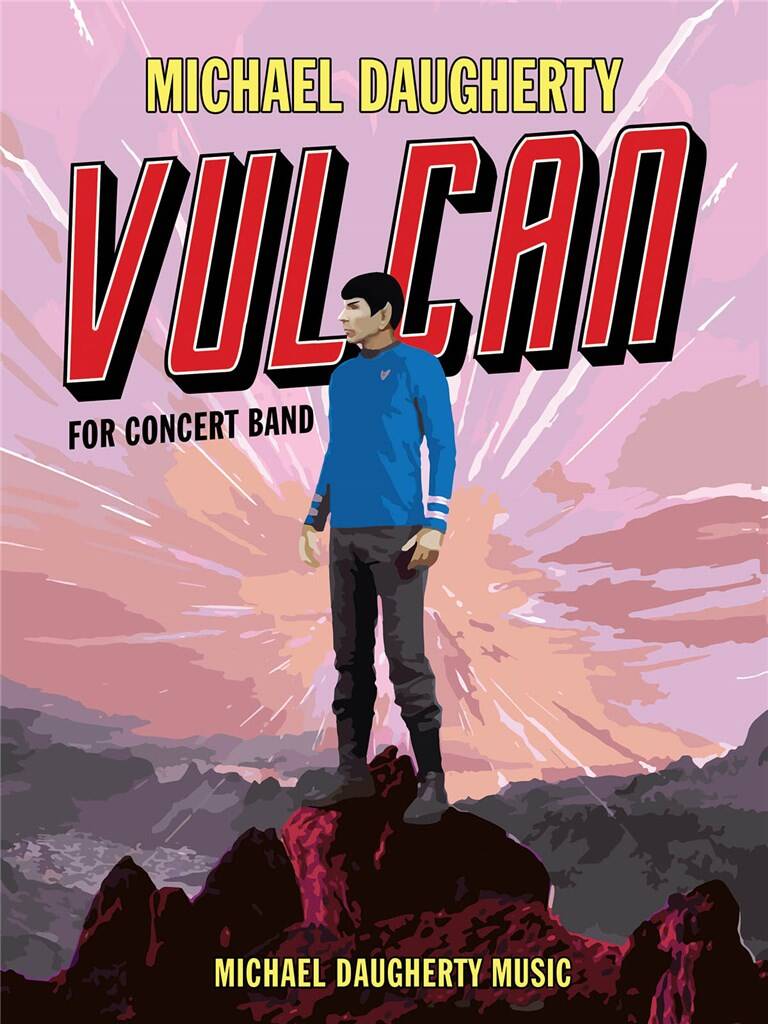
Vulcan - Michael Daugherty
(2014) Vulcan for Concert Band is Grammy award winning composer Michael Daugherty's first work for the high school and intermediate level college band. The work is a colorful homage to Gene Roddenberry's interstellar universe as depicted in the classic American television series Star Trek (1966-69). The title refers to the fiery planet Vulcan, home world of half-human, half-Vulcan Mr. Spock. As the rational-minded science officer aboard the starship Enterprise (commanded by the hot-blooded Captain James T. Kirk), Mr. Spock grapples with the fascinating predicament of making decisions predicated on human emotion versus Vulcan logic. Daugherty has composed stirring, yet highly structured music that alludes to the Vulcan Pon Farr ritual, Vulcan telepathic mind-melds, and the volcanic planet itself. At the the Ann Arbor, Michigan world premiere (utilizing the combined forces of the Pioneer, Huron and Skyline High School bands), Vulcan was an immediate hit and will surely become one of Daugherty's most performed works. Instrumentation The number of players doubling each part is at the conductor's discretion, but should be in keeping with a balanced sound. Piccolo 2 Flutes 2 Oboes English Horn (optional but recommended) 3 Bb Clarinets (minimum 2 players per part) 2 Bb Bass Clarinets Eb Contralto Clarinet or Bb Contrabass Clarinet and Bb Bass Saxophone (optional but recommended) 2 Bassoons 2 Eb Alto Saxophones Bb Tenor Saxophone Eb Baritone Saxophone 3 Bb Trumpets (straight metal mutes, harmon mutes-stem out) 2 F Horns 2 Trombones (straight metal mutes) Euphonium 2 Tubas Contrabass or Electric Bass (optional but recommended) Timpani (4 drums recommended) Percussion (instruments are not shared): 1. Glockenspiel, Xylophone 2. Vibraphone, Small Anvil (metal beater) 3. Shakaray, Marimba, Chimes, Suspended Cymbal (yarn mallets) 4. Two Tam-Tams (small, medium), Tambourine, Mark Tree, Finger Cymbals, Vibraslap, Piccolo Snare Drum 5. Tenor Drum, Maracas, Snare Drum 6. Large Bass Drum Movement I (YouTube) Movement II (YouTube) Movement III (YouTube)
Estimated dispatch 7-14 working days
-
£149.40
Lullaby from Four Watercolours - Tor Aulin
Few composers have had such an impact on Swedish music life as Tor Aulin (1866 1914). He studied violin and music theory in Stockholm 1877 83, and in Berlin 1884 86. In 1887 he founded the Aulin Quartet, which for more than 20 years played animportant role in broadening Swedish interest in chamber music. The quartet was often on tour with the composer Wilhelm Stenhammar at the piano.1889 1902 Aulin was the leader of the orchestra at the Royal Opera in Stockholm.At Aulinsinstigation the Concert Association in Stockholm (later The Royal Philharmonic Orchestra) was founded in 1902, and he was its conductor until 1909. From then on he was the conductor of the Gothenburg ConcertAssociation (nowadays The GothenburgSymphony Orchestra).Besides being a first class violinist, Tor Aulin was also an accomplished pianist, and Edvard Grieg was deeply impressed by Aulin's rendering of his piano concerto.Aulins list of works is dominated by his musicfor violin. He wrote three violin concertos, the third of which still has a place in the repertoire.Four Aquarelles for violin and piano from 1899 is his most beloved composition. In 1996 Jerker Johansson arranged this work for soloinstruments, one for each of the four movements, and concert band. The solo instruments being clarinet, trumpet, flute and alto saxophone.
Estimated dispatch 7-14 working days
 View Music