
Results
-
 £79.20
Three Moods of Hanukkah (Concert Band - Score and Parts)
A contemporary arrangement of the classic American folk tune, harmonized by James S. Ralston and arranged by James Barnes. Starting out in a lush and sustained chorale style using the entire lower brass choir, this wonderful arrangement has a tantalizing ending that is sure to teach your students about phrasing, tone production, and tuning.
Estimated dispatch 7-14 working days
-
 £118.99
TRANZENDENTAL DANSE OF JOI (Concert Band) - Bonney, James
This energetic new work fuses the percussion of street musicians, the wind and brass colours of modern jazz, and the form and structure of classical music. Percussionists play everything from plastic buckets to clay flowerpots while laying down a heavily syncopated groove. There is an open section that allows any instrument you desire the unique opportunity to show off their improvisational skills in a wind ensemble setting. This piece is as rhythmically and melodically infectious as it is soulfully uplifting - a guaranteed crowd-pleaser. American Grade 4
Estimated dispatch 7-14 working days
-
 £104.99
Triumphal Prelude (Concert Band - Score and Parts)
This work was commissioned by the Musikkapelle Heiden, Germany, on the occasion of the centenary of this versatile and energetic music society. Triumphal Prelude begins with fireworks of sounds and fanfares, which are worthy of a centennial. It is therefore an ideal opening work. Undoubtedly, the sparkling music will enthrall the audience, thanks to the dazzling sound of the Brass players - who can be heard above the radiant performance of the Woodwind players. 04:40
Estimated dispatch 7-14 working days
-
£69.99
Viva Excelsior (Concert Band - Score and Parts)
Wim Laseroms composed Viva Excelsior on the occasion of the hundredth anniversary of music society Excelsior in Losser (the Netherlands).After a powerful tutti entry, the percussion section bridges the period up to the first reprise. This festive march is then followed by a playful melodic theme in which the semi-quavers prevail, accompanied by a beautiful legato countermelody in the horns and euphoniums. During the second reprise a marcato bass solo and a technically sparkling and dynamic contrasting phase alternate. The trio features a new theme - starting from the chalumeau register and leading to an exuberant repeat in the brass with ornamentations by the high wood players. 04:40
Estimated dispatch 7-14 working days
-
£49.50
Warm and Fuzzy (Concert Band - Score and Parts)
Warm and Fuzzy says it all when describing this rich, lush-sounding contemporary jazz ballad that will appeal to your kids and audience alike. Great full ensemble writing, brief written solo spots for clarinet (2nd clarinets never go over the break), and very reasonable brass ranges all combine to make this a wonderful tool for teaching legato style. Very effective, extremely playable, and oh so pretty. A wonderful change of pace for any concert.
Estimated dispatch 7-14 working days
-
 £70.00
WARM-UP FUNDAMENTALS FOR CONCERT BAND - Balmages & Gausline
Warm-up Fundamentals was conceived as a tool for directors to use as part of a daily ensemble routine. It covers important fundamental concepts such as breathing, long tones, interval slurs, articulation, flexibility, chords and chorales. Each section breaks concepts down to their most fundamental elements before integrating them together. This gradual approach to the ensemble warm-up helps extend the practical applications of these exercises well into rehearsals and performances. Each instrument part fits on one folded piece of paper, so it's extremely practical in size and can easily fit inside a folder without issue. These warm-ups are also ideal for guest conducting appearances such as honor bands, where conductors need to achieve a uniform sound in a short amount of time. Topics include: Breathing - Build breath support and lung capacity; Long Tones - Approached with phrasing in mind; Interval Slurs -- Both descending and ascending; Articulation - Designed to promote air flow in addition to clarity and speed; Flexibility - Octave studies for woodwinds and lip slurs for brass; Chorales - Progressive chorales that begin with small interval movement and short phrases to allow focus on sound and intonation; Balance - Focus on section, instrument family and full ensemble; Phrasing - All exercises are designed with ensemble phrasing in mind; Efficient - No big part books! Individual parts easily fit into folders and allow for quick navigation to save rehearsal time; Practical - Ideal for guest conducting appearances; Introductory Text - Discusses each section in detail and provides suggestions
Estimated dispatch 7-14 working days
-
 £82.95
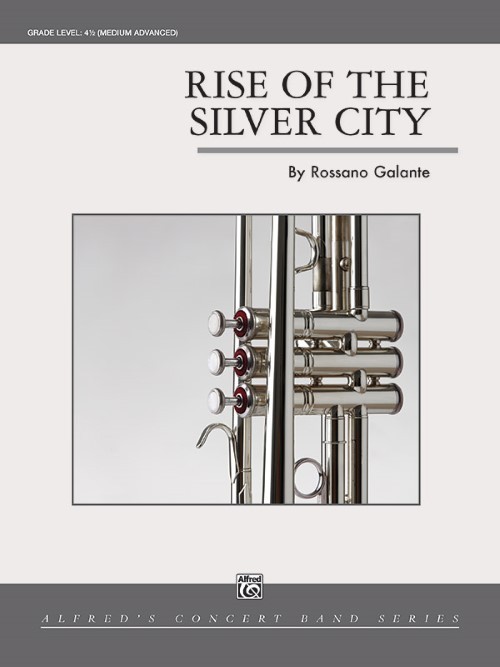
Rise of the Silver City (Concert Band - Score and Parts) - Galante, Rossano
The title of this colourful work is derived from Meriden, CT, once the silver capital of the world. Brass flourishes, lyrical woodwinds, and stately themes lead to the heroic climax.Duration: 4:30
Estimated dispatch 7-14 working days
-
 £248.99
Missa Brevis - Jacob de Haan
Missa Brevis, written for choir and wind band, was commissioned by the Conseil Dpartemental pour la Musique et la Culture de Haute-Alsace (Dir.: Philippe Pfisterer) in Guebwiller (France), in celebration of the millennium of Pope Leon IX'sbirth in guisheim (France). The composer conducted the first performance on June 23, 2002. It was performed live for the French television channel France 2. The mass movements Kyrie, Gloria, Credo, Sanctus, Benedictus, and Agnus Deiare very suitable for the Catholic as well as the Protestant liturgy. For this mass, various ways for performing in diverse variable strengths are possible. An instrumental performance is possible if the brass represents the choir parts. In thisoption, it is desirable for the brass to be positioned separately from the rest of the band (on a gallery, for example), so that the idea of two choirs is approached. In a performance with a large choir, the brass can work very well as a support. Inthat case, the dynamics of the brass should be adapted somewhat, since these are actually intended for an instrumental performance. You can also leave out the brass entirely for the benefit of the choir. For the accompaniment of smaller choirs, youcan opt for a small ensemble from the band. This can also be a quartet, put together as desired. For the performance of this mass, the obvious choice is one of the above options. However, as an alternative, a performance with a combination of theseoptions (vocally/instrumentally) is also possible not just from an artistic point of view (variation), but also from a practical starting point for example in the case that the choir has rehearsed only two movements. With a full strength, theconductor can vary the instrumentation to his or her liking. Then the brass can also play a role in the accompaniment (instead of supporting the choir). The following combinations are possible:1. clarinet choir (from Eb Clarinet to BassClarinet)2. clarinet choir + saxophones3. brass (flugelhorns, horns, euphoniums, bass section)4. brass (2 trumpets / 2 trombones)5. double reeds (optional + flute, optional + string bass)6. tutti7. all winds8. allbrassIn a performance by brass band and choir, it is usually advisable to leave out option 1 (choir + brass + band). The choir sings self-reliantly, accompanied by a full brass band. In an instrumental performance, you can consider a combinedquartet (two cornets and two trombones) + brass band.Choral parts available separately.
Estimated dispatch 7-14 working days
-
 £138.00
The Saints And the Royal - Eric Swiggers
The Saints and the Royal was composed on behalf of Royal brass band St. Willibrord Heeswijk on the occasion of its 200th anniversary in 2023.When the marching band was founded in 1823, it was given the name "Harmonie Sint Cecilia," referring to Saint Cecilia, the patron saint of music. Around 1904, the name was changed to 'Kerkelijke fanfare Willibrord', strongly emphasizing the connection with the church in Heeswijk, of which Saint Willibrord is the patron saint. In 1973, at its 150th anniversary, the band received the predicate 'royal'. From that time on one speaks of the Royal brass band Saint Willibrord.The composition musically depicts both Saints Saint Cecilia and Saint Willibrord and the jubilee royal brass band. Although one of the oldest musical societies in the Netherlands, this fanfare is alive and kicking and will celebrate its 200th anniversary in 2023. The composition therefore opens festively and energetically. The alto saxophone plays a recitative, the Gregorian "Cantantibus organis Caecilia virgo in corde suo soli domino decantabat" from the vespers of the feast day of Saint Caecilia, the patron saint of music. This is taken over by the full wood and soft brass group. After a brief, playful interlude, this chant is played by the full orchestra, like an organ, larded with circumambulations.St. Willibord was born in England but made the crossing to the Netherlands in 690 to preach the gospel as a missionary. This was far from harmless and he faced frequent uprisings. After his death he was buried in Echternach in Luxembourg. In this place he is commemorated to this day with the annual "Spring Procession" or "Dance Procession". This procession of Echternach went as follows until 1947: 3 steps forward, 2 steps backward. Hence we hear this procession back in a 5/8 measure: 3 + 2.After this procession, the Gregorian vesper of Sint Caecilia sounds one more time, leading the composition to a reprise of the opening: The jubilee Royal Fanfare Sint Willibord Heeswijk.
Estimated dispatch 7-14 working days
-
 £89.99
Centennial Prelude - Jan Van der Roost
This short opening music was composed on commission of the symphonic band of Jan Van der Roost's village (= Kontich near Antwerp / Belgium). In 1991, this community band celebrated its 100th anniversary. After composing commissioned pieces from different countries (even from Japan), this was the most 'near' commission he ever received indeed!It is a short but varied piece, featuring all sections of the band. After a short introduction, played by the brass instruments, a crisp rhythm starts and boxes the main theme. After a second theme, played by brass and percussion, a short melodical passage brings some 'rest'. At the end, the fanfare of the introductionreoccurs.Although this "Centennial Prelude" isn't a really demanding piece, it sounds colourful and energetic. It has been recorded on CD by the band of the 'Royal Dutch Airforce' and the 'Desford Colliery Brass band'.
Estimated dispatch 7-14 working days
 View Music