
Results
-
 £95.95
A Little Night and Day Music - Samuel Adler
Commissioned by Carl Fischer for a school band series in the 1970s, A Little Night and Day Music is a classic of the modern band repertoire. The "Night Music" section is a study in color and atmosphere and makes striking use of contemporary instrumental techniques including clusters and aleatory. The second section ("Day Music") is a bright and brassy contrast, full offerive and an exhilarating momentum. (Only the first section of A Little Night and Day Music is included on the recording)
Estimated dispatch 7-14 working days
-
 £87.00
Music for a Fanciful Story - Toshiharu Kataoka
'Music for a Fanciful Story' was commissioned by the Symphonic band Mokuyougomi in Japan to celebrate the twenty-fourth anniversary of its annual concert. 'Music for a Fanciful Story' consists of four parts: Overture, Waltz, Hymn and Finale. There is no concrete story, but the composer expects you to play this tune, imaging its original story by yourself.
Estimated dispatch 7-14 working days
-
 £84.99
Thank You For The Music - Björn Ulvaeus
The Swedish band ABBA ruled the pop charts in the 70s with their unique. Folksy style of disco dance songs and heart-felt ballads. Their music has been cleverly woven into the musical show Mamma Mia!, which has played to sold-out audiences everywhere. Don Campbell's exciting arrangement of Thank You for the Music brings one of the highlights from this hit musical to your concert stage. Don't miss out on the fun!
Estimated dispatch 7-14 working days
-
 £84.99
The Essence of Music - Sven Van Calster
ESSENTIA is an collaborative orchestral merger in Essen, Noorderkempen, in Belgium. This amalgamation was first established in September 2010. The piece The Essence of Music was written in honour of the founding of this young, dynamic and energetic wind band. The composition perfectly encapsulates the project and its achievements in music, and is therefore ideally suited as a concert opener.
Estimated dispatch 7-14 working days
-
£104.99
Choral Music - Jacob de Haan
Jacob de Haan was commissioned to write Choral Music a concert band from Dinxperlo (Netherlands). This band gave the work its premiere in 1997 during the World Music Contest in Kerkrade. Choral Music is based on the chorale Sollt ich meinem Gott nicht singen by the seventeenth century German composer Johann Schop. Contrary to the title, Choral Music has nothing in common with a traditional choral arrangement. This contrasting work has a flashing beginning and only much later following on several thematic changes does Jacob de Haan allow the chorale melody to develop into its original form. Following this episode the chorale becomes a toccata developing into a whirlwind finish.
Estimated dispatch 7-14 working days
-
£60.99
The Music Factory - Jan de Haan
The Music Factory was written to introduce beginner players to ensemble playing as early as possible. Thanks to the low grade of difficulty of this piece this it is possible to play in a 'real band' after only a few lessons. Because of the four-part instrumentation, The Music Factory is suitable for smaller strengths, taking into account that it is important to divide parts evenly among the players. Also includes an ad-lib keyboard/piano part to support the ensemble.
Estimated dispatch 7-14 working days
-
 £89.99
Enjoy the Music - Thomas Doss
'Enjoy the Music' is the motto of Austrian composer Thomas Doss. This motto is reflected in this lively concert work in which the composer shows music is melody, harmony, rhythm, dynamics, timbre and much more. The modern yet tuneful melodies of this piece make use of all the colours of the concert band and the results speak for themselves. This item will be a definite favourite with both performers and audience.
Estimated dispatch 7-14 working days
-
 £59.95
Cartoon Music - Peter Graham
Originally written for percussionist Evelyn Glennie's Grammy-nominated Album 'Reflected in Brass', this wind band version is arranged in the style of Scott Bradley, for long the doyen of composers of music for animation. His `Tom and Jerry' scores reference a wide range of music, from Liszt to Schoenberg via Tin Pan Alley. Sharp-eared listeners will catch similar quotes in Cartoon Music.
Estimated dispatch 7-14 working days
-
 £78.99
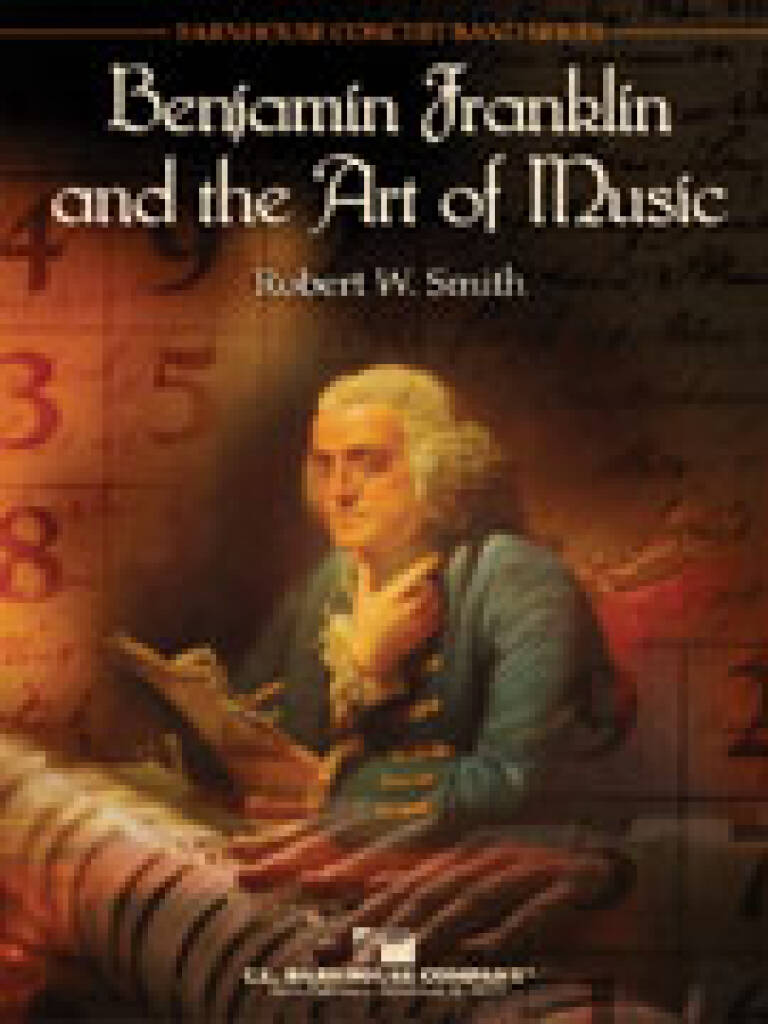
Benjamin Franklin and the Art of Music - Robert W. Smith
Benjamin Franklin's love for the art of music was well documented in American history. Robert W. Smith has selected three musical moments in Ben Franklin's life and created this unique composition for the concert band. Beginning with a setting of "My Plain Country Joan." a song composed as an anniversary gift to his wife, Franklin's jovial personality is evident through the timelessness of his music. The second section is based on Franklin's glass armonica. The delicate and ethereal sounds of this beautiful instrument provide a quiet moment of reflection for all. The finale is based on Franklin's "magic squares." an arrangement of numbers in a square where all rows, columns and diagonals add to the same sum. Robert W. Smith extracted the melody based on the numeric sequence in a 3 x 3 magic square. The resulting musical statement and fugue truly shows the close relationship between mathematics and music. An amazing concept, an amazing cross-curricular piece!
Estimated dispatch 7-14 working days
-
 £237.99
Second Symphony (Concert Band - Score and Parts) - Barnes, James
Premiered by the University of Kansas Symphonic Band with Robert E. Foster conducting, this work was presented the 1982 Neil A. Kjos Memorial Award for the most significant contribution to wind band music. It consists of three movements: an "Elegia" in sonata form, "Variazioni Interrotte" (Interrupted Variations), and a "Finale" in classic sonata form concluding in a coda which ends the symphony in a final, dramatic, colorful outburst, the sort of pure musical energy that only a modern symphonic band can produce. Movements: I. Elegia, II. Variazioni Interrotte, III. Finale. Duration: 22.00
Estimated dispatch 7-14 working days
 View Music