
Results
-
 £179.99
Reminiscencia Gitana (Concert Band - Score and Parts) - Waignein, Andre
Reminiscencia Gitana was originally a piano piece. Andre Waignein wrote the piece for the Spanish pianist Blanca Quevedo, a student of his at the Royal Conservatoire of Brussels. This work has all the elements that make a composition interesting: melody, virtuosity and most importantly the Gitana (gypsy) character. Each section follows on without interruption making a contrasting whole that will captivate both players and audience until the last note.Duration: 14.00
Estimated dispatch 7-14 working days
-
 £74.95
Alpine Echoes (Cornet Solo) (Concert Band - Score and Parts) - Windsor, Basil - Bashford, Rodney
Alpine Echoes was composed by Basil Windsor at the turn of the last century to feature the echo cornet. It was a famous part of Harry Mortimer's repertoire when he was principal cornet of the Fodens Motor Works Band from 1925 to 1940. It is an incredibly taxing but colorful work.
Estimated dispatch 7-14 working days
-
£14.95
Alpine Echoes (Cornet Solo) (Concert Band - Score Only) - Windsor, Basil - Bashford, Rodney
Alpine Echoes was composed by Basil Windsor at the turn of the last century to feature the echo cornet. It was a famous part of Harry Mortimer's repertoire when he was principal cornet of the Fodens Motor Works Band from 1925 to 1940. It is an incredibly taxing but colorful work.
Estimated dispatch 7-14 working days
-
 £104.99
Ceremonial March (Concert Band - Score and Parts) - Van der Roost, Jan
In the course of the two centuries following the death of Henry Purcell in 1695, no British composer of any statue was apparent. Consequently, the break-through of Edward Elgar (1857-1934) as an internationally known and respected composer at the end of the last century, was of considerable importance. As a composer Elgar was largely self-taught and he looked towards the continent for his inspiration. He is without doubt on par with his contemporaries such as the somewhat younger Richard Strauss. The Belgian composer Jan Van der Roost is a genuine admirer of Elgar's music and on the occasion of the fiftieth anniversary of the composer's death in 1984 he composed the "Ceremonial March". Van der Roost was inspired by the most famous and frequently played works from Elgar's catalogue of works, the characteristic "Pomp and Circumstances" marches, and decided to add his own, sixth march to the existing collection.Duration: 5:30
Estimated dispatch 7-14 working days
-
 £32.95
Largo and Finale (from the New World Symphony) (Concert Band - Score and Parts) - Dvorak, Antonin - O'Reilly, John
The familiar themes from the first and last movements of Dvorak's New World Symphony provide a good vehicle for introducing quality music at an easy grade level.
Estimated dispatch 7-14 working days
-
 £84.99
Creamy and Crispy Wind Band Set (Score & Parts)
This composition of Marc Cunningham has four parts, and takes place on a sunny day in a picturesque town. 1. Promenade Many people walk through the city. The band passes through the streets. People are strolling along the avenues and amorous couples are sitting on a park bench. 2. Lovey Dovey One of these couples is knee-deep in love. 3. Crispy and Creamy Here the contrasts between a crisp staccato section in two-four time signature and a smooth legato section in three-four time signature are depicted. Is Crispy the boy and Creamy the girl? 4. Farewell In the last particle the couple says goodbye. We still think back to the walk through the city. It sounds a little less happy now. Not everyone is good at saying goodbye, sometimes a tear flows. 07:45
Estimated dispatch 7-14 working days
-
£94.99
Czardas (Clarinet solo) Wind Band Set (Score & Parts) - Monti, Vittorio
Vittorio Monti was born on January 6, 1868 in Naples (Italy). His musical education (violin and composition), he enjoyed at the conservatory there. Around his 30's Monti went to Paris. He earned a living as a conductor and wrote several ballets and operettas. In his last years, Monti died in 1922, he devoted himself to teaching and composing. His famous "Czardas" has made his name known even today. Initially the czardas was a Hungarian folk dance , but after the mid-nineteenth century it was even a dance for the upper-class. Czardas begins with a slow introduction, the Lassan (slow and sad), and then the fast part, Friska, follows. Czardas is not, as so many people think typical gypsy music. 05:30
Estimated dispatch 7-14 working days
-
£94.99
Czardas (Xylophone solo) Wind Band Set (Score & Parts) - Monti, Vittorio
Vittorio Monti was born on January 6, 1868 in Naples (Italy). His musical education (violin and composition), he enjoyed at the conservatory there. Around his 30's Monti went to Paris. He earned a living as a conductor and wrote several ballets and operettas. In his last years, Monti died in 1922, he devoted himself to teaching and composing. His famous "Czardas" has made his name known even today. Initially the czardas was a Hungarian folk dance , but after the mid-nineteenth century it was even a dance for the upper-class. Czardas begins with a slow introduction, the Lassan (slow and sad), and then the fast part, Friska, follows. Czardas is not, as so many people think typical gypsy music. 05:30
Estimated dispatch 7-14 working days
-
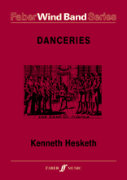 £105.00
Danceries (Set I) (Concert Band - Score and Parts) - Hesketh, Kenneth
The term 'Danceries' can be found in a copy of Playford's Dancing Master, an extensive collection of folk and popular tunes of the seventeenth century (and no doubt earlier). This publication was used by master fiddle players to teach the various dance steps of the day to a nobleman's house or a king's court. Whilst this present set of 'Danceries' cannot be said to be an aid to terpsichorean agility, it will at least set feet tapping! The melodies themselves are a mixture of new and old--well, nearly. Where the old occurs it has been adapted in mood and composition and is often interspersed with completely new material. The harmonies and rhythms bring a breath of the new into these themes and add to the drama of the set.Movement 1: Lull me beyond thee. Gentle and lilting, almost a barcarole, this movement is very much a reverie. The original tune had the name 'Poor Robin's Maggot' - a rather disconcerting title; maggot, however, in seventeenth-century parlance meant whim or fancy. This theme can also be found in The Beggar's Opera by John Gay (first performed in 1728) under the title 'Would you have a young lady' (Air 21).Movement 2: Catching of Quails. A colourful, buoyant scherzo on an original melody. The thematic material is shuttled around the band to contrast with full-bodied tuttis. The last few bars fade away to almost nothing before a final surprise!Movement 3: My Lady's Rest. A tender pavane, also on an original theme, with Moorish leanings. Solos for principal winds and brass contrast with warmer tutti passages. The movement culminates with a final presentation of the theme before evaporating in held flute and trumpet chords.Movement 4: Quodling's delight. The final movement to the set combining one of the melodies from Playford's Dancing Master ('Goddesses') with an original contrasting melody. A dramatic and exuberant ending to the set of 'Danceries'.Duration: 12.00
Estimated dispatch 7-14 working days
-
£104.99
Farewell Medley (Concert Band - Score and Parts)
While it can be fairly easy to select a musical piece for the beginning of a concert, the search for a proper closing piece can sometimes be more difficult. Helping to fill this gap was Stefan Schwalgin's motivation for this Farewell Medley. In this piece he has woven four world-famous folk tunes from the Anglo/Irish/Scottish culture (Danny Boy, Amazing Grace, The Last Post and Auld Lang Syne) into a high-quality arrangement that allows the band to display its full range of colours at the end of any concert. 05:50
Estimated dispatch 7-14 working days
 View Music