
Results
-
 £84.99
Durkle Bandrydge Suite Wind Band Set (Score & Parts) - Fraser, Bruce
Durkle Bandrydge is the name of the composers imaginary world, but it could very well be anyones invisible dream world with a different name. In this very versatile suite by Bruce Fraser, 8 characters are featured, each with its own peculiarities, making Durkle Bandrydge such a colourful place. Do these characters differ that much from us? That is for you to find out! In the last part, all characters come together in a special way.Durkle Bandrydge exists at the end of your street. It is invisible to humans, but Durkle Bandrygators can watch us with great interest. The music will introduce you to some of the characters who live in this unusual place. The parts: Somnanbulyss, who is a giant troll guarding the entrance to Durkle Bandryde. At least, he is supposed to, but he tends to sleep most of the time. His music is therefore very slow moving and sleepy. Long Gwysteen is a tall, mysterious, and somehow sophisticated character, who walls around with a shell on his back. His music glides along rather gracefully. Squelfitch is a rather unpleasant and smelly character who lives in a bog, which is why his music sounds rather slimy and a bit like trying to walk through quicksand. Perfydlia is a meddling old woman, who gossips about everybody and squeals with sudden delight at the small exciting bits of tittletattle about others in the village. In the music you can hear her sudden little squeals of delight. Maryann Lovely is a beautiful young lady, graceful, gorgeous, absolutely devine, and her music is obviously just the same. Thistledoo Nicely is a lively character who spends and spends and spends with her credit card, buying the latest fashion and never worries about having to pay the bills. Her music reflects her excitement when shopping and het 'happy go lucky' approach to life. Marsyn Edginton is the Lord of the manor, the richest man in town, the 'big cheese', the man with all the power and, of course, the biggest house. He is very grand and his music like he could be a king. Jimmy McScotsmyn is a red haired scotsman wearing tartan cap. He misses his home country terribly and eats lots of shortbread, oatcakes, scotch eggs, porridge and drinks an enormous amount of Scotch Wisky, which helps him to have fond memories of the kind of music he would like to dance to when he was a younger man. His favourite dance is a Jig and this is the music he remembers. Grand March of the Durkle Bandrydgators. We hope that you have enjoyed meeting these characters from Drukle Bandrydge and would invite you to listen to all the villagers now march along in a grand parade - it is a pity that you can not see them, what is a wonderful sight. If you listen carefully, you will hear the melodies which belong to the characters as they march past. Oh what a grand spectacle! 10:00
Estimated dispatch 7-14 working days
-
 £279.99
Van Gogh (Concert Band - Score and Parts) - Doss, Thomas
This composition is not a work inspired by the life of the famous painter, but rather an attempt at a pictorial immersion into his world. In addition to Van Gogh's character and tragic life, the technique he employed to create his works, the bright colours of his paintings and his view of nature served as inspiration for this musical work. Point by point, stroke by stroke, Van Gogh brought his own world to life on canvas.On the life of Van Gogh: The Dutch artist Vincent van Gogh was one of the most important pioneers of Modernism, despite being relatively unknown during his own lifetime. As an artist, he chose a life of poverty and seclusion. From today's perspective, his important woks were created from 1880 onwards, when he had already more or less succumbed to madness. While his earlier works could still be classed as contemporary, he matured into a pioneer of Expressionism with his later work indicating an increasing self-awareness. He was just 37 years old when he died but he created over 750 paintings and 1600 drawings in the last ten years of his life.The structure of the work:Start: Brushes and Paints: Van Gogh retired to Arles in southern France where he found his artistic home. The colours and flowering gardens of this landscape awakened in him an unbelievably great creative power.A: A Picture Comes into Being: Van Gogh's psychotic episodes and bouts of depression did not stop him from painting wonderful pictures. Hardly anyone recognised his genius during his lifetime, on the contrary, he often felt misunderstood.C: Paris - Arles: In Paris (from 1886), Van Gogh became inspired by the French art scene. His works found few takers, however. He met and befriended the painter Paul Gauguin, but the lack of success made Van Gogh short tempered, and he began to drink. Eventually, he moved from Paris to Arles in the south of France to establish an artists' collective with Gaugin. Within a few weeks, the two got into such a violent argument that Van Gogh attacked his friend with a knife. The friends parted ways and afterwards Van Gogh cut off his right ear. In 1889 he voluntarily admitted himself into a mental hospital at St. Remy, suffering from hallucinations and fearing that he would lose his mind.G: The Starry Night One of his most famous paintings, created in 1898.H: Death and Brotherly Love Vincent van Gogh accepted an invitation to Auver-sur-Oise in 1890. This was one of his most intensive creative periods. He also went there for treatment, but his mental state hardly improved. After an extended walk, he injured himself fatally with a pistol under mysterious circumstances. Not even to his beloved brother Theo, who had supported him all his life, did he reveal on his deathbed how the accident had occurred.J: Art Market Today, Van Gogh's paintings are among the most expensive paintings on the art market. How ironic, given that he could hardly sell a painting during his lifetime. "I put my heart and soul into my work and lost my mind in the process." (Vincent van Gogh)Duration: 13.15
Estimated dispatch 7-14 working days
-
 £123.20
3 Letzte Motetten (Concert Band - Score and Parts) - Bruckner, Anton - Doss, Thomas
Anton Bruckner (b. 4.9.1824, Ansfelden, d. 11.10.1896, Vienna) didn't have it easy. Throughout his life, the Austrian composer was plagued by self-doubt. Anton Bruckner came from a simple, rural background. After the death of his father, he was accepted as a choirboy at the monastery of Sankt Florian in 1837. After several years as a school assistant and his own organ and piano studies, he first worked as organist in St. Florian, then from 1855 as cathedral organist in Linz. Introduced to music theory and instrumentation by Simon Sechter and Otto Kitzler, he discovered Richard Wagner as an artistic role model, whom he admired throughout his life and also visited several times in Bayreuth. In 1868 Anton Bruckner became professor of basso continuo, counterpoint and organ at the Vienna Conservatory; ten years later court organist; and in 1891 finally honorary doctor of the University of Vienna. He was considered an important organ virtuoso of his era, but had to wait a long time for recognition as a composer. It was not until Symphony No.7 in E major, composed between 1881 and 1883, with the famous Adagio written under the effects of Wagner's death, that he achieved the recognition he had hoped for, even if he was reluctant to accept it given his inclination towards scepticism and self-criticism. Anton Bruckner was a loner who did not want to follow a particular school or doctrine. He composed numerous sacred vocal works, such as his three masses, the Missa Solemnis in B flat minor (1854), the Te Deum (1881-84) and numerous motets. As a symphonic composer, he wrote a total of nine symphonies and many symphonic studies from 1863 onwards, tending to revise completed versions several times over. Bruckner's orchestral works were long considered unplayable, but in fact were merely exceptionally bold for the tonal language of their time, uniting traditions from Beethoven through Wagner to folk music, on the threshold between late Romanticism and Modernism. Anton Bruckner composed about 40 motets during his lifetime, the earliest a setting of Pange lingua around 1835, and the last, Vexilla regis, in 1892. Thomas Doss has compiled some of these motets in this volume for symphonic wind orchestra. These motets show many characteristics of personal expression, especially Bruckner's colourful harmony in the earlier works, which is in places aligned with Franz Schubert (changes between major and minor; and movements in thirds). Later works are characterised by many components which, in addition to the expanded stature of the movements, include above all a sense of the instrumentation as an outward phenomenon and the harmony as a compositional feature that works more internally. Some aspects of Bruckner's work are the result of his long period of study, which familiarised him not only with the tradition of his craft, but also gave him insights into the "modernity" of his time in such composers as Wagner, Liszt and Berlioz. From this developed his personal standpoint, which always pursues the connection between the old and the new.Duration: 14.00
Estimated dispatch 7-14 working days
-
 £256.00
14 Motetten (Concert Band - Score and Parts) - Bruckner, Anton - Doss, Thomas
Anton Bruckner (b. 4.9.1824, Ansfelden, d. 11.10.1896, Vienna) didn't have it easy. Throughout his life, the Austrian composer was plagued by self-doubt. Anton Bruckner came from a simple, rural background. After the death of his father, he was accepted as a choirboy at the monastery of Sankt Florian in 1837. After several years as a school assistant and his own organ and piano studies, he first worked as organist in St. Florian, then from 1855 as cathedral organist in Linz. Introduced to music theory and instrumentation by Simon Sechter and Otto Kitzler, he discovered Richard Wagner as an artistic role model, whom he admired throughout his life and also visited several times in Bayreuth. In 1868 Anton Bruckner became professor of basso continuo, counterpoint and organ at the Vienna Conservatory; ten years later court organist; and in 1891 finally honorary doctor of the University of Vienna. He was considered an important organ virtuoso of his era, but had to wait a long time for recognition as a composer. It was not until Symphony No.7 in E major, composed between 1881 and 1883, with the famous Adagio written under the effects of Wagner's death, that he achieved the recognition he had hoped for, even if he was reluctant to accept it given his inclination towards scepticism and self-criticism. Anton Bruckner was a loner who did not want to follow a particular school or doctrine. He composed numerous sacred vocal works, such as his three masses, the Missa Solemnis in B flat minor (1854), the Te Deum (1881-84) and numerous motets. As a symphonic composer, he wrote a total of nine symphonies and many symphonic studies from 1863 onwards, tending to revise completed versions several times over. Bruckner's orchestral works were long considered unplayable, but in fact were merely exceptionally bold for the tonal language of their time, uniting traditions from Beethoven through Wagner to folk music, on the threshold between late Romanticism and Modernism. Anton Bruckner composed about 40 motets during his lifetime, the earliest a setting of Pange lingua around 1835, and the last, Vexilla regis, in 1892. Thomas Doss has compiled some of these motets in this volume for symphonic wind orchestra. These motets show many characteristics of personal expression, especially Bruckner's colourful harmony in the earlier works, which is in places aligned with Franz Schubert (changes between major and minor; and movements in thirds). Later works are characterised by many components which, in addition to the expanded stature of the movements, include above all a sense of the instrumentation as an outward phenomenon and the harmony as a compositional feature that works more internally. Some aspects of Bruckner's work are the result of his long period of study, which familiarised him not only with the tradition of his craft, but also gave him insights into the modernity of his time in such composers as Wagner, Liszt and Berlioz. From this developed his personal standpoint, which always pursues the connection between the old and the new.Duration: 39.00
Estimated dispatch 7-14 working days
-
 £205.70
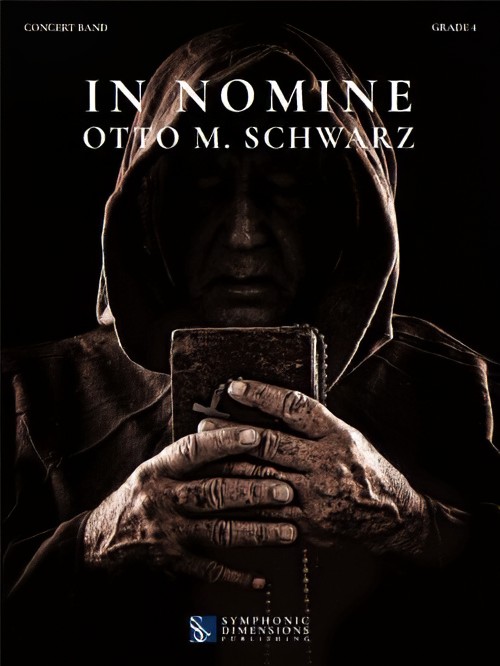
In Nomine (Concert Band - Score and Parts) - Schwarz, Otto M.
How often has something been justified by, declared to be, or blessed as 'in the name of' some cause or other? How can it be that opposing armies and the use of weapons are ever 'in the name of...'? This is a common thread in the history of different faiths. Good was created but evil was committed and all 'in the name of...' This thread is also found in the history of the Premonstratensian Abbey at Wadgassen. The abbey was built in the 12th century on unfertile, desolate moorland, which later evolved into the most powerful religious community in the Saarland. The history of the abbey records quite astounding achievements under the motto desertum florebit quasi lilium ('the desert will bloom like a lily'); but also the harsh treatment of delinquents. The order had its own school, in which children were taught the seven liberal arts (which included music as well as geography and astronomy), but the poor were left to starve outside the abbey walls and were only allowed to eat from the members' leftovers on feast days. The medieval witch trials demanded their pound of flesh, and one group that fell victim were ecstatic dancers who moved wildly to music, which was interpreted as the devil's work. The result: a show trial that sentenced the dancers to death by fire. All in the name of... The year is 1789: Abbot Bordier is in the tenth year of his command. He does not yet know that he is to be the last abbot of an almost 700-year tradition. Not far from the abbey is the French border, which has long been making itself felt with the sound of gunfire, and the brothers continue to keep a nervous eye on it. The first portents of the French Revolution loom, but no one wants to believe it, that is, until the French pound the door down, storm the abbey and come right into the brothers' chambers. In a blind fury, all the pipes of the abbey organ are torn out, icons beheaded with swords and brothers beaten death while numerous buildings are set on fire. The abbey church is in flames. A frantic and desperate escape begins. Abbot Bordier and a handful of brothers make their getaway via the River Saar, adjacent to the abbey, to the neighbouring village of Bous. They survive, but their life, the Premonstratensian abbey, is destroyed. While they flee towards Prague and the sanctuary of the Strahov Monastery, the abbey at Wadgassen is razed to the ground and becomes a stone quarry. The desert blooms once more, however. A few short decades later, a glasswork arises from the foundations of the abbey. As peace returns to the region, it brings jobs and a new vision for its people.Duration: 11.15
Estimated dispatch 7-14 working days
-
 £143.00
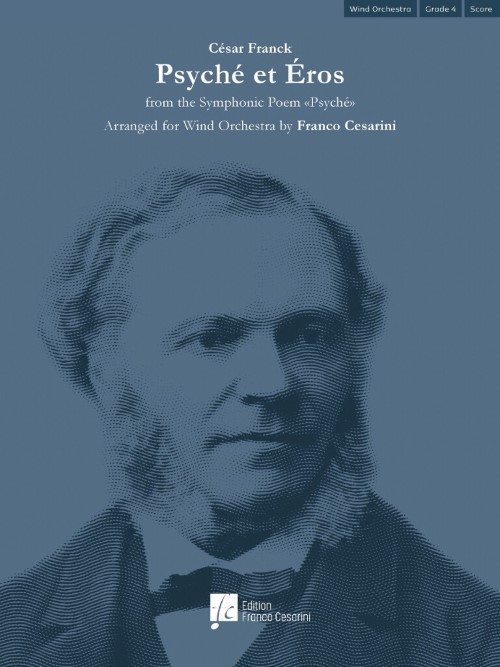
Psyche et Eros (Concert Band - Score and Parts) - Franck, Cesar - Cesarini, Franco
Cesar Franck, composer, pianist, organist and music teacher, completed Cupid and Psyche, his sixth and last symphonic poem in 1887. It was first performed in Paris in 1888 and was a complete success, but the piece later fell completely into oblivion, and it was only thanks to some meticulous research that it has returned to concert halls. The intricate love affair between Psyche and Cupid is an original story of the Metamorphoses, written in the 2nd century AD by Apuleius. The tale is about overcoming obstacles in love and their final union. The symphonic poem is divided into three parts and calls for a choir. The movement that is the subject of this arrangement, Psyche et Eros, is positioned at the end of the second part. Franco Cesarini's version for wind orchestra carefully illustrates the nuances of the instrumental colours, and represents a real test aimed at demonstrating the musicality and interpretative skills of orchestras and their conductors. Duration: 10.30
Estimated dispatch 7-14 working days
-
 £75.00
Angelus ad Virginem (Concert Band with Optional Choir - Score and Parts) - Noble & Willcocks
Angelus ad Virginem (or its English title, Gabriel, From Heven King Was To The Maide Sende) was a popular medieval carol,whose text is a poetic version of the Hail Mary and the Annunciation to the Virgin Mary. Probably Franciscan in origin, it was brought to Britain by French friars in the 13th century. It is said to have originally consisted of 27 stanzas, with each following stanza beginning with the consecutive letter of the alphabet. Surviving manuscripts may be found in a c. 1361 Dublin Troper (a music book for use at Mass) and a 13th or 14th century vellum Sequentiale that may have been connected with the Church of Addle, Yorkshire. Its lyrics also appear in the works of John Audelay (perhaps a priest, he definitely spent the last years of his life at Haughmond Abbey, where he wrote for the monks), in a group of four Marian poems.
Estimated dispatch 7-14 working days
-
 £250.00
The England of Elizabeth,Three Portraits from (Concert Band - Score and Parts) - Williams, Vaughan - Noble, Paul
This suite was derived from Vaughan Williams' score for the film, The England of Elizabeth, written in 1955. It was the composer's tenth of his 11 cinematic efforts and designed to serve a more descriptive role than other such scores, since the movie was a documentary featuring no action scenes, but lots of images of paintings, buildings, and the like. Composer Muir Matheson adapted this three-movement suite, probably shortly after the composer's death in 1958, though publication of the manuscript would not come until 1964. The first movement is entitled Explorer, and refers to Sir Francis Drake. Its music is mostly festive and colourful, but features interior passages of exotic flavor, similar in style to that of Vaughan Williams' then-recent Symphony No.8. The second movement is entitled Poet and, at about seven minutes, is the longest of the three in this 16 to 17 minute work. It also contains probably the score's best music, hardly a surprising result since the poet in question is Shakespeare, one of the composer's favourites and an inspirational springboard for so many other of his works. The mood is mostly subdued and Vaughan Williams presents lovely, if slightly somber music in the opening, and follows it with a hearty, folk-like dance tune. The latter part of this movement depicts Shakespeare as a noble, heroic figure in English history. The last movement, Queen, is devoted to Queen Elizabeth. It has a regal yet muscular manner at the outset, and features a gentle but somewhat disengaged middle section. It returns to the splendor and colour of the opening to close the work. This suite is important because it distills some of the best music from the film into a logically assembled structure. Program notes extracted from those of Robert Cummings.
Estimated dispatch 7-14 working days
-
 £164.95
Amphibiosity (Concert Band - Score and Parts) - Ellerby, Martin
Amphibiosity was commissioned by the Royal Marines Band Service with funds made available by the Royal Navy and Royal Marines Charities for the 2014 Mountbatten Festival of Music held at the Royal Albert Hall in London.The work was written in celebration of the 350th Anniversary of the Royal Marines Corps and utilises many familiar tunes associated with them. Although the piece is cast in one continuous movement it falls into an introductions, ten sections and a coda.The Introduction sets the tone with the Amphibiosity mofif - a call to attention, it is of serious intent. During the course of the work it returns as a point of reference. The first section makes use of The Globe and Laurel (Original Regimental Slow March of the Royal Marines, the tune (Early One Morning) making an apt appearance, it has been played in the minor and like much of the quotational material in the piece is of a referenced nature being symbolic in meaning. However it soon turns to the major to provide a less sombre aspect to the introduction proper. There follows an interlude, the Amphibiosity motif returning rather like a ritornello to give cohesion to the structure and act as a point of change.Section two presents Sarie Marais (Regimental March Past of the Royal Marine Commandoes), the first half of the tune used as a fugal subject (placed in the minor) and as such providing the impression of a building up of activity. The ensuing third section is light-hearted commencing with an original hornpipe leading into the fourth section, Seascape, representing the fleet at sea. Another interlude follows, the Amphibiosity motif reappearing as a woodwind fanfare making way for the fifth section. Anticipation, serious matters lie ahead, there is trouble in the papers, the Corps will be placed on standby.Section six is subtitled Preparation, all hands-on deck, time to get set: A Life on the Ocean Wave (Regimental March of the Royal Marines) is alluded to. On reaching section seven, Assault, the landing goes ahead. Within this section there is an internal interlude reflecting on things past: other men have been in this position before. It is a taut and trying situation, training must pay off!Section eight is named Victory, but not gung-ho, and here the Seascape music is revisited. The penultimate ninth section is called Rememberances, although all made it this time, it was not always the case in times past and the Naval Hymn (Eternal Father) provides a moment of tribute to the fallen of previous generations.The Finale (section ten) delivers By Land and Sea (Slow March of the Royal Marines) in a bright and positive orchestration, the mood being celebratory. In a brief Code, the Amphibiosity motif makes a last triumphant appearance.Duration: 10.30
Estimated dispatch 7-14 working days
-
 £32.95
Amphibiosity (Concert Band - Score only) - Ellerby, Martin
Amphibiosity was commissioned by the Royal Marines Band Service with funds made available by the Royal Navy and Royal Marines Charities for the 2014 Mountbatten Festival of Music held at the Royal Albert Hall in London.The work was written in celebration of the 350th Anniversary of the Royal Marines Corps and utilises many familiar tunes associated with them. Although the piece is cast in one continuous movement it falls into an introductions, ten sections and a coda.The Introduction sets the tone with the Amphibiosity mofif - a call to attention, it is of serious intent. During the course of the work it returns as a point of reference. The first section makes use of The Globe and Laurel (Original Regimental Slow March of the Royal Marines, the tune (Early One Morning) making an apt appearance, it has been played in the minor and like much of the quotational material in the piece is of a referenced nature being symbolic in meaning. However it soon turns to the major to provide a less sombre aspect to the introduction proper. There follows an interlude, the Amphibiosity motif returning rather like a ritornello to give cohesion to the structure and act as a point of change.Section two presents Sarie Marais (Regimental March Past of the Royal Marine Commandoes), the first half of the tune used as a fugal subject (placed in the minor) and as such providing the impression of a building up of activity. The ensuing third section is light-hearted commencing with an original hornpipe leading into the fourth section, Seascape, representing the fleet at sea. Another interlude follows, the Amphibiosity motif reappearing as a woodwind fanfare making way for the fifth section. Anticipation, serious matters lie ahead, there is trouble in the papers, the Corps will be placed on standby.Section six is subtitled Preparation, all hands-on deck, time to get set: A Life on the Ocean Wave (Regimental March of the Royal Marines) is alluded to. On reaching section seven, Assault, the landing goes ahead. Within this section there is an internal interlude reflecting on things past: other men have been in this position before. It is a taut and trying situation, training must pay off!Section eight is named Victory, but not gung-ho, and here the Seascape music is revisited. The penultimate ninth section is called Rememberances, although all made it this time, it was not always the case in times past and the Naval Hymn (Eternal Father) provides a moment of tribute to the fallen of previous generations.The Finale (section ten) delivers By Land and Sea (Slow March of the Royal Marines) in a bright and positive orchestration, the mood being celebratory. In a brief Code, the Amphibiosity motif makes a last triumphant appearance.Duration: 10.30
Estimated dispatch 7-14 working days
 View Music