
Results
-
 £39.95
Blues for Big Ears - Mark Nightingale
Blues for Big Ears is one of Mark Nightingales' Easy Jazzy Tudes, one of Warwick Music's bestselling publications. The band arrangement came about as a result of a stroke of inspiration. After teaching the piece to pupils the idea to arrange it for band was formed. The solo in the middle can be read, or if you have a budding player who likes to improvise feature them. The quavers throughout should not be swung! The Tubas and instruments playing the bass part, should aim for a light sound, and try to imitate the sound of a double bass playing pizziccato. As there are easy parts attached, band directors can include their youngest players, so they don't feel left out. If you have a good drummer, get him to improvise during the fills, rather than read the notated part.
Estimated dispatch 7-14 working days
-
 £89.99
Distant Hymns - Greg Sanders
Distant Hymns is the third movement from the composer's work Dreams and Faith (The Solomon Valley Anthology). The American Composers Alliance commissioned the work for their Continental Harmony Project. In the late 1880s and early 1900s, many of the inhabitants of the Solomon River area in northern Kansas meticulously documented their lives in the vast expanse of the Kansas prairie in writings in their personal diaries. Several writers recorded an unusual phenomenon where the wind often carried sounds over the open prairie and fields with no visible sound source. An example of this display was sometimes the presence of music, often church hymns, carried with the wind from assumed distant churches that were frequently not there. The melodies could be heard constantly changing in volume and sound as the winds continuously changed directions. Distant Hymns is a musical representation of this experience, where a simple hymn tune is handed to and integrated between different groups of instruments. Ebbing frequently, the music varies in loudness and softness as the melody moves freely upon the wind.
Estimated dispatch 7-14 working days
-
 £86.00
Postcard from the Arctic - Dirk Brossé
Sir Dirk Bross, music director at the Philadelphia Chamber Orchestra, is a versatile composer of orchestral and symphonic repertoire, chamber music, film & musical. His compositions are performed worldwide by the most prominent orchestras and soloists. About the new series of 10 "Musical Postcards" for wind band, Dirk says the following: "Composing is a commitment; it is my life's mission. For me composing means creating a vacuum around myself and allowing myself to be submerged by impressions. It is a continual struggle between fantasy and reality, between dream and reality. Out of chaos of sounds and emotions I try to order my thoughts by juggling shreds of melodies, original chords, striking sound colours and alternating rhythms. Melody, harmony, rhythm and sound colours are finally balanced to generate a harmonious universe. This series of ten 'Musical Postcards' are a reflection of my travels, thoughts, discoveries and musical career so far, which has brought me around the globe. I look forward to you joining me on this voyage of discovery..."
Estimated dispatch 7-14 working days
-
 £137.99
Odyssee - Jan Bosveld
The Odyssee tells the story of Odysseus, the undaunted hero. In times long ago the blind poet Homer wrote this famous epic. The "Odyssey" follows the "Iliad", the story of the bloody war between the Greek and the Trojans. This battle endsafter ten years thanks to the Odysseys famous trick. the Trojan Horse. The Odyssey is not a war epic, but a story about perseverance, loyalty, adventure, and the survival instinct of its ingenious hero. In The Odyssey, Homer describes howOdysseus, the king of Ithaca, had to endure another ten years of affliction after the ten years of war in Troy before he could finally return to his home land. During those years, his wife, Penelope, had to try and keep her many admirers away.These men not only wanted het hand but also the kingship. To prove her husbands worth, she played a trick: "As soon as I have finished weaving this shroud for my father-in-law, Laertes, I will choose one of you to become my husband", she promisedthem. But during the night, she secretly loosened what she had woven during the day, prolonging the time until Odysseus would finally return. After twenty long years, when he finally stood at the door, she wondered: Is this really my husband? Ishe an imposter? Cunningly, she asked him to move the bed, because only she and her husband know that the bed was immovable and was build around an old three trunk! Odysseus was deeply moved: this really was his wife, his Penelope! Nearly threethousands years later, the loyalty and strength of this character, and all the dangerous adventures that Odysseus survived thanks to courage and intelligence, still moves us today. Odyssee by Jan Bosveld is not just an adventure story, butrather a characteristic piece in which memories of Homers story can be heard. The composition opens with a firm, stirring theme describing our hero, Odysseus, in detail: This man is not to be taken lightly. The further development of thisshort introduction completes this character sketch: trustworthy, perseverant, and a genius. After that we can picture Odysseus on the lonely beach of Ogygia. Do the trumpets depict his memories of the war of Troy? Does he think of his wife, as werecognise the weaving loom of Penelope in the murmuring eighth? In the solemn, plaintive part that follows, we can imagine Penelope feeling lonely, sitting in the womens room with her servants.One of the girls plays the harp, but that does notclear the sombre atmosphere. Then we can imagine seeing the sorceress Circe, who changed Odysseus men into swine. After she gives a simple magic sign something follows that reminds us of the sound of pigs grunting. Then the Odysseus theme resounds:the hero comes to savi his comrades. Assisted by Hermes, he forces Circe to lift the spell. The piece ends the same way as it began, with an animated theme: Odysseus is still the same, undefeated and not to be taken lighty!
Estimated dispatch 7-14 working days
-
 £159.60
Suite Acadienne - Bernhard Bogisch
1. La belle Franoise.This song tells the story of the beautiful Franoise, who is visited by her lover on the eve of his departure. She helps him prepare for his voyage and they talk for the last time at the foot of a rock, which has been their trysting place. The next day, when he has left the harbour, he hears the sound of a bell. It is the bell that tolls for Franoise, who is being carried to her grave.2. Le Prince Eugne.At least two versions of this song are in existence, both of which are represented here. It tells of the prince Eugne, who, on his way to Paris, encounters twenty of his worst enemies. He manages to kill fourteen of them before his sword breaks. He then asks his page to get him another sword, but the lad is too afraid for his own life. This being the case the prince tells him to tell his wife to take care of his son, who 'will have his revenge by lighting a candle in Paris'.3. Pinson et Cendrouille.This song deals with the marriage of two not further specified animals, who have nothing with which to prepare a wedding feast, and need help from the other animals. But when the rat comes in carrying a fiddle, he is chased away.4. Le Dpart de l'Amant.At least two versions of this song are known, both of which are represented here. It is one of many songs dealing with departure, and is of Canadian origin. The lover is warned of the charms of the pretty 'canadiennes' which among Acadiens refers to French Canadians from Qubec. 'Be true to me save your heart. When I return from my voyage I will make you happy'.5. Le Remde son Talon.This, like many children's/folk songs is a bit of a nonsense song. Marguerite has trouble with the heel of her shoe, and asks her mother for help. Mom suggests various things, such as an onion (too round), a tomato (too flat) etc. In the end it turns out that a bachelor is her best bet.
Estimated dispatch 7-14 working days
-
 £138.00
San Pedro de Alcntara - Valdemar Gomes
The Spanish war galleon with 64 cannons, built in Cuba between 1770 and 1771 for an English shipowner in the service of the King of Spain left Peru for Cadiz in 1784 with a huge cargo of copper, gold, silver and other valuables on board. There were also more than 400 people on board, including passengers, crew and Inca prisoners after a revolt. The Atlantic crossing went smoothly, passing Portugal to take advantage of favourable winds. The shipwreck off Peniche was the result of human error, apparently due to French maps with dramatic errors in the position of the islands of Berlengas and neighbouring islets. On 2 February 1786, the sea was calm and the night clear, but they hit the rock formation Papoa and the hull immediately broke in two. The bottom sank quickly, while the deck remained afloat for some time. 128 people lost their lives, including many Indians who were trapped in the basement. This shipwreck is considered one of the most important in maritime history.What the composer wants to convey, and what can be felt as one listens, is first of all the sound of power, of hope, of the glory of conquest, of the splendour of wealth. This is followed by the perception of the maritime environment, the harmony with the softness of the ocean, the gliding of the hull in the foam of the sea on sunny, blue days. But along with this tranquillity, you soon hear a rhythmic chain that makes you feel a representation of the hustle and bustle, of the busy crew, of the hard work of a sailor, of the desperation of an exotic people imprisoned in a dark, damp cellar. A distinct rhythm that reminds us of the "salero" of Andalusia, with its Arab influences and its people, the soothing of the resignation of others who are forced to submit. Then we clearly hear a crescendo that makes us imagine the agony of the collision that precedes the shipwreck. The breaking of the hull, the water flooding everything, the despair, the clash of bodies on the rocks, the tragedy to come. Before the "grand finale", in which the return of musical softness reminds us that the story is over. The supremacy of nature over human greed. The waves, though gentle, sweep the wreckage, the lives and the treasures of the New World to the bottom of the sea.
Estimated dispatch 7-14 working days
-
 £84.99
Bread and Games - William Vean
'Panem et Circenses', Bread and Games were essential for keeping the citizens of ancient Rome in check. While the bread was meant for the poorest among the Romans, the Games were Popular Pastime Number One for everybody.There were different kinds of games, such as chariot races (especially popular with female spectators), or wild-beast fights, where lions, tigers, bulls or bears were set on one another or even on human beings. Most popular, however, were the Gladiator fights. In 'Bread and Games' William Vean depicts one of the many fights in the antique Colosseum. 1. Entrance of the Gladiators: By powerful bugle-calls the attention of the peoplewas asked for, after which the Gladiators entered the Arena at the sound of heroic marching-music.2.Swordfight: We can hear that the fights were not mere child's play in this part.On the contrary, they were a matter of life and death and were fought accordingly.3.Mercy of the Emperor: Sometimes a wounded gladiator could be fortunate, depending on the mercy of the audience. Waving one's handkerchief meant mercy, a turned-down thumb meant no pardon. The Emperor had the right to take the final decision, but he usually complied with the wish of the majority of the public. 4.Lap of Honour: Gladiators were mainly selected among slaves, convicted criminals, or prisoners of war. Consequently, winning was very important, as it would mean fame, honour and sometimes even wealth. A lap of honour, therefore, was the winner's due reward.
Estimated dispatch 7-14 working days
-
 £72.99
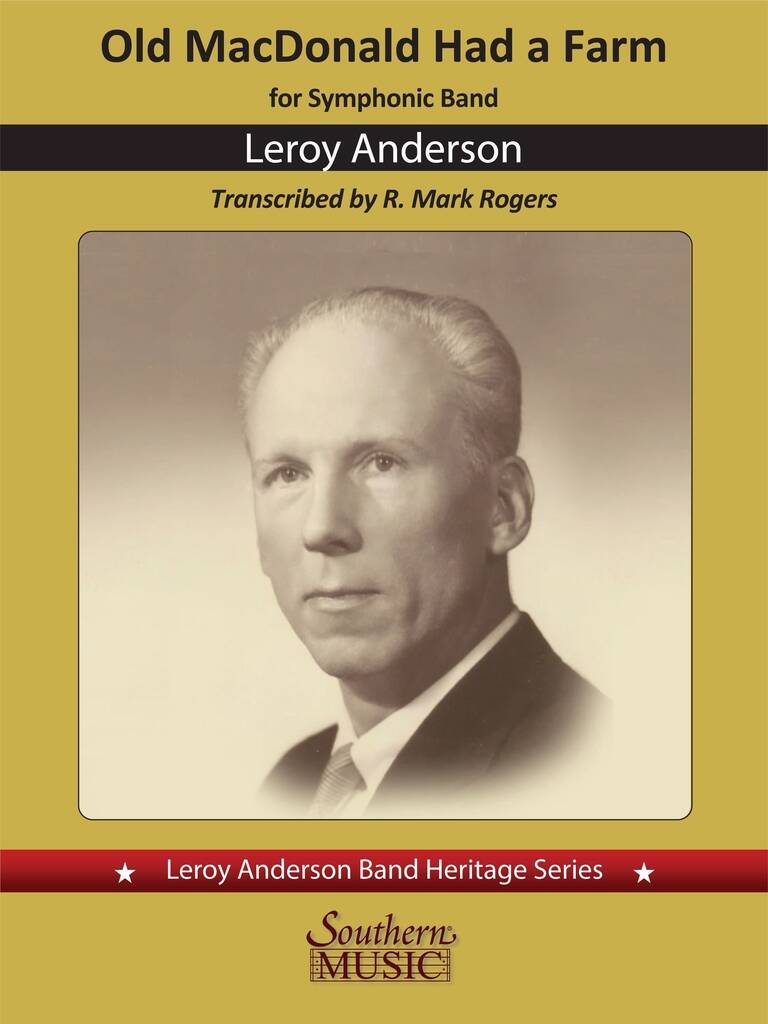
Old Macdonald Had A Farm - Leroy Anderson
Leroy Anderson's setting of Old MacDonald Had a Farm has little in the way of documentation. It was written for and programmed by the Boston Pops under Arthur Fiedler, but it did not enjoy frequent hearings, so the setting was unknown outside of Boston. Conductors should feel free to feature animal sounds closer to home (for instance the sound of pigs in swine-rich Iowa or bison in Montana). To that end it is suggested that the members of the percussion section use their creativity to add humor and local color to this arrangement. This exclusive Southern band edition by Mark Rogers reintroduces Anderson_x001A_s enchanting work to new generations of audiences.
Estimated dispatch 7-14 working days
-
£79.50
Unsinkable Farewell
The RMS Titanic was not unsinkable, but this hymn played in the final fatal moments, is unsinkable and resonates even stronger today. Josh McInnish's arrangement of this old Methodist hymn opens with the sound of the ocean, and includes the refrain of a Fanny Crosby hymn at the end. This beautiful musical setting will convey the love and loss of that tragic moment in our world's history.
Estimated dispatch 7-14 working days
-
£106.95
Kivgik - Carl Strommen
Meaning messenger in Inuit, Carl Strommen's piece Kivgik was inspired by the composer's observance of a large gathering of the Inuit people in Alaska. Carl has tried to emulate the sound of their drums being used to communicate between tribes. The piece also contains bold harmonic colors and driving 6/8 rhythms. There is a nice repose section in the middle of the piece that symbolizes the more solemn parts of this annual gathering or Kivgik. This multicultural piece offers many unique, cross-curriculum teaching opportunities and will be perfect at your next contest or festival performance.
Estimated dispatch 7-14 working days
 View Music