
Results
-
£13.95
Festival of Music 2003
1Reach for the SkyJohn AddisonThe Massed Bands of the Royal Air Force3.292The TrapRon GoodwinThe Massed Bands of the Royal Air Force2.573Come What MayBuerwaldCorporal Matthew Little with The Massed Bands of the Royal Air Force4.324Carnival of Venicearr. Duncan StubbsThe Massed Bands of the Royal Air Force5.595Tribute to Cole Porterarr. RichardsonThe Massed Bands of the Royal Air Force9.356CzardasMonti arr. Duncan StubbsCpl Barry Stringer & Cpl Justine Stringer The Massed Bands of the Royal Air Force3.547Coastal Command Suite, Excerpts fromR. Vaughan WilliamsThe Massed Bands of the Royal Air Force7.158The Other Side of the Rainbowarr. Hunt/LaidlerEmer McParland with The Massed Bands of the Royal Air Force8.339Clarinet ConcertoMozart arr. CasteelJnr Tech Gayle Williams (Clarinet) with The Massed Bands of the Royal Air Force5.3110On the Street Where You LiveLerner & LoeweCorporal Matthew Little with The Massed Bands of the Royal Air Force3.4811CartoonPaul HartThe Massed Bands of the Royal Air Force10.1212I've Got a Gal in KalamazooWarren & GordonThe Massed Bands of the Royal Air Force4.3713Songs of World War Iarr. RichardsonThe Massed Bands of the Royal Air Force4.2714Royal Air Force March PastDavies & DysonThe Massed Bands of the Royal Air Force1.56
Estimated dispatch 7-14 working days
-
£39.95
Keep the Faith - Score and Parts - Duncan Stubbs
Program NotesKeep the Faith originally started as a personal tribute to my late mother. Not long after writing the opening ideas I was approached to write music to accompany a rendition of the poem "We Will Keep the Faith" by Moina Michael for performance as part of the 100th Anniversary of the start og World War I. The appropriateness of the music already written and the sentiment behind both concepts was a coincidence too good to overlook. Rarely sentimental and always practical I feel sure my mum would be delighted that the music she originally inspired was being used to portray a much wider universal message of remembrance.Whether performed with or without the poem a fully sustained sound should always be aimed for. The 'bugle' call at bar 20 and again at bar 76 should reflect a distant call across the trenches, the cornet remaining prominent over the upper woodwind. The tempo indication is a guide only and allowance must be made for the acoustic in which the piece is performed. The music must always flow, but appropriate rubato should be freely used together with appropriate tenuto in the middle of phrases.- Duncan Stubbs
Estimated dispatch 7-14 working days
-
£7.95
Keep the Faith - Score only - Duncan Stubbs
Program NotesKeep the Faith originally started as a personal tribute to my late mother. Not long after writing the opening ideas I was approached to write music to accompany a rendition of the poem "We Will Keep the Faith" by Moina Michael for performance as part of the 100th Anniversary of the start og World War I. The appropriateness of the music already written and the sentiment behind both concepts was a coincidence too good to overlook. Rarely sentimental and always practical I feel sure my mum would be delighted that the music she originally inspired was being used to portray a much wider universal message of remembrance.Whether performed with or without the poem a fully sustained sound should always be aimed for. The 'bugle' call at bar 20 and again at bar 76 should reflect a distant call across the trenches, the cornet remaining prominent over the upper woodwind. The tempo indication is a guide only and allowance must be made for the acoustic in which the piece is performed. The music must always flow, but appropriate rubato should be freely used together with appropriate tenuto in the middle of phrases.- Duncan Stubbs
Estimated dispatch 7-14 working days
-
£34.95
March - Rosehill - Albert Jakeway
March - Rosehill was composed by the conductor of the Rosehill band, a one Colonel Albert Jakeway and was named after the premises that were occupied by the Salvation Army's Assurance Society when they were evacuated during the World War 2. It is a majestic march that will find good use in a performance or marching band.
Estimated dispatch 7-14 working days
-
 £119.99
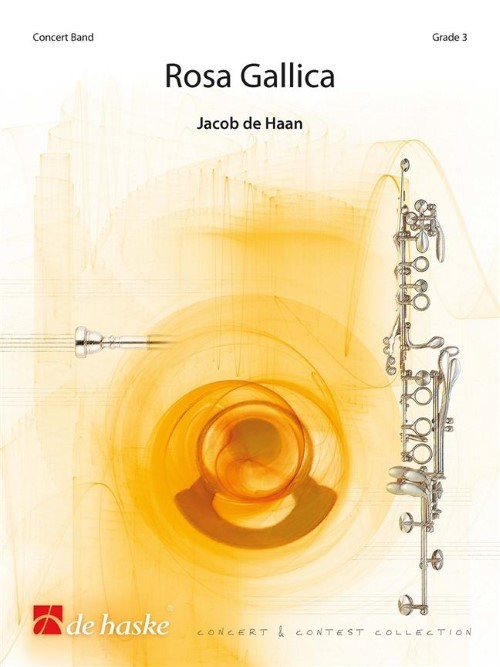
Rosa Gallica (Concert Band - Score and Parts) - De Haan, Jacob
Rosa Gallica has been written to commemorate the centenary of the First World War. The work focuses largely on France as a lot of the fighting took place there. With the title Rosa Gallica (French rose), the composer wishes to emphasize the poetic image of the rose. The stem represents the years gone by - such as those taken up by the First World War - and the thorns refer to the conflict and the pain that the victims had to endure. The rose itself forms the picture of beauty - and symbolises opening up to a peaceful world. The piece depicts France from the end of the 19th century through to its role at the heart of the First World War and beyond. A spectacular and dramatic new work by Jacob de Haan. Duration: 8.30
Estimated dispatch 7-14 working days
-
 £52.95
Escadrille (Concert Band - Score and Parts) - Orcino, Leonard A.
Early in World War I (1916), prior to the USA entering the conflict, Americans joined the French Air Corps. They were originally called the Escadrille Americaine and the name was changed to Escadrille de Lafayette after protest from the Germans that America was not in the war. The Escadrille had a reputation for daring recklessness and a party atmosphere. The corps mascots were two lion cubs, Whiskey and Soda. The insignia was an American Indian head with a flowing war bonnet. The entire squadron merged with the American Air corps (1918) once the USA entered the war.Duration: 2.30
Estimated dispatch 7-14 working days
-
 £64.95
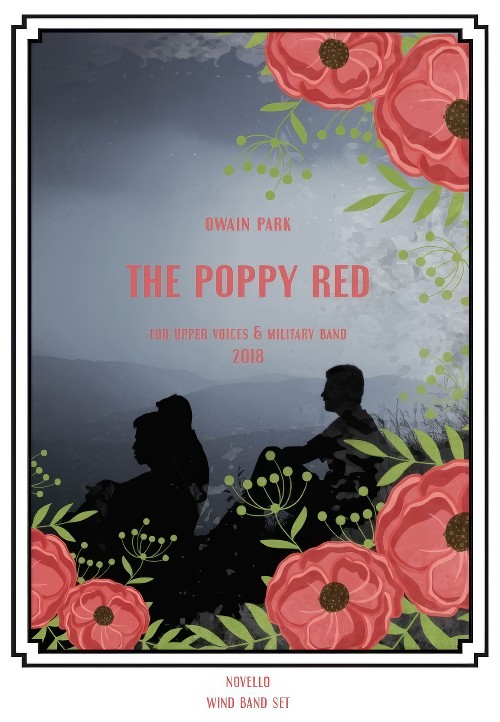
The Poppy Red (Concert Band Accompaniment - Score and Parts) - Park, Owain
Commissioned by the Military Wives Choirs to commemorate the centenary of 1918, the end of the First World War. The Vocal score is available separately - NOV167387-01To mark the centenary of the end of World War I, the Military Wives Choirs - 69 choirs from across Britain and abroad - commissioned Owain to write a piece for their album, 'Remember'. The text for Owain's work, 'The Poppy Red', is inspired by the 1918 poem 'We Shall Keep The Faith' by Moina Michael, itself inspired by John McCrae's 'In Flanders Fields'. The recording brought together 1105 voices with The Band of the Household Cavalry, conducted by Hilary Davan Wetton.
Estimated dispatch 7-14 working days
-
 £2.25
£2.25The Poppy Red (Upper Voices Vocal Score) - Park, Owain
Commissioned by the Military Wives Choirs to commemorate the centenary of 1918, the end of the First World War. The Military Band Accompaniment is available separately - NOV167387To mark the centenary of the end of World War I, the Military Wives Choirs - 69 choirs from across Britain and abroad - commissioned Owain to write a piece for their album, 'Remember'. The text for Owain's work, 'The Poppy Red', is inspired by the 1918 poem 'We Shall Keep The Faith' by Moina Michael, itself inspired by John McCrae's 'In Flanders Fields'. The recording brought together 1105 voices with The Band of the Household Cavalry, conducted by Hilary Davan Wetton.
Estimated dispatch 7-14 working days
-
 £174.99
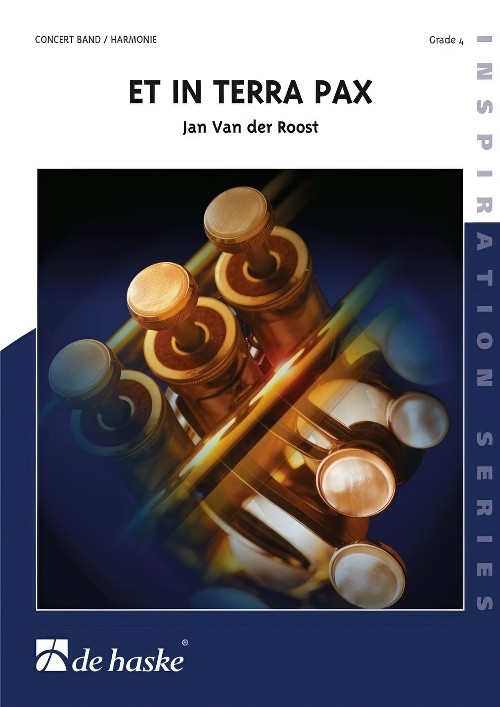
Et in terra Pax (Concert Band - Score and Parts) - Van der Roost, Jan
This piece was commissioned by the Concert Band Vlamertinge and is a plea for peace: the title translates as Peace on Earth. This is expressed by means of the vocal contribution expected from the performers. In various places of the piece you can recognize, the words Et In Terra Pax, an appeal for peace, at first jumbled together but later more rhythmically structured, developing into synchronized massed voices. The work starts with a pentatonic theme based on the notes D, E, G, A and C (taken from 'ConCErtbAnD VlAmErtinGE' and the name of the conductor, NiCk VAnDEnDriessChe). A somewhat sad melody is developed during an orchestral climax which leads to the first explosion of sound (measure 62 onwards). Suddenly the opening measures are recaptured, albeit with a differently coloured sound: the words Et in Terra Pax bring the first movement to a close. A restless Allegro follows which abruptly stops and is replaced by a calming chorale-like passage. A narrator reads aloud the poem 'Sonnet' by the young poet Charles Hamilton Sorley, who was killed during World War I. This poem fittingly puts into words the cruelty and senselessness of war. After the expanded recapitulation of the allegro, the broad, almost infinite atmosphere of the beginning returns. Clarinet and English horn play the pentatonic opening theme once more, this time broadly, while the words Et in Terra Pax are repeated again and again by the rest of the ensemble. The composer has purposely avoided all forms of aggression and bombastic sounds regularly used in works about war. Fear of violence and destruction can be heard and felt during the allegro passages. The charged opening makes way in the end for hope: May peacefulness replace cruelty in everyday life, too.Duration: 13:45
Estimated dispatch 7-14 working days
-
 £149.99
Colditz Castle Wind Band Set (Score & Parts)
Written as a commission by the Stichting de Inrichting foundation of Wijk bij Duurstede (the Netherlands), Rob Goorhuis Requiem voor de mens (Requiem for Man) on lyrics by Andr? van Zwieten was composed in the year 2001. This work for choir and wind-band greatly impressed the audience, whilst its composer remained obsessed by its war theme. When he subsequently heard that the Rundfunk Blasorchester from the German town of Leipzig -a place not far from Colditz - was to dedicate a CD to his work, Rob Goorhuis got the idea to process some of the themes from his Requiem for Man into an instrumental composition about the famous Colditz castle. a place still bearing the scars of war. From 1933 to 1934, the castle was a Schutzhaftlager. During the Second World War, it was used as a prison for senior officers. From this prison, many escapes were undertaken, which even resulted in the castle being nicknamed The Escape School. In the seventies, a television-series about this period made the castle very well-known with the public at large.The despondent tone of the opening theme underscores the sadness caused by wars and violence. Nevertheless the works ending is hopeful and triumphant. Peace is celebrated, but with the hope for a lasting peace sadly remaining a topical issue to the present moment. 09:30
Estimated dispatch 7-14 working days
 View Music