
Results
-
 £159.60
Evocazioni (1985) - Paul Huber
This work, composed in 1985, wants to shake you up and put a spell on you at the same time. Today, humanity is threatened by many dangers, many of which we are not able to banish. We need help from a higher power. The Chorale "Aus tiefer Not schrei' ich zu dir" (from deep distress I cry to you) illustrates this. This motif appears in diverse variations. But, in his arrogance the wicked man does not believe in the rule of evil demons in the world.With the Gregorian melody in the sequence "Dies irae" (day of wrath) from the requiem mass, the nearing of disaster is announced: without God man goes astray. He falls into ruin.To deepen the poignancy of this composition, Paul Huber cited a dramatic episode from his symphony "The nostraie aetatis angoribus" (from the anxiety of our time).
Estimated dispatch 7-14 working days
-
 £90.30
Suite on Russian Dances - Terry Kenny
Since the Soviet Union no longer seems to be that far away from our Western World, we are eager to know Russian music better. Of course, we do prefer the music by Russian composers (such as Salnikov's Children's Symphony). Though many Westeuropean composers now get inspired by the penetrating Russian folk music. Terry Kenny's suite has got three parts: Rondo, Romance and Trepak.
Estimated dispatch 7-14 working days
-
£54.99
Show World - J.J. Richards
Note: This is a reprint from a vintage publication of 1907.THIS SET IS CURRENTLY MISSING A SOPRANO SAX AND Eb CORNET PART. WE ARE WORKING TO RESOLVE THE ISSUE.No conductor score is published for this work. The Solo Cornet part serves as a conductor guide.Parts for Eb Horns are included; no F Horn parts are published for this work.If a C Piccolo/C Flute part was not published originally, one has been subsequently added by our editorial staff.
Estimated dispatch 7-14 working days
-
£204.99
Credentium - Jan Van der Roost
A spectacular dive via an extended chromatic scale immediately submerges us in a charged and somewhat archaic-feeling atmosphere. Trumpets, horns and trombones resound in rhythmic patterns, buttressed by restless motifs in the percussion. A second theme, in the woodwinds, begins much calmer but is quickly pushed aside by that same brass offensive. This introduction is the musical expression of the sometimes tumultuous early history of the town of Peer in Belgium. It closes with a D scale played over two octaves and repeated three times, symbolizing the church steeples that dominate the townscape. Peer has the credentials of a town, and people should know about it.There followsa rhythmic, turbulent passage: in the course of history, Peer has not been spared the ravages of war, arson, occupation, epidemic and other evils. In contrast, a slow, pastoral, lyrical part expresses the periods of peace and prosperity the town has known, as well as the serene geographic setting that still characterizes the place. Various instruments in groups are developed in solo style while the accompaniment displays vast, painterly images of sound. Now and then an exotic intonation is heard: a variety of peoples and cultures have left their mark on the town.This episode of tranquility and peacefulness comes to a sudden end when, via a surprising, almost chaotic transitional passage, we are in effect transported back to our own time. A hopeful, festive march expresses the confidence in the future that the Royal Concert Band of Peer exudes. This confidence is wholly justified: under the direction of conductor Willy Fransen, the 95 members of the concert band have experienced an extended period of good fortune, and the 75 musicians of the youth band - and the 45 little musicians of the mini-band - are involved in thriving operations.
Estimated dispatch 7-14 working days
-
 £113.30
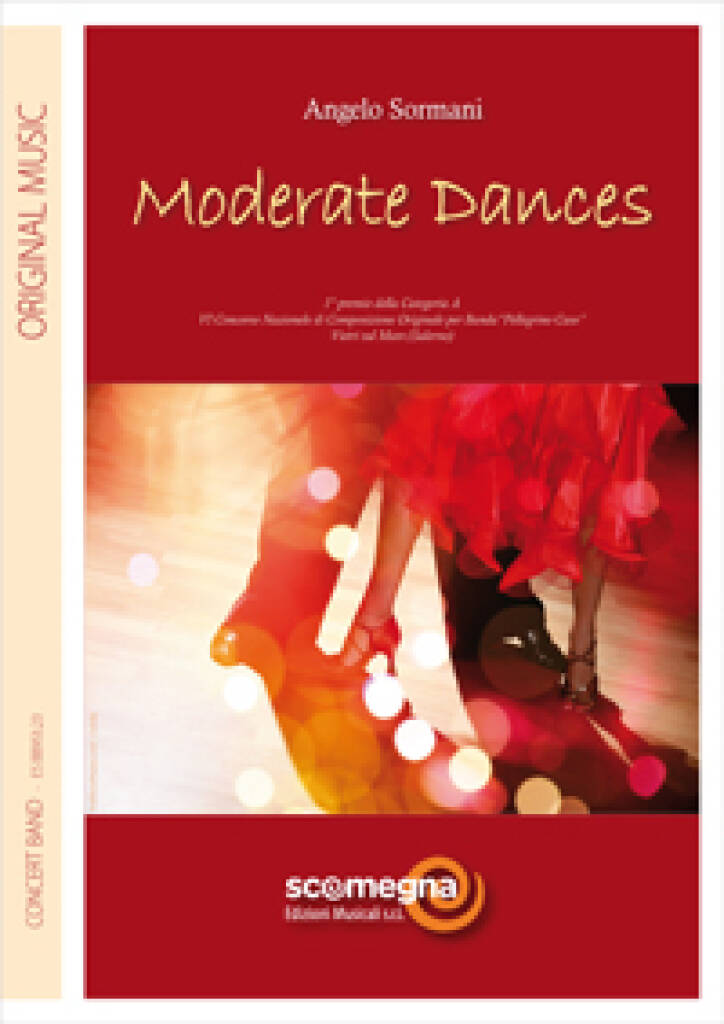
Moderate Dances - Angelo Sormani
This piece is a tribute to dance music, especially passionate, intense and meditative dance music. "Moderate Dances" is divided into three movements: a "Tango", a "Slow Waltz" and a "Bossa Nova". Each movement and each dance has its own particular characteristics but, when combined, these different rhythmic beats and times give the piece a feeling of completeness and uniformity. The Tango started to flourish in the suburbs of Buenos Aires in around 1880. There is still some doubt as to its origins, which may be Cuban (Habanera) but are probably African. It was most popular in Argentina and Brazil: here the male protagonist was originally the "gaucho" with his inseparable guitar, later to be replaced by the proud, elegant "compadre". By around 1910 the Tango had spread to Italy and France. New clubs opened, where the upper classes could watch and dance the Tango. Here the dance also underwent some rapid transformations. The exaggerated and extravagant gestures and body movements disappeared. Slow, gliding steps replaced the old rotational movements. The women's red ankle-boots and the partners "staring into each other's eyes" accentuated the erotic nature and sensuality of this dance. So much so that, in 1913, the German government banned soldiers from dancing the Tango. Those who broke the law were immediately discharged from the army. From a strictly musical perspective, the basic instruments were a flute, a harp (the diatonic harp typically played by the Indians of Paraguay) and a violin, or flute, guitar and violin or even clarinet, guitar and violin. These instruments were easy to transport, ideal for playing at parties, in the streets and in courtyards. The musicians played by ear, frequently improvising: there were no scores, no records, which is the main reason why it is impossible to trace the Tango back to its exact origins. However, the Tango's evolution (and growing popularity) was once again fostered by its fundamental ability to absorb "other" cultures, languages and sounds. And it was the arrival of the "bandoneon" (an accordion-like instrument that was invented in Germany and brought to Rio de la Plata by some immigrant), which replaced the flute, that marked the beginning of the Tango's huge success outside Argentina. A number of talented composers, above all the great Astor Piazzola (1921-1992), transformed the bandoneon from a simple accompanying instrument to a solo instrument that was to become the distinguishing feature of the 20th century Tango. The Slow Waltz originated from the Waltz, the typical dance of the Bavarian and Tyrolese peasants in the 1700s. It was composers like Johann Strauss, father and son, who carried the Waltz to its zenith in the 1800s, creating the sensual and melancholy yet joyful and charming dance we are all familiar with. When the Waltz first became popular in Germany, the members of respectable society were shocked at the closeness of the dancing partners, who had always previously danced apart. The main difference between the Waltz and Slow Waltz is that the latter has a slower, more expressive rhythm: the men wear tails and the women wear ball gowns decorated with beads and feathers and couples dance in graceful rotational movements. "Bossa Nova" is the title of the last movement in the piece. Jobim, the great Brazilian musician, described this musical genre as a combination of modern Jazz and Samba. Bossa Nova means "new wave". This was the name of the artistic and musical movement that evolved in Brazil in the late Fifties and was extremely popular throughout the Sixties. The songs are usually about love or social matters, drawing inspiration from the slums of Rio De Janeiro and the lives of their inhabitants. Bossa Nova, with its original compositions and the artistic talent of its musicians, also became hugely popular in the United States and Europe, and top Jazz musicians (Ella Fitzgerald, Stan Getz, Bob Cooper, Charlie Bird, Sonny Rollins, Dexter Gordon, Dizzy Gillespie) started to include Bossa in their repertoires.
Estimated dispatch 7-14 working days
-
 £72.99
Wind Power - Robert Buckley
In this impressive piece, the title Wind Power can refer either to the various machines that are driven by the wind, or the soaring sound of a wind band. In a cinematic style, this work opens powerfully with a series of tone clusters followed by a constantly moving series of notes depicting the ebb and flow of the wind. Then we are soaring high above the ground in a glider with only the sound of the wind keeping us aloft. With dramatic shifts in dynamics along with pulsing rhythms, this piece is a fun challenge for all members of the ensemble. Dur: ca. 5:00
Estimated dispatch 7-14 working days
-
 £137.99
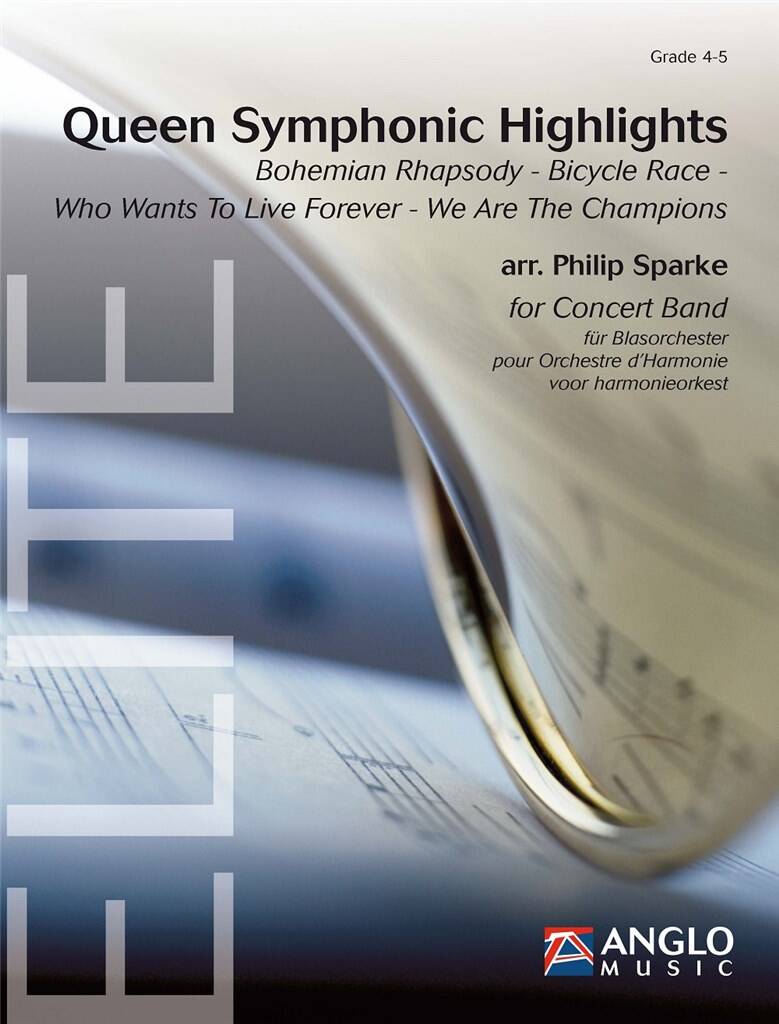
Queen Symphonic Highlights
The British rock band Queen, formed in 1970, are one of the most popular bands of all time. The music of Queen already exists in numerous instrumental arrangements at all kinds of levels. However, arranger Philip Sparke has taken a unique approach: he has created an exceptional medley in a challenging, symphonic style from four of their greatest hits: 'Bohemian Rhapsody', 'Bicycle Race', 'Who Wants to Live Forever' and 'We Are the Champions'.
Estimated dispatch 7-14 working days
-
 £60.99
The Willow Tree - Pádraigín Ní Uallacháin
Although this haunting tune has the flavor and sentiment of a traditional Irish folk song, it was composed in 1995 by multifaceted artist Pdraign N Uallachin. Her inspiration for the song was the idea that when we are happy or sad, the elements and the natural world are aligned with our feelings. From the wistful lyrics of the song; Down by the river there's a tall willow tree, who weeps all night for you and me. This evocative setting for band follows this sentiment through peaks and valleys of sound and emotion. Dur: 3:10
Estimated dispatch 7-14 working days
-
 £495.00
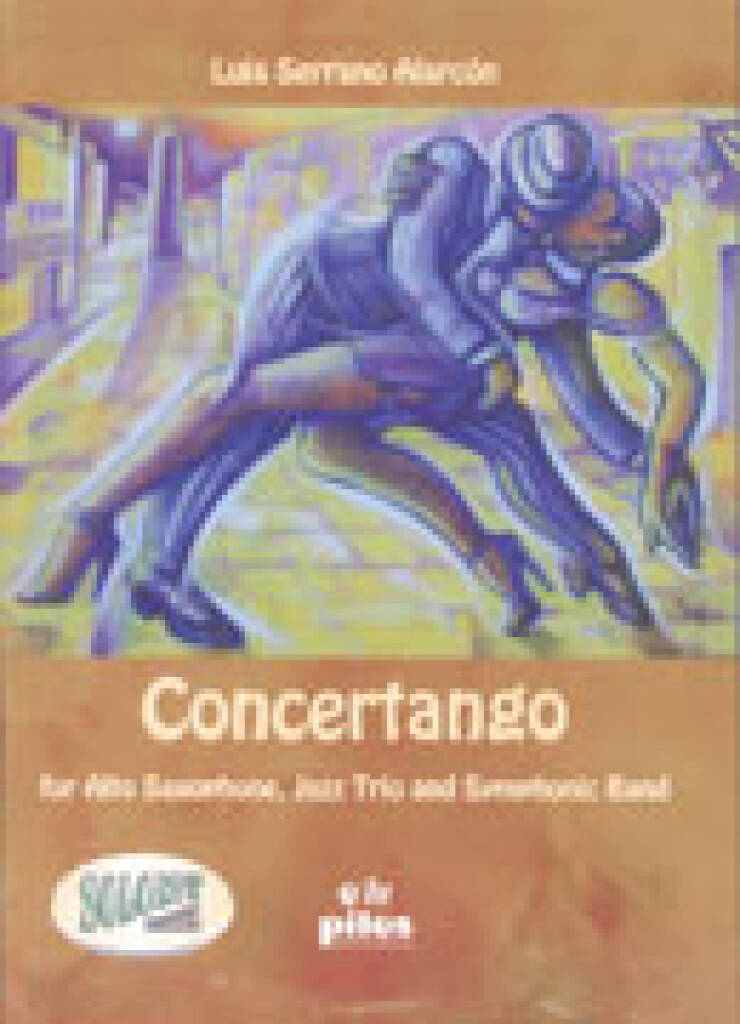
Concertango - Luis Serrano Alarcón
Opus III is proud to announce that we are now the exclusive distributor for North America and Asia of Concertango, by Luis Serrano Alarcn. A 25 minute work exploring musical fusion on multiple levels through the contrast of symphonic winds to a jazz trio (piano, bass, drums). Both groups are independent at times followed by a merge into a single unique musical force. The alto saxophone soloist stands as the uniting musical element between the two groups. The omnipresent and uniting musical force is the tango and, in particular, the works of Astor Piazzolla. Luis Serrano Alarcn has transformed the rhythms, ensemble settings and stylistic idioms into a powerful artistic statement that communicates to all. A highly effective work for mature ensembles.
Estimated dispatch 7-14 working days
-
 £87.99
A Life Well Lived - Rob Romeyn
Every now and then we are fortunate enough to know people who make lasting impressions, seem larger than life, and are just memorable. "A Life Well Lived" by Rob Romeyn, dedicated to the memory of his lifelong friend Jeff Norman, presents a powerful and triumphant message of personal courage, strength, and grace... a true celebration of life. The music begins with a transparent, ethereal quality that seems almost too perfect for this world. From here, a hauntingly beautiful melody is introduced. This melody develops and evolves, finally maturing into a statement of incredible emotion and power. After a breathtaking climax, the intensity subsides, back to the exquisite quality from which the music began, finally ending with a heartfelt spell that will not soon be forgotten. A very emotional, lyrical piece of uncommon quality, not to be overlooked. Our highest recommendation!
Estimated dispatch 7-14 working days
 View Music