
Results
-
£184.99
Rubicon - Bert Appermont
The Rubicon is a river in Northern Italy which Julius Caesar crossed with his army in 49 BC in defiance of the leaders of Rome, who feared his power. A civil war against rival Pompey ensued, which culminated in Caesar seizing power as the absoluteruler of Rome. The phrase "crossing the Rubicon" therefore refers to any person committing himself irrevocably to a risky, decisive and irrevocable of course of action.The work consists of three parts that deal with this important moment in history.Part 1 (Meditation) symbolises Caesars request to the Gods to assist him in his difficult choice. In a slow introduction we hear the melancholy and beseeching sounds of the duduk (alternatively, this part can be played by a soprano saxophone)and of the soprano solo singer over the bourdon accompaniment. The soprano solo singer then sings "dona tibi pacem" (give him rest) in a melodious and probing theme.In Part 2 (Battle of Pharsalus) trumpets and trombones resound alternately ina stately Roman fanfare, producing a stereophonic effect. This develops into a martial theme in which Caesars impressive army goes to battle against the army of rival Pompey. While the theme of Caesars army fades away, Pompeys theme emerges as anaive dance in six-eight time. His army is definitely in the majority and it believes it can easily defeat the enemy. Suddenly trumpets and trombones clash on two sides of the orchestra: Caesars army advances and attacks. A fierce battle ensues inwhich the two themes are played alternately as well as simultaneously. Thanks to his shrewd battle tactics, Caesar manages to win this legendary battle after all: his theme resounds ever louder in trumpets and horns until everything dies out andchanges into a kind of reconciliation between the soldiers of the two armies. The melancholy "dona tibi pacem" from part 1 now serves as a reconciliation theme.Caesar is now the sole ruler of the New Roman Empire, which would be destined to leave itsmark on our Western civilisation to this day. The third part is a sparkling succession of dance music (Dance) with many Greek and Roman elements in which Caesars victory is praised and celebrated. It is common knowledge that the culture(arts, gods, etc.) of the Romans drew heavily on Greek culture. I have therefore used an authentic Greek theme (the Seikolos song) several times in this part (bar 17 in the euphonium, bar 60 in the base section, bar 68 in the sopranosaxophone) to suggest the music of that era and to evoke the right atmosphere. After a gradual increase in tempo in the entire orchestra, the opening melody gloriously resounds once more, surrounded by virtuoso dance music. The work ends withbombastic brass fanfares in which Caesars theme triumphs once more.NOTE FOR THE CONDUCTOR:The Armenian duduk and the monochord that are used in the introduction give a special tone to the music, but could be substituted (soprano saxophone instead ofthe duduk) or left out (monochord). The soprano solo is also doubled within the orchestra and could therefore also be left out if necessary, although it does provide the work with an extra dimension. The male voices in the introduction and the finalecould possibly be replaced with a synthesizer with choral setting.As a visual and acoustic element in part 2, the trumpets, the e-flat cornet, the small drum and trombones can be stood up and placed at two sides of the orchestra (bar 80).Seen fromthe point of view of the conductor, put the trumpets, the e-flat cornet and the small drum in the left section and the trombones in the right section of the orchestra. This also helps to create a visual contrast between the two themes of the secondpart. The players can be seated again at bar 97 or bar 121. The soprano soloist can be placed in or in front of the orchestra, depending on what gives the best result. For the conclusion of the work the soprano solo can be sung from afar (from thewings) to create additional atmosphere.This work was composed especially for the "St Joseph" brass band from Pey/Echt (Belgium) with conductor Mark Prils.
Estimated dispatch 7-14 working days
-
 £104.99
A Little Irish Suite - Marco Pütz
A Little Irish Suite is an original work composed specifically for the Compact Band Series. This series offers smaller ensembles the opportunity to perform original, high-quality works. A Little Irish Suite consists of three movements, all based on Irish folk tunes. Clear structure and crisp harmonies complemented by plain, comprehensible melodies, are characteristic of this piece. It offers conductors the opportunity to work on tone, balance, phrasing as well as on technique with their ensemble. As with all works in the Compact Band Series, A Little Irish Suite features optional parts for instruments that are played less frequently. Conductors can pickand choose the parts needed to best fit the music and the musicians available, to determine the best possible instrumentation for their own ensemble. The duration of six minutes and the large variety and contrast of material played in A Little Irish Suite also make it an ideal selection for competitions or festivals.
Estimated dispatch 7-14 working days
-
 £38.50
Teachers from Outer Space! - Amy Adam
You can't lose when you get your administrators or other staff members involved in your performance. Teachers from Outer Space is a hilarious comedy skit for band that lets three or more of your staff members temporarily become outer space aliens and use every corny outer space joke in the book! If you are looking for a funny contrast highlight - greetings Earthling, you've found it!
Estimated dispatch 7-14 working days
-
 £134.99
Dublin Pictures - Marc Jeanbourquin
Ireland is a multi-faceted country that has developed a popular and distinctive musical culture. The first movement of Dublin Pictures reflects Irish festivals where there is dancing and traditional beer flowing. More tranquil in its feel, the second movement illustrates the landscape that can be seen from the Ha'penny Bridge, a bridge that crosses the River Liffey in Dublin. This movement highlights the wide range of the orchestra's sound colours as the musicians' voices combine with the wind and percussion to accompany the soloist. The lively and joyful rhythms of the last movement take the listener to Temple Bar, the famous tourist quarter of the city, well knownfor its vibrant nightlife. The music's energy and virtuosic motifs are in contrast to the previous movement and provide a spirited and festive finale.Marc Jeanbourquin wrote this piece in three movements for Azimuts Brass in 2011. He then arranged it for Concert, Fanfare or Brass Band
Estimated dispatch 7-14 working days
-
 £94.00
Popocatepetl
This suite of three short movements depicts Popcatepetl, a dormant volcano in Mexico. Useful for developing understanding of this form, the composition includes overture, ballad, and Latin styles. Opportunities abound for teaching the concepts of dynamic contrast, balance between sections, and rhythmic development. There are several short solos, but most of the composition works on the development of full-ensemble skills. Although the movements can be performed as stand-alone selections, the entire suite is less than 6 minutes in length.
Estimated dispatch 12-14 working days
-
 £47.80
Illuminate - Wind Band (Andrew Wainwright)
Written for the Chicago Staff Band's tour of England in 2015, this exhilarating work was premiered at The Salvation Army's Boundless International Congress at London's O2 Arena to an audience of 20,000 people. It has since been arranged here for wind band. The piece is structured as a through-composed triptych, weaving together the popularcontemporary worship songs Shine on Us (Michael W. Smith) and Speak, O Lord (Keith and Kristin Getty) with the historic Salvationist anthem The World for God (Evangeline Booth) to explore themes of light, guidance, and mission. The work opens with energy and rhythmic drive, centering on Shine on Us. A stark contrast follows in the meditative middle section. Here, the music explores the contemplative depths of Speak, O Lord, featuring solo horn. The final section introduces a nostalgic and stirring reference to General Evangeline Booth's classic hymn, The World for God. The finale juxtaposes all three themes. As the disparate melodies intertwine and layer upon one another, the music builds to a triumphant climax - a representation of 'illumination' that celebrates a shared faith across generations. PDF download includes score and full set of parts. To view a video of All-Virginia Symphonic Band performing the work please visit: https://www.youtube.com/watch?v=EDhIsM7r4qQ Sheet music available from : UK: www.wind-band-music.co.uk USA: www.solidbrassmusic.com Difficulty Level: Medium Advanced Instrumentation: Piccolo Flute 1-2 Oboe 1-2 Bassoon 1-2 Clarinet in Bb 1-3 Bass Clarinet in Bb Alto Saxophone Tenor Saxophone Baritone Saxophone Trumpet in Bb 1-3 Horn in F 1-4 Trombone 1-2 Bass Trombone Euphonium Tuba Double Bass Timpani Percussion 1-2
In stock: Estimated dispatch 1-3 days
-
 £149.99
St. Martin's Suite (Concert Band - Score and Parts) - Van der Roost, Jan
This suite was composed by Jan Van der Roost on the occasion of the 110th anniversary of the 'Koninklijke Sint Martinusfanfare' (Royal Saint Martinus Fanfare Band) from Halle (Belgium). The composer was required to create a suite in three movements based on three images associated with the 'Sint Martinusfanfare' from the small town of Halle in the province of Brabant. The first movement (Andante Pomposo) describes Martin, a soldier in the Roman army. In Andante Moderato we see the image of Martin, who become a Christian and chooses to devote his life to God. In this movement, the composer was inspired by the Brabantine gothic art of the Sint Martinus Basilica in Halle. The contrast between the dark Basilica and the statue of Our Lady between the soaring pillars will vividly come to life for audiences of this descriptive piece. The final movement, Allegro Molto Vivace', could have been an image for a frivolous peasant in the Halle carnival. In a triptych about St. Martin it is more fitting to refer to it as an apotheosis, the crown on the pastoral work of Martin, Bishop of Tours, Patron Saint of the Fanfare Band and the Basilica of Halle.Duration: 13:30
Estimated dispatch 7-14 working days
-
 £87.95
St. Francis Variations (Concert Band - Score and Parts) - Wheeler, Alastair
Variations on St Francis is a set of four contrasting movements based on the sturdy 17th century hymn tune Lasst uns erfreuen, best known as St Francis after its composer with associated words "All creatures of our God and King". Although often notated in various metres, the tune's original unbarred freedom and Vaughan Williams' later 3/2 setting both inform this work's flexible approach to rhythm and stress.The piece is built from three ideas: the bold opening line of the tune, descending peals of Alleluia, and the answering response phrase.A grand March opens the work, with open-fifth fanfares and flowing Alleluia countermelodies. The Dance that follows shifts the response into a minor key, driven by syncopation and playful overlapping lines. A lyrical Cantabile / Intermezzo, led by cor anglais (or alto saxophone), offers contrast before a Rondo Scherzo reimagines the tune in a quirky modal style, featuring falling thirds and bright harmonic colour. A confident Coda brings the work to a close with chorale statements launched from the percussion section.Duration: 7.30
Estimated dispatch 7-14 working days
-
 £17.95
St. Francis Variations (Concert Band - Score only) - Wheeler, Alastair
Variations on St Francis is a set of four contrasting movements based on the sturdy 17th century hymn tune Lasst uns erfreuen, best known as St Francis after its composer with associated words "All creatures of our God and King". Although often notated in various metres, the tune's original unbarred freedom and Vaughan Williams' later 3/2 setting both inform this work's flexible approach to rhythm and stress.The piece is built from three ideas: the bold opening line of the tune, descending peals of Alleluia, and the answering response phrase.A grand March opens the work, with open-fifth fanfares and flowing Alleluia countermelodies. The Dance that follows shifts the response into a minor key, driven by syncopation and playful overlapping lines. A lyrical Cantabile / Intermezzo, led by cor anglais (or alto saxophone), offers contrast before a Rondo Scherzo reimagines the tune in a quirky modal style, featuring falling thirds and bright harmonic colour. A confident Coda brings the work to a close with chorale statements launched from the percussion section.Duration: 7.30
Estimated dispatch 7-14 working days
-
 £77.50
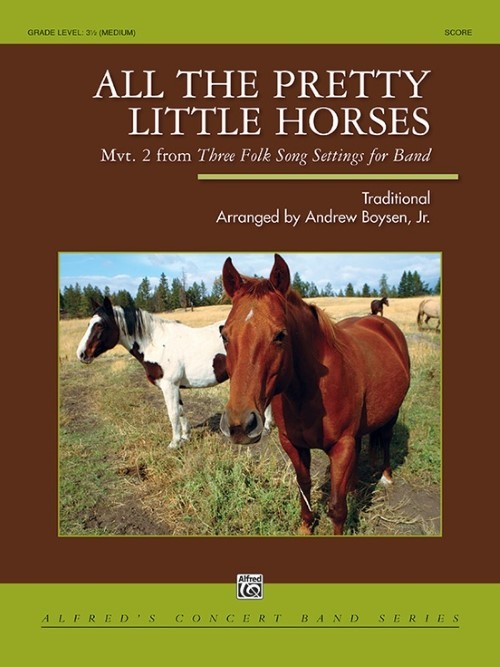
All the Pretty Little Horses (Concert Band - Score and Parts) - Boysen Jr, Andrew
The second movement of Three Folk Song Settings for Band, All the Pretty Little Horses provides a lyrical contrast to the two outer movements. This lullaby is thought to be of African-American origin.Duration: 4.30
Estimated dispatch 7-14 working days
 View Music