
Results
-
 £120.40
Intermissions - Daniele Carnevali
This piece was commissioned by the organising committee of the "La Prime Luz 1812" national band contest, held in Bertiolo (Udine), as the compulsory piece for category A. It consists of three movements and, rated as a first international category or national excellence grade piece, it requires the appropriate variety of timbres and instrumentalists with the necessary skills. The themes, enhanced by the use of unusual tones and compound beats, are often broken, interrupted: hence the title of the piece, intermissions, meaning interruptions. The unifying element is the musical language that, through the use of artificial modes and fourths, seeks to create a balance between tensions of differing intensity and nature.
Estimated dispatch 7-14 working days
-
 £113.30
Moderate Dances - Angelo Sormani
This piece is a tribute to dance music, especially passionate, intense and meditative dance music. "Moderate Dances" is divided into three movements: a "Tango", a "Slow Waltz" and a "Bossa Nova". Each movement and each dance has its own particular characteristics but, when combined, these different rhythmic beats and times give the piece a feeling of completeness and uniformity. The Tango started to flourish in the suburbs of Buenos Aires in around 1880. There is still some doubt as to its origins, which may be Cuban (Habanera) but are probably African. It was most popular in Argentina and Brazil: here the male protagonist was originally the "gaucho" with his inseparable guitar, later to be replaced by the proud, elegant "compadre". By around 1910 the Tango had spread to Italy and France. New clubs opened, where the upper classes could watch and dance the Tango. Here the dance also underwent some rapid transformations. The exaggerated and extravagant gestures and body movements disappeared. Slow, gliding steps replaced the old rotational movements. The women's red ankle-boots and the partners "staring into each other's eyes" accentuated the erotic nature and sensuality of this dance. So much so that, in 1913, the German government banned soldiers from dancing the Tango. Those who broke the law were immediately discharged from the army. From a strictly musical perspective, the basic instruments were a flute, a harp (the diatonic harp typically played by the Indians of Paraguay) and a violin, or flute, guitar and violin or even clarinet, guitar and violin. These instruments were easy to transport, ideal for playing at parties, in the streets and in courtyards. The musicians played by ear, frequently improvising: there were no scores, no records, which is the main reason why it is impossible to trace the Tango back to its exact origins. However, the Tango's evolution (and growing popularity) was once again fostered by its fundamental ability to absorb "other" cultures, languages and sounds. And it was the arrival of the "bandoneon" (an accordion-like instrument that was invented in Germany and brought to Rio de la Plata by some immigrant), which replaced the flute, that marked the beginning of the Tango's huge success outside Argentina. A number of talented composers, above all the great Astor Piazzola (1921-1992), transformed the bandoneon from a simple accompanying instrument to a solo instrument that was to become the distinguishing feature of the 20th century Tango. The Slow Waltz originated from the Waltz, the typical dance of the Bavarian and Tyrolese peasants in the 1700s. It was composers like Johann Strauss, father and son, who carried the Waltz to its zenith in the 1800s, creating the sensual and melancholy yet joyful and charming dance we are all familiar with. When the Waltz first became popular in Germany, the members of respectable society were shocked at the closeness of the dancing partners, who had always previously danced apart. The main difference between the Waltz and Slow Waltz is that the latter has a slower, more expressive rhythm: the men wear tails and the women wear ball gowns decorated with beads and feathers and couples dance in graceful rotational movements. "Bossa Nova" is the title of the last movement in the piece. Jobim, the great Brazilian musician, described this musical genre as a combination of modern Jazz and Samba. Bossa Nova means "new wave". This was the name of the artistic and musical movement that evolved in Brazil in the late Fifties and was extremely popular throughout the Sixties. The songs are usually about love or social matters, drawing inspiration from the slums of Rio De Janeiro and the lives of their inhabitants. Bossa Nova, with its original compositions and the artistic talent of its musicians, also became hugely popular in the United States and Europe, and top Jazz musicians (Ella Fitzgerald, Stan Getz, Bob Cooper, Charlie Bird, Sonny Rollins, Dexter Gordon, Dizzy Gillespie) started to include Bossa in their repertoires.
Estimated dispatch 7-14 working days
-
 £196.50
Fanfare- Reminiscence and Celebration - Ellen Taaffe Zwilich
Originally composed for orchestra with 3 offstage brass sextets, Fanfare; Reminiscence and Celebration has been re-created by Ellen Taaffe Zwilich for symphonic band plus three offstage brass sextets for a dazzling theater-in-the-round concert experience. The score is provided in 11x17 format for ease in reading. For advanced and university ensembles. Dur.: 12
Estimated dispatch 7-14 working days
-
 £168.50
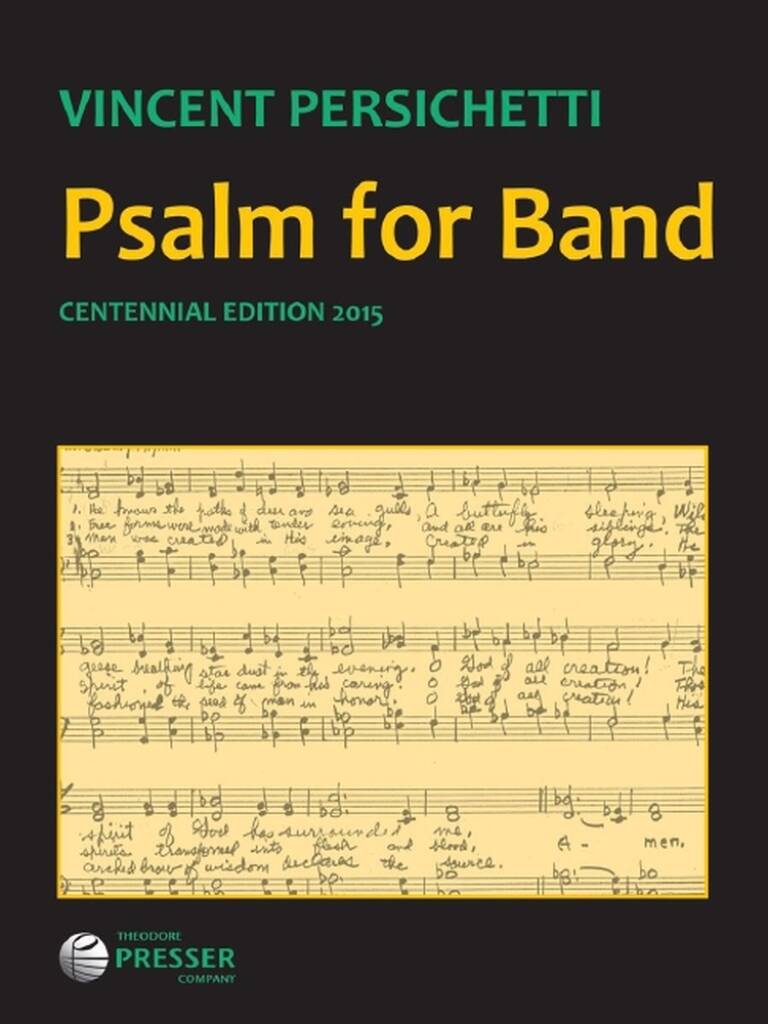
Psalm for Band - Vincent Persichetti
Psalm for Band is a piece constructed from a single germinating harmonic idea. There are three distinct sections - a sustained chordal mood, a forward moving chorale, followed by a Paean culmination of the materials. Extensive use is made of separate choirs of instruments supported by thematic rhythms in the tenor and bass drums. Psalm was selected for performance at the CBDNA Convention in December 1952 as one of the eight most outstanding compositions for band written in the previous several years. Theodore Presser Company editor Daniel Dorff, on the new Centennial Edition, explains, "The 1954 Elkan-Vogel publication had a full score in a calligrapher's hand that was quiteaccurate, and a set of parts that was problematic in readability and accuracy. The present 2015 edition is faithful to and compatible with the original published score, with carefully and cleanly prepared parts bearing cues, easy page turns, and individual parts for each player."
Estimated dispatch 7-14 working days
-
£196.50
Downshifting - Dan Welcher
Commissioned by a consortium of 20 high school and university bands coordinated by Scott Hanna of the University of Texas at Austin, Downshifting is inspired by Welcher's joy of bicycle riding. Welcher explains in the program note: When I decided to write a piece for band that was basically entertaining and uplifting, it made perfect sense to call it Downshifting... With three gears on the front sprocket and seven on the rear, it's possible to keep one's legs going at a constant speed (for me, q = 126) while the bike itself may be moving very slowly or very quickly. I determined to capitalize on this in writing Downshifting, which keeps the same mathematical inner pulse,'shifting' (with a ratchet) as the terrain changes.
Estimated dispatch 7-14 working days
-
 £71.50
Ancient Ritual - Elliot Del Borgo
This programmatic work depicts a primitive rite in sound. Cast in three sections, the piece uses contemporary harmonies and colorful percussion to display the moods and energies of a long-ago ceremony. This is the first addition to this series by the prominent American composer Elliot Del Borgo, and adds a new dimension. (3 minutes)
Estimated dispatch 7-14 working days
-
 £104.50
Fanfare Intermezzo and Dance - David Gorham
Commissioned by the North Hills Symphonic Band of Pittsburgh, PA, this composition provides three contrasting settings in the Gorham style that have become a favorite with school bands, and is sure to become a "standard" for program and festival performance.
Estimated dispatch 7-14 working days
-
 £104.50
Second Connecticut Regiment - D. D. Reeves
David W. Reeves (1838-1900) was a skilled cornet soloist and band leader. He was called the "Father of Band Music in the U.S.A." He wrote over 150 marches, galops and polkas. In 1981, The Second Connecticut Regiment was named one of the three "most worthy marches" by Col. William Santelmann, Director of the United States Marine Band. This new edition, by another former conductor of the Marine Band, brings the work up to the standards of his former bands library.
Estimated dispatch 7-14 working days
-
 £82.50
Silver Jubilee Overture - John Edmondson
The 1984 effort by the well-known composer is currently found on several state lists. Three contrasting sections make up the Overture, beginning with a brisk rhythmic introduction which is followed by a slow melodic theme featuring flutes. An entrance by the percussion brings back the original theme with the full band building to a majestic finale. ( 5 minutes 30 seconds)
Estimated dispatch 7-14 working days
-
 £71.50
If You're Happy - Robert E. Foster
This one is a natural for that lighter moment in your young bands concert! The students and the audience will have fun with the hand claps and foot stomps. Theres lots of great teaching points too as your band gets to move through three simple keys!
Estimated dispatch 7-14 working days