
Results
-
 £69.95
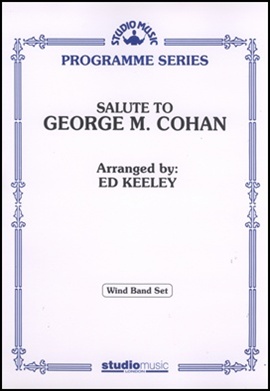
SALUTE TO GEORGE M. COHAN (Programme Concert Band) - Keeley, Ed
This medley presents four of the biggest Cohan hits: I'm a Yankee Doodle Dandy; Mary's a Grand Old Name; Give My Regards to Broadway; Over There. This last title has had great prominence in the UK recently with a pseudo operatic performance being used for a successful TV insurance advertisement 'Go Compare'. This took the song back to its roots as the first recording of it was by the great Italian tenor, Caruso.
Estimated dispatch 7-14 working days
-
 £69.99
Two Israeli Folksongs (Wind Band - Score and Parts)
This piece features two folksongs from Israel, each portraying a different mood. The first section.'Ma Averech'(How shall this child be blessed) is calm and nostalgic, with a slight hint of melancholy. In the second section,'Zemer Atik' (Old Song), the celebration breaks out! An exciting, varied composition that your band will love playing!Duration:4:30
Estimated dispatch 7-14 working days
-
 £57.50
WONDROUS STAR (Intermediate Concert Band) - Johnson, Timothy
This item may be Print on Demand (approx 3 weeks). Whether a powerful opener or a thrilling centerpiece, this stirring new arrangement of "We Three Kings" maintains relentless momentum. Melodic and orchestrational surprise after surprise unfolds. Timothy Johnson gives this delightful old favorite an entirely new wardrobe in an arrangement that bears great gifts for the musicians and the audience alike.
Estimated dispatch 7-14 working days
-
 £123.20
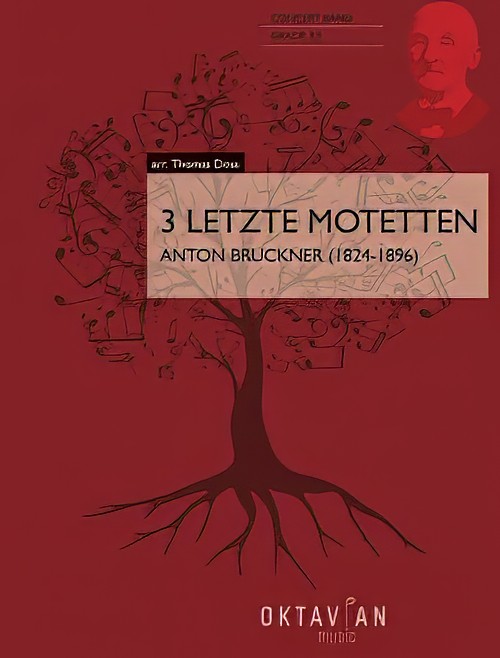
3 Letzte Motetten (Concert Band - Score and Parts) - Bruckner, Anton - Doss, Thomas
Anton Bruckner (b. 4.9.1824, Ansfelden, d. 11.10.1896, Vienna) didn't have it easy. Throughout his life, the Austrian composer was plagued by self-doubt. Anton Bruckner came from a simple, rural background. After the death of his father, he was accepted as a choirboy at the monastery of Sankt Florian in 1837. After several years as a school assistant and his own organ and piano studies, he first worked as organist in St. Florian, then from 1855 as cathedral organist in Linz. Introduced to music theory and instrumentation by Simon Sechter and Otto Kitzler, he discovered Richard Wagner as an artistic role model, whom he admired throughout his life and also visited several times in Bayreuth. In 1868 Anton Bruckner became professor of basso continuo, counterpoint and organ at the Vienna Conservatory; ten years later court organist; and in 1891 finally honorary doctor of the University of Vienna. He was considered an important organ virtuoso of his era, but had to wait a long time for recognition as a composer. It was not until Symphony No.7 in E major, composed between 1881 and 1883, with the famous Adagio written under the effects of Wagner's death, that he achieved the recognition he had hoped for, even if he was reluctant to accept it given his inclination towards scepticism and self-criticism. Anton Bruckner was a loner who did not want to follow a particular school or doctrine. He composed numerous sacred vocal works, such as his three masses, the Missa Solemnis in B flat minor (1854), the Te Deum (1881-84) and numerous motets. As a symphonic composer, he wrote a total of nine symphonies and many symphonic studies from 1863 onwards, tending to revise completed versions several times over. Bruckner's orchestral works were long considered unplayable, but in fact were merely exceptionally bold for the tonal language of their time, uniting traditions from Beethoven through Wagner to folk music, on the threshold between late Romanticism and Modernism. Anton Bruckner composed about 40 motets during his lifetime, the earliest a setting of Pange lingua around 1835, and the last, Vexilla regis, in 1892. Thomas Doss has compiled some of these motets in this volume for symphonic wind orchestra. These motets show many characteristics of personal expression, especially Bruckner's colourful harmony in the earlier works, which is in places aligned with Franz Schubert (changes between major and minor; and movements in thirds). Later works are characterised by many components which, in addition to the expanded stature of the movements, include above all a sense of the instrumentation as an outward phenomenon and the harmony as a compositional feature that works more internally. Some aspects of Bruckner's work are the result of his long period of study, which familiarised him not only with the tradition of his craft, but also gave him insights into the "modernity" of his time in such composers as Wagner, Liszt and Berlioz. From this developed his personal standpoint, which always pursues the connection between the old and the new.Duration: 14.00
Estimated dispatch 7-14 working days
-
 £256.00
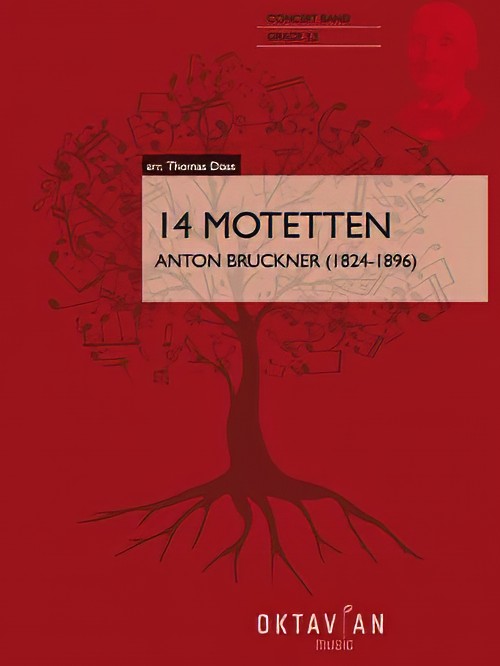
14 Motetten (Concert Band - Score and Parts) - Bruckner, Anton - Doss, Thomas
Anton Bruckner (b. 4.9.1824, Ansfelden, d. 11.10.1896, Vienna) didn't have it easy. Throughout his life, the Austrian composer was plagued by self-doubt. Anton Bruckner came from a simple, rural background. After the death of his father, he was accepted as a choirboy at the monastery of Sankt Florian in 1837. After several years as a school assistant and his own organ and piano studies, he first worked as organist in St. Florian, then from 1855 as cathedral organist in Linz. Introduced to music theory and instrumentation by Simon Sechter and Otto Kitzler, he discovered Richard Wagner as an artistic role model, whom he admired throughout his life and also visited several times in Bayreuth. In 1868 Anton Bruckner became professor of basso continuo, counterpoint and organ at the Vienna Conservatory; ten years later court organist; and in 1891 finally honorary doctor of the University of Vienna. He was considered an important organ virtuoso of his era, but had to wait a long time for recognition as a composer. It was not until Symphony No.7 in E major, composed between 1881 and 1883, with the famous Adagio written under the effects of Wagner's death, that he achieved the recognition he had hoped for, even if he was reluctant to accept it given his inclination towards scepticism and self-criticism. Anton Bruckner was a loner who did not want to follow a particular school or doctrine. He composed numerous sacred vocal works, such as his three masses, the Missa Solemnis in B flat minor (1854), the Te Deum (1881-84) and numerous motets. As a symphonic composer, he wrote a total of nine symphonies and many symphonic studies from 1863 onwards, tending to revise completed versions several times over. Bruckner's orchestral works were long considered unplayable, but in fact were merely exceptionally bold for the tonal language of their time, uniting traditions from Beethoven through Wagner to folk music, on the threshold between late Romanticism and Modernism. Anton Bruckner composed about 40 motets during his lifetime, the earliest a setting of Pange lingua around 1835, and the last, Vexilla regis, in 1892. Thomas Doss has compiled some of these motets in this volume for symphonic wind orchestra. These motets show many characteristics of personal expression, especially Bruckner's colourful harmony in the earlier works, which is in places aligned with Franz Schubert (changes between major and minor; and movements in thirds). Later works are characterised by many components which, in addition to the expanded stature of the movements, include above all a sense of the instrumentation as an outward phenomenon and the harmony as a compositional feature that works more internally. Some aspects of Bruckner's work are the result of his long period of study, which familiarised him not only with the tradition of his craft, but also gave him insights into the modernity of his time in such composers as Wagner, Liszt and Berlioz. From this developed his personal standpoint, which always pursues the connection between the old and the new.Duration: 39.00
Estimated dispatch 7-14 working days
-
 £65.00
Hymnsong from Mannin Veen (Concert Band - Score and Parts) - Wood, Haydn - Longfield, Robert
Composed in 1933, Haydn Wood's classic work "Mannin Veen: A Manx Tone Poem" has remained a staple in the wind band repertoire. The opening segment of the work is based on the folk hymn "The Good Old Way." Robert Longfield has carefully adapted this stunning section as a stand-alone chorale scored for contemporary band instrumentation. Duration: 2.30
Estimated dispatch 7-14 working days
-
 £124.99
Shamadan Dance (Euphonium Solo with Concert Band - Score and Parts) - Doss, Thomas
The Shamadan is an old oriental folk dance full of symbolism in which a female dancer, often on the occasion of a wedding, balances a candelabra on her head as a token of spiritual light. In this work, the euphonium takes up the role of the dancer. At the very beginning, the soloist already has the opportunity to shine in an unaccompanied recitative. Next, the soloist and band alternate, and in the course of the work the band also plays an important part with various technical highlights. More variation is created with a solo passage accompanied by percussion and hand claps, culminating beautifully in a grand tutti towards the end of the piece. Challenging music with much to enjoy! Duration: 8.30
Estimated dispatch 7-14 working days
-
 £69.99
Song of Gratitude (Concert Band - Score and Parts) - Doss, Thomas
Song of Gratitude was written for an old friend. Many friendships that start off at a young age last for life and thus form a sort of connecting thread throughout one's existence. In this particular work, this notion is mirrored in a short motif that expands more and more and becomes more passionate until it finally settles down in a thankful closing passage. Duration: 4.00
Estimated dispatch 7-14 working days
-
 £59.00
Get Off My Housetop (A Christmas Felony) (Concert Band - Score and Parts) - Bradley, Evan W.
Get Off My Housetop - A Christmas Felony provides a new and somewhat twisted musical perspective on the concept of Santa Claus. When we review all the lore surrounding St. Nick, it is easy to interpret him and his job as kind of creepy. This student-approved arrangement uses "Up On the Housetop" and "Jolly Old St. Nicholas" - along with a host of fun percussion effects - to offer some new thoughts on Santa. You've never played a Christmas piece quite like this before! Duration: 2.30
Estimated dispatch 7-14 working days
-
 £95.00
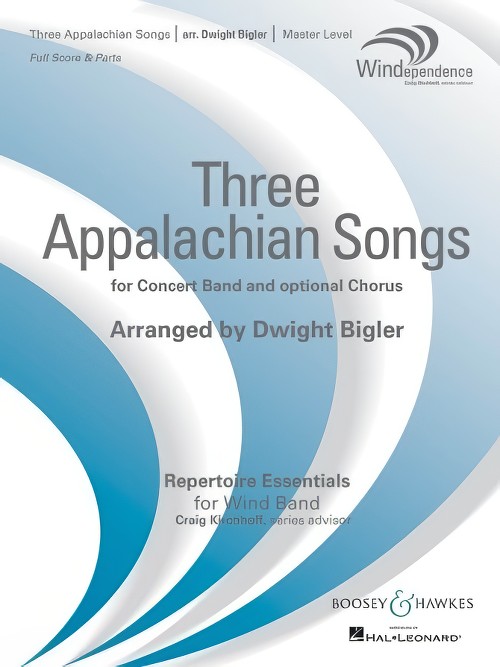
Three Appalachian Songs (Concert Band with Optional Choir - Score and Parts) - Bigler, Dwight
The classic early American folk songs Cluck Old Hen, Poor Wayfarin' Stranger and Sourwood Mountain are beautifully set for band and SATB chorus in this appealing concert suite. Arranged with various performance options available, these songs may be performed individually as well as together in a suite format. In addition, these can be performed with band alone, chorus and piano alone, or with combined groups.
Estimated dispatch 7-14 working days
 View Music