
Results
-
 £110.00
Down by the Riverside (Concert Band with opt. Choir - Score and Parts) - Rutter, John - Noble, Paul
Down by the riverside is a spiritual that was sung by slaves in the South as a work song. It dates back to before the American Civil War. John Rutter's lively arrangement of this barnstorming American folk-song builds up from a quiet opening to a triumphant conclusion. This arrangement is a faithful adaptation of the original orchestration for chorus and orchestra, but it is arranged so that it may be performed by band alone. The style is an authentic toe-tapping early jazz creation that relates to the 'jitterbug' era, and the band arrangement is complete with an optional jazz clarinet solo as well as a rousing chorus by the sax section. The piano part is cued if needed. This is a perfect opportunity to get the entire band 'swinging', and could even entice a 'One mo' time!' finale.
Estimated dispatch 7-14 working days
-
 £248.99
Missa Brevis Wind Band Set (Score & Parts)
Missa Brevis, written for choir and wind band, was commissioned by the Conseil D?partemental pour la Musique et la Culture de Haute-Alsace (Dir.: Philippe Pfisterer) in Guebwiller (France), in celebration of the millennium of Pope Leon IX's birth in ?guisheim (France). The composer conducted the first performance on June 23, 2002. It was performed live for the French television channel France 2. The mass movements Kyrie, Gloria, Credo, Sanctus, Benedictus, and Agnus Dei are very suitable for the Catholic as well as the Protestant liturgy. For this mass, various ways for performing in diverse variable strengths are possible. An instrumental performance is possible if the brass represents the choir parts. In this option, it is desirable for the brass to be positioned separately from the rest of the band (on a gallery, for example), so that the idea of two choirs is approached. In a performance with a large choir, the brass can work very well as a support. In that case, the dynamics of the brass should be adapted somewhat, since these are actually intended for an instrumental performance. You can also leave out the brass entirely for the benefit of the choir. For the accompaniment of smaller choirs, you can opt for a small ensemble from the band. This can also be a quartet, put together as desired. For the performance of this mass, the obvious choice is one of the above options. However, as an alternative, a performance with a combination of these options (vocally/instrumentally) is also possible - not just from an artistic point of view (variation), but also from a practical starting point - for example in the case that the choir has rehearsed only two movements. With a full strength, the conductor can vary the instrumentation to his or her liking. Then the brass can also play a role in the accompaniment (instead of supporting the choir). The following combinations are possible: 1. clarinet choir (from Eb Clarinet to Bass Clarinet) 2. clarinet choir + saxophones 3. brass (flugelhorns, horns, euphoniums, bass section) 4. brass (2 trumpets / 2 trombones) 5. double reeds (optional + flute, optional + string bass) 6. tutti 7. all winds 8. all brass In a performance by brass band and choir, it is usually advisable to leave out option 1 (choir + brass + band). The choir sings self-reliantly, accompanied by a full brass band. In an instrumental performance, you can consider a combined quartet (two cornets and two trombones) + brass band. Choral parts available separately. 0:20:00
Estimated dispatch 7-14 working days
-
 £139.99
Pacific Dreams (Concert Band - Score and Parts) - De Haan, Jacob
Pacific Dreams describes the experience of Miguel, a traveling composer from Spain who, feeling somewhat alienated from his homeland, is wandering through an area of Sydney known as The Rocks. At a small outdoor market in a typical street of this old colonial neighbourhood, he discovers a print of William DeShazos painting Pacific Dreams. Portrayed in the painting is the surf of one of the exotic islands in the Pacific. Next, with the impressive Sydney Harbour Bridge looming over the narrow streets of The Rocks, he envisions sultry Pacific beaches. Suddenly a theme he once composed about the lakes in Japan comes to him. Is it the Asian influences present in cosmopolitan Sydney that bring this theme to mind? Or perhaps the waters around Sydney, over which he could sail to Tahiti? He is uncertain. Could this same theme be used to create a new composition about his feelings for the metropolis Sydney? How then to work his Pacific Dreams into the mix? Miguel is certainly no fan of Hawaiian music. Maybe he could use the vocabularies of islands like Hawaii and Tahiti, their beautiful vowel combinations being sung ad libitum by a mixed choir.With these ideas and his newly purchased print of Pacific Dreams, he boards the Metro at Circular Quay. He has a final glimpse of the harbour and the Sydney Opera House as the train races into the ground. On to the hotel! To work! He must compose!Maestoso: Miguel is impressed as he gazes upon the Sydney Harbour Bridge. And yet, he wants to go away from this city. Away, to an exotic island in the Pacific.Steady Rock : In the Rocks, musicians are playing at a square. Miguel basks in the atmosphere but at the same time he is fantasising about Hawaii and Tahiti.Andante Lamentoso: In his hotel room, Miguel is feeling sad and lonely in this big city. He takes comfort in his Pacific Dreams.Allegro: Miguel boards the boat that takes him from Darling Harbour to Circular Quay. In his mind he is travelling on to Hawaii. Or is it home, where the bolero is playing? He is pulled back to reality by the skyline of Sydney.Duration: 9:15
Estimated dispatch 7-14 working days
-
 £128.00
Ratatouille Satirique (Concert Band - Score and Parts) - Satie, Erik - De Meij, Johan
Erik Satie, born in Honfleur in Normandy (France) in 1866 is undoubtedly one of the most striking personalities in the history of French music. He composed in various, often quite divergent, styles. Besides light-hearted, entertaining works he also wrote several serious compositions, among which the three ballets: Parade, Rel che and Les Aventures de Mercure. However his piano pieces, such as Trois Gymnopedies or Gnossiennes will remain his most popular compositions. Satie co-operated with almost all great artists of his time: Pablo Picasso, Jean Cocteau, Sergej Diaghilev and Georges Braque and the composers Darius Milhaud (Le Groupe des Six) and Claude Debussy. Johan de Meij made an orchestration of three short pieces by Erik Satie: I. Prelude (from: Jack in the Box) II. Reverie (from: Trois petites pieces montees) III. Marche: Le Piccadilly (1904) It was only after Satie's death in 1925 that the manuscript of the piano piece Jack in the Box was recovered. Satie himself thought he had lost the manuscript in a bus. When his flat in Arceuil was cleaned out, a small notebook was discovered behind his piano and it contained the manuscript which was assumed to be lost forever. The R?verie (De l'Enfance de Pantagruel) is an extract from Trois petites pieces montees, originally composed for small symphony orchestra. In this suite it is meant as a restful intermezzo. It is clear that, as with Milhaud (La Creation du Monde) and Debussy (Golliwogg's Cakewalk; Le Petit Negre), it is hard to deny obvious influences of jazz music in Erik Satie's compositions. Le Piccadilly, dating from 1904, displays a lot of similarities with the compositions of Scott Joplin. Duration: 7.00
Estimated dispatch 7-14 working days
-
 £59.95
Christmas Night (Concert Band - Score and Parts) - Wiffin, Rob
This is an arrangement of carols associated with Christmas night. The main song in this arrangement is O Holy Night but it also includes the opening phrase of Franz Gruber's Silent Night as an accompanying motif. The music starts with some lux argentum and then two horns play It came upon the midnight clear as a prelude to the main theme. The first iteration of this beautiful Christmas song should ideally be played on the cor anglais. However, it is cued for oboe or trumpet should a cor anglais not be available.O Holy Night was composed by Adolphe Adam in 1847, originally set to a French poem, Minuit, Chretiens (Midnight, Christians) and published as Cantique de Noel.Duration: 5.00
Estimated dispatch 7-14 working days
-
 £205.70
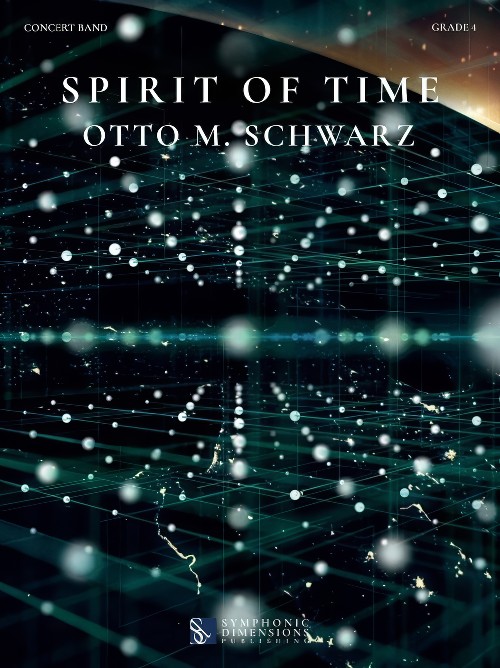
Spirit of Time (Concert Band - Score and Parts) - Schwarz, Otto M.
Zeitgeist; transformations; a departure for new shores... these are buzzwords we often encounter nowadays. Above all in this digital age, it is essential that we face changes positively and that we make the very best of them. Music is emotion! Otto M. Schwarz begins many of his lectures with this phrase, and this is exactly what we feel in this new concert work. Rapid, and full of energy, is the leap into a new chapter, wonderful opportunities are waiting to be discovered in uncharted lands. But change is not only loud and momentous. The creative power of the future lies dormant in the inventive spirit of the individual, quietly, thoughtfully, silently and alone! The final sequence of this work is all about good vibes: it lights the way to a positive future and stands for the dawn of a new era!Duration: 9.45
Estimated dispatch 7-14 working days
-
 £85.00
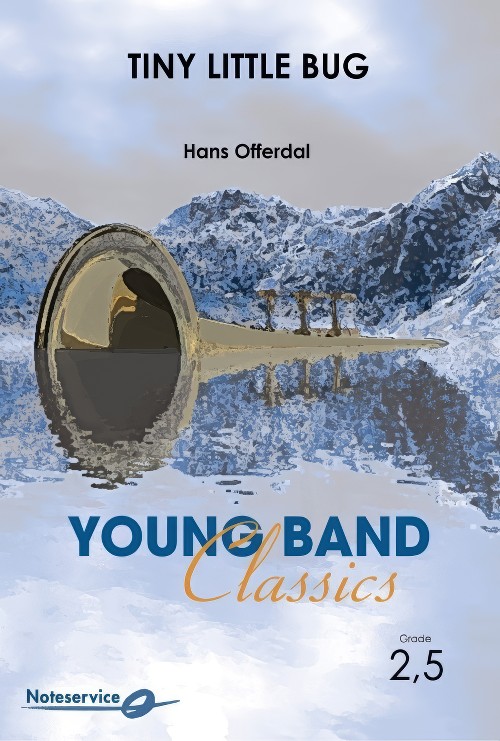
Tiny Little Bug (Concert Band - Score and Parts) - Offerdal, Hans
This is a day in the life of a tiny little bug. It is under attack and on the run. Will it survive? There are great challenges in the use of accelerando, ritardando and dynamics. Dissonances are present several places, but the voice leading is diatonic and the whole piece is based on one single scale: Bb melodic minor. It is notated as a concert Bb major scale with one accidental (third scale step lowered). Feel free to use it during warm-ups! Duration: 5.30
Estimated dispatch 7-14 working days
-
£50.00
Cats' Night Out - Phillips, Todd
"Cats' Night Out" follows the adventures of a cat as it makes its big escape to explore the magical mysteries that await our feline friend in the darkness of the great outdoors. The opening line foreshadows the upcoming movements of our cat as it experiences a night outside. The first movement, "On the Prowl," musically represents the cat as it roams around the neighborhood looking for adventure. The second movement "Mouse Hunt," melodiously depicts a cat as it hunts down its favorite prey the mouse. The surprise ending represents the mouse making his great escape. This is a truly enjoyable selection for students and audiences alike. This programmatic work is an excellent choice for your next concert.
Estimated dispatch 7-14 working days
-
 £75.00
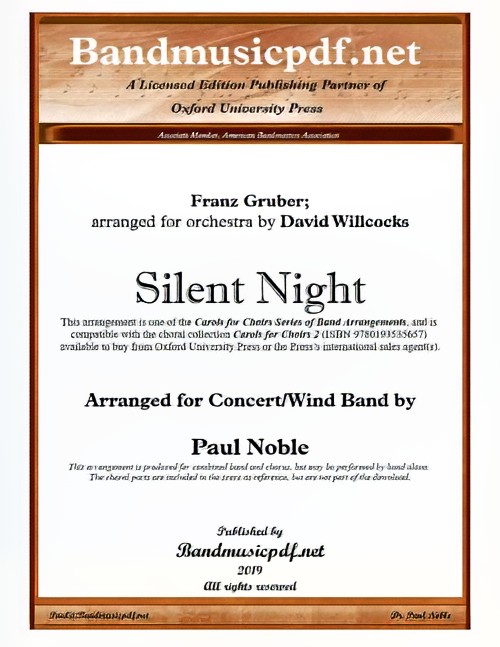
Silent Night (Concert Band with Optional Choir - Score and Parts) - Gruber, Franz - Noble & Willcocks
Silent Night (German: Stille Nacht, heilige Nacht) is a popular Christmas carol, composed in 1818 by Franz Xaver Gruber to lyrics by Joseph Mohr in the small town of Oberndorf bei Salzburg, Austria. It was declared an intangible cultural heritage by UNESCO in 2011. Over the years, because the original manuscript had been lost, Mohr's name was forgotten and although Gruber was known to be the composer, many people assumed the melody was composed by a famous composer, and it was variously attributed to Haydn, Mozart, or Beethoven. However, a manuscript was discovered in 1995 in Mohr's handwriting and dated by researchers as c. 1820. It states that Mohr wrote the words in 1816 when he was assigned to a pilgrim church in Mariapfarr, Austria, and shows that the music was composed by Gruber in 1818. This is the earliest manuscript that exists and the only one in Mohr's handwriting. The song has been recorded by a large number of singers across many music genres. This haunting setting by David Willcocks also includes slight textual alterations to the piece that has been translated into about 140 languages. This arrangement represents one in the Series of Band Arrangements compatible with David Willcocks' Carols for Choirs.
Estimated dispatch 7-14 working days
-
 £37.95
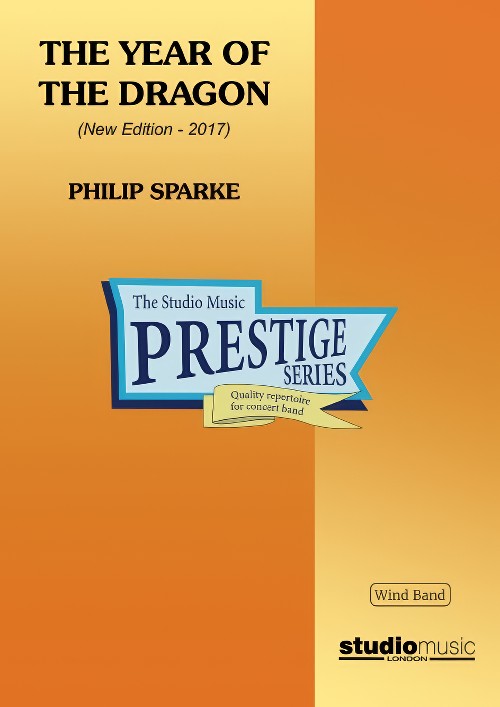
The Year of the Dragon (Prestige Concert Band - Score only) - Sparke, Philip
The 2017 version of The Year of the Dragon was commissioned by the Siena Wind Orchestra and given its world premiere on June 17th 2017 in Bunkyo Civic Hall, Tokyo, conducted by the composer.The original wind band arrangement of The Year of the Dragon was made in 1985, a year after the composer wrote the brass band version. At that time he was still learning the intricacies of writing for wind band (and still is!) and in the 32 years which have elapsed since then, his approach to scoring for the medium has developed and, hopefully, improved.Here are the main differences between the two versions:In the 1980's, the wind band movement was much less international than it is now. British wind bands were still to some extent based on the military band tradition of the time, which tended to use rather smaller instrumentation than the then-dominant American university model. The new version embraces a much more international instrumentation, including low woodwinds and string bass, as well as an expanded percussion section.In the original version there was a touch of naivety in the way the composer wrote for the woodwinds; much of their articulation was transferred too literally from the brass version, resulting in some unidiomatic writing, which he has tried to improve in the new version.In addition to the above, Philip's own compositional style has matured and developed in the intervening 32 years. There are some passages in the original which he simply would not write today - not because they are 'wrong', but because his way of writing has changed. The new version is perhaps how he would have written it today, rather than simply dressing the original version in new clothes.The work is in three movements:Toccata opens with an arresting side drum figure and snatches of themes from various sections of the band, which try to develop until a broad and powerful theme from the middle of the band asserts itself. A central dance-like section soon gives way to the return of this theme, which subsides until faint echoes of the opening material fade to a close.Interlude takes the form of a sad and languid solo for alto saxophone. A chorale for the whole band introduces a brief spell of optimism but the saxophone solo returns to close the movement quietly.Finale is a real tour-de-force for the band with a stream of rapid semi-quavers running throughout the movement. The main theme is heroic and march-like but this is interspersed with lighter, more playful episodes. A distant fanfare to the sound of bells is introduced and this eventually returns to bring the work to a stirring close.
Estimated dispatch 7-14 working days
 View Music