Results
-
 £65.99
Gravitas - Larry Clark
The definition of gravitas (dignity, seriousness, or solemnity of manner) perfectly describes the style of this piece. It contains some carefully placed descending dissonance in the introductory material that is used throughout the piece to make even the youngest of students sound bold!
Estimated dispatch 7-14 working days
-
 £53.50
Atlantis - Anne McGinty
Already a classic in the grade 1 repertoire, Anne McGinty's composition sounds sophisticated without being hard. It features effective use of polychords, modal harmonies and a driving percussion part. Written with just a single tempo, this is sure to make your beginners sound great! Dur: 2:05
Estimated dispatch 7-14 working days
-
 £108.40
Three Brass Cats - Chris Hazell
This is what Chris Hazell, the composer, had to say about 'Three Brass Cats': 'Some years ago I had four cats in the house - all were strays and decided that I was a soft touch when it came to free board and lodgings, so instead of moving on, they all decided to stay. Sadly they have all now gone to the great cattery in the sky. However, at the time they were around I was asked to write some pieces for a brass group (The Philip Jones Brass Ensemble). What should I write about? Well, I've always liked writing about the people and places around me (they appear in a lot of my music) so I thought.. I know, my cats. These days I don't have any cats as I travel around a lot with my work, but it's nice to think that they're still with me in the music.'
Estimated dispatch 7-14 working days
-
 £38.20
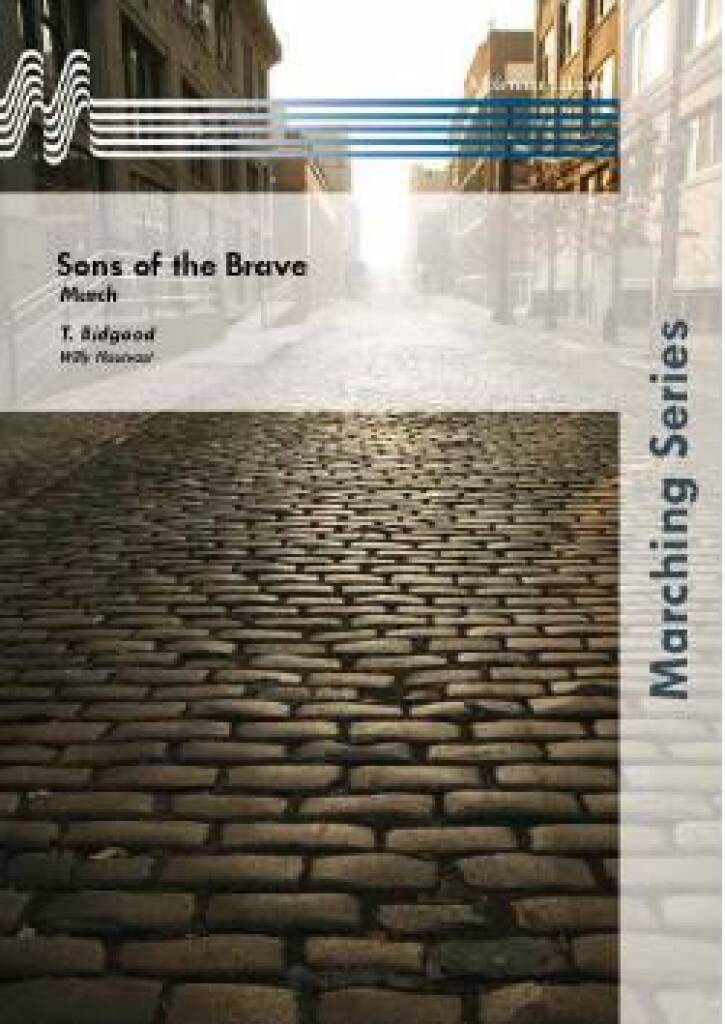
Sons of the Brave - T. Bidgood
This is one of the most popular British marches; it was written by Thomas Bidgood (1870-1925) a gifted music teacher who conducted his own professional orchestra, several theatre orchestras and wind bands. He composed a lot of light orchestral music and some fifteen marches, among which 'Vimy Ridge' and 'Sons of the Brave' (1899). The latter was dedicated to the 'Duke of York's Military School' and was first performed in public during the Boers War in South Africa at the turn of the century.
Estimated dispatch 7-14 working days
-
Athabasca - Peter Meechan
The stunning Athabasca Glacier, in the Columbia Icefield in the Canadian Rockies, provided the inspiration for this work. After having visited the Glacier in 2016, I knew that it would find a place in my music - the sheer magnitude of it was stunning, the visual was breath-taking, and the rate at which it is receding (5 meters per year) completely devastating.Now sadly collapsed, beneath the Glacier there were great, expansive ice caves - thankfully they were photographed by explorers, and it is these photos that provided the inspiration for the work; an imaginary walk through these fragile, beautiful structures; what music would sound like in them, what talking would sound like in them; and what moments of listening would sound like in them.When writing the piece I also wanted to try and acknowledge the diminishing nature of the Glacier. Whilst not being something you can visibly notice by simply observing for a short time, it is still happening in front of very eyes. This is represented by the tempos in the piece - almost doubling from the original tempo to the fastest tempo of the work (around 2/3rds of the way through), and - hopefully - almost imperceptibly.When commissioned by Ray Baril and the Edmonton Winds to write a new work for them, the Alberta connection between the group and the Glacier was impossible to resist.Peter Meechan 2018
Estimated dispatch 5-14 working days
-
£185.00
East Coast Pictures - Nigel Hess
East Coast Pictures was commissioned by the British Youth Wind Orchestra with funds from the National Westminster Bank plc. These three short 'pictures' were inspired by several visits to a small part of the American East Coast, an area that provides great extremes in the geography and the people. Movement 1: Shelter Island is a small island situated near the end of Long Island, a few hours drive east of New York. In the summer it becomes a crowded tourist trap; but in the winter it is gloriously deserted and bravely faces the onslaught of the turbulent Atlantic, shrouded in sea mists and driving rain. This 'picture' is a fond memory of a winter weekend on Shelter Island. Movement 2: In upstate New York lie the Catskills Mountains--an extraordinary combination of tranquillity and power, peace and majesty. Once seen, they call you back again and again. Movement 3: New York - or to be more precise, Manhattan. For anyone who is familiar with this bizarre and wonderful city, here is a 'picture' that needs no explanation. For those not yet hooked this is a foretaste of things to come!
In stock: Estimated delivery 1-3 days
-
 £11.42
Stick Control: Snare Drum Book - George Lawrence Stone
George Lawrence Stone's is the original classic, often called the bible of drumming. In 1993, magazine named it first in the top 25 drumming books of all-time. In the words of the author, this is the ideal book for improving "control, speed, flexibility, touch, rhythm, lightness, delicacy, power, endurance, preciseness of execution, and muscular coordination," with extra attention given to the development of the weak hand. This indispensable book for drummers of all types includes hundreds of basic to advanced rhythms and moves through categories of single-beat combinations, triplets, short roll combinations, flam beats, flam triplets and dotted notes, and short roll progressions. "It truly is a timeless classic and an essential requirement for every drummer's library."
Estimated dispatch 3-5 working days
-
£85.00
Der Aufstand - Gavin Higgins
Der Aufstand (German for 'riot') is not a descriptive work, nor is it solely based on the riots of 2011. It does, however, draw on the idea of opposing forces and escalating anger. The work falls into two contrasting sections that are linked by a series of repeated, 'screaming' chords. A slow build drives the first section from a single pitch to a blazing orchestral tutti. The second section is a fast and wild series of fanfares and driving rhythms that ultimately cannot be sustained. In many ways this mirrors the first. Both sections open on single tones (Bb and E) and grow to a climax of brass and hammered chords. The first performance took place on the last day of the 2012 Olympic Games. Der Aufstand is a noisy antithesis to the celebratory fanfare.Wind Band Grade: 6 (Professional and elite student and 'national' bands)Duration: 10 minutes
In stock: Estimated delivery 1-3 days
-
 £56.53
Suite - A Renaissance Christmas (Wind Band) Kevin Norbury
VIEW SCORE PDF This magnificent festive suite was written by Kevin Norbury for the Pierre Elliott Trudeau High School Wind Symphony and features three well known carols set in a Renaissance style. Three contrasting movements comprise the work: i. Processional (Personent hodie - On this day earth shall ring) This is a short piece imagining a torchlight Yuletide procession (perhaps bearing the traditional roasted wild boar), using a well-known Christmas melody from the large collection of music compiled in the 16th century called Piae Cantiones (1582). The tune is presented twice with accompanying, related melodic material. ii. Pastorale (Quem pastores laudavere - Shepherds sang their praises o'er him) This is a 14th-century melody which was originally collected by Michael Praetorius at the end of the 16th-century. The treatment throughout is very lyrical without overly complex harmonies. The melody is heard three times with brief linking episodes and a short coda. iii. Celebration! (In dulci jubilo - In sweet celebration - Ding-dong merrily on high) This magnificent 13th-century melody was also a part of Michael Praetorius's collection. It is traditionally associated with the words 'Good Christian men, rejoice!' The opening is a straight transcription of the great chorale prelude for organ by J.S. Bach. After the grandeur of the opening, the tune is heard in more of a 'folky' style. A lot of related melodic material is then presented before the tune Ding-dong merrily on high is heard. After another episode of previously used music In dulci jubilo reappears in a joyful conclusion to the piece. Sheet music available from : UK: www.wind-band-music.co.uk USA: www.solidbrassmusic.com Difficulty Level: Medium Instrumentation: Piccolo Flute Oboe Bassoon Clarinet in Bb 1-2 Bass Clarinet in Bb Alto Saxophone in Eb 1-2 Tenor Saxophone in Bb Baritone Saxophone in Eb Trumpet in Bb 1-2 Horn in F 1-2 Trombone 1-2 Bass Trombone Euphonium Tuba Double Bass Timpani Glockenspiel Tubular Bells Tambourine Snare Drum Tenor Drum
In stock: Estimated dispatch 1-3 days
-
£70.00
The Ringing Isle - Jonathan Dove
Handel called Britain 'the ringing isle' because when he moved to London, he heard bells ringing everywhere: great bells in church towers, and handbells in some of the first private houses he visited. The sound of people 'ringing the changes' is a peculiarly British sound of celebration, and it seems a good starting point for a piece celebrating British musical life. Within The Ringing Isle, Dove incorporates some traditional change-ringing patterns, from 'Grandsire Doubles', 'Oxford Treble Bob Minor' and his own version of 'Plain Bob Major'. Handel's phrase also conjures up an image of a magical island, and so this is how Dove envisaged how it must have been to approach Britain from an ocean voyage.
In stock: Estimated delivery 1-3 days
 View Music
 Listen to MP3