
Results
-
 £137.99
Odyssee Wind Band Set (Score & Parts)
The Odyssee tells the story of Odysseus, the undaunted hero. In times long ago the blind poet Homer wrote this famous epic. The "Odyssey" follows the "Iliad", the story of the bloody war between the Greek and the Trojans. This battle ends after ten years thanks to the Odysseys famous trick. the Trojan Horse. The Odyssey is not a war epic, but a story about perseverance, loyalty, adventure, and the survival instinct of its ingenious hero. In The Odyssey, Homer describes how Odysseus, the king of Ithaca, had to endure another ten years of affliction after the ten years of war in Troy before he could finally return to his home land. During those years, his wife, Penelope, had to try and keep her many admirers away. These men not only wanted het hand but also the kingship. To prove her husbands worth, she played a trick: "As soon as I have finished weaving this shroud for my father-in-law, Laertes, I will choose one of you to become my husband", she promised them. But during the night, she secretly loosened what she had woven during the day, prolonging the time until Odysseus would finally return. After twenty long years, when he finally stood at the door, she wondered: Is this really my husband? Is he an imposter? Cunningly, she asked him to move the bed, because only she and her husband know that the bed was immovable and was build around an old three trunk! Odysseus was deeply moved: this really was his wife, his Penelope! Nearly three thousands years later, the loyalty and strength of this character, and all the dangerous adventures that Odysseus survived thanks to courage and intelligence, still moves us today. Odyssee by Jan Bosveld is not just an adventure story, but rather a characteristic piece in which memories of Homers story can be heard. The composition opens with a firm, stirring theme describing our hero, Odysseus, in detail: This man is not to be taken lightly. The further development of this short introduction completes this character sketch: trustworthy, perseverant, and a genius. After that we can picture Odysseus on the lonely beach of Ogygia. Do the trumpets depict his memories of the war of Troy? Does he think of his wife, as we recognise the weaving loom of Penelope in the murmuring eighth? In the solemn, plaintive part that follows, we can imagine Penelope feeling lonely, sitting in the womens room with her servants.One of the girls plays the harp, but that does not clear the sombre atmosphere. Then we can imagine seeing the sorceress Circe, who changed Odysseus men into swine. After she gives a simple magic sign something follows that reminds us of the sound of pigs grunting. Then the Odysseus theme resounds: the hero comes to savi his comrades. Assisted by Hermes, he forces Circe to lift the spell. The piece ends the same way as it began, with an animated theme: Odysseus is still the same, undefeated and not to be taken lighty! 07:45
Estimated dispatch 7-14 working days
-
 £79.95
Variations on 'Was Lebet' (Concert Band - Score and Parts) - Wainwright, Andrew
Variations on 'Was Lebet' is based on the German chorale of the same name, the first line of which translates as 'O worship the Lord in the beauty of holiness!' The opening fanfare figure in the Trumpets should be supported by bold, organ-like sostenuto chords in the lower band. Ensure that the fanfare in the Trumpets and Trombones from bars 25 to 28 is given equal articulation and volume in the antiphonal parts. After this majestic introductory section, the first of five contrasting variations is presented, although the tune is never realised in full form until the final variation, with fragments gradually being revealed as the piece progresses.Variation I is somewhat classical in approach, with its energy coming from a regular contrast between cantabile references to the theme, set against lively staccato figures. Ensuring a lightness of touch will be important here; the music should be poised and never sound frantic. As a result, careful attention should be paid to the tempo marking, being no quicker than 136 beats per minute. Snippets of the chorale come and go, with the last phrase of the hymn completing the movement. This final statement, at bar 95, should be an immediate change in tempo and a separate statement to the music that comes before.Variation II is plaintive in mood, giving the listener the chance to reflect on the following words, which form part of the second verse: 'Comfort thy sorrows and answer thy prayerfulness, Guiding thy steps as may best for thee be.' There is opportunity for rubato in this movement, at the discretion of the conductor.Variation III is somewhat quirky and volatile in nature, and takes its inspiration from the 3rd and 4th verses which describe the fearful times in life that we must entrust to the Lord. Driven by the Percussion section in particular, there are references here to Variation I with its chorale-like figures and hurtling scalic figures, and there is a feeling of a lack of resolution. A somewhat abrupt ending suggests that our sense of completeness in Christ is yet to be resolved. It is important that clarity and tempo are maintained in the bass line between sections L and M. Aim for consistency of line in the bass parts, particularly with the trade-offs between players here.There is a French romantic feel to the waltz in Variation IV, with the opportunity for various soloists to display their musicianship. A sense of ironic humour pervades throughout. The Clarinet and Bassoon duet from section U should be playful and display a lightness of touch, with that sense of style continued throughout the movement.Variation V is fugal in nature, with each section of the band being handed the theme at various points. Again it is important that a steady tempo is set at Y in order to maintain control. The sense of momentum gradually increases to a grandiose presentation of the full theme, beginning at section CC, affirming our completeness in the Lord, with the words of the first and last verses reiterated: O worship the Lord in the beauty of holiness! Bow down before him, his glory proclaim; With gold of obedience and incense of lowliness, Kneel and adore him, the Lord is his name.Duration: 11.45
Estimated dispatch 7-14 working days
-
 £15.95
Variations on 'Was Lebet' (Concert Band - Score only) - Wainwright, Andrew
Variations on 'Was Lebet' is based on the German chorale of the same name, the first line of which translates as 'O worship the Lord in the beauty of holiness!' The opening fanfare figure in the Trumpets should be supported by bold, organ-like sostenuto chords in the lower band. Ensure that the fanfare in the Trumpets and Trombones from bars 25 to 28 is given equal articulation and volume in the antiphonal parts. After this majestic introductory section, the first of five contrasting variations is presented, although the tune is never realised in full form until the final variation, with fragments gradually being revealed as the piece progresses.Variation I is somewhat classical in approach, with its energy coming from a regular contrast between cantabile references to the theme, set against lively staccato figures. Ensuring a lightness of touch will be important here; the music should be poised and never sound frantic. As a result, careful attention should be paid to the tempo marking, being no quicker than 136 beats per minute. Snippets of the chorale come and go, with the last phrase of the hymn completing the movement. This final statement, at bar 95, should be an immediate change in tempo and a separate statement to the music that comes before.Variation II is plaintive in mood, giving the listener the chance to reflect on the following words, which form part of the second verse: 'Comfort thy sorrows and answer thy prayerfulness, Guiding thy steps as may best for thee be.' There is opportunity for rubato in this movement, at the discretion of the conductor.Variation III is somewhat quirky and volatile in nature, and takes its inspiration from the 3rd and 4th verses which describe the fearful times in life that we must entrust to the Lord. Driven by the Percussion section in particular, there are references here to Variation I with its chorale-like figures and hurtling scalic figures, and there is a feeling of a lack of resolution. A somewhat abrupt ending suggests that our sense of completeness in Christ is yet to be resolved. It is important that clarity and tempo are maintained in the bass line between sections L and M. Aim for consistency of line in the bass parts, particularly with the trade-offs between players here.There is a French romantic feel to the waltz in Variation IV, with the opportunity for various soloists to display their musicianship. A sense of ironic humour pervades throughout. The Clarinet and Bassoon duet from section U should be playful and display a lightness of touch, with that sense of style continued throughout the movement.Variation V is fugal in nature, with each section of the band being handed the theme at various points. Again it is important that a steady tempo is set at Y in order to maintain control. The sense of momentum gradually increases to a grandiose presentation of the full theme, beginning at section CC, affirming our completeness in the Lord, with the words of the first and last verses reiterated: O worship the Lord in the beauty of holiness! Bow down before him, his glory proclaim; With gold of obedience and incense of lowliness, Kneel and adore him, the Lord is his name.Duration: 11.45
Estimated dispatch 7-14 working days
-
 £150.00
A Child's Garden of Verses (Soprano Solo with Concert Band - Score and Parts) - Jager, Robert - Noble, Paul
A Child's Garden of Verses has a very special meaning for me. Bob Jager, a family friend, was visiting in our home, and my wife, Mitzi Noble, a soprano soloist, was singing to his children. Bob's two young children became so enthralled with the music that Bob wanted to capture that moment. So he composed this piece for Mitzi, and dedicated it to his children, Kathleen and Matthew. The text is from Robert Louis Stevenson's poems: I. Happy Thought; II. The Wind; III. The Land of Counterpane; IV. From a Railway Carriage; V. Escape at Bedtime. Bob writes: The ideal performance instrumentation would be one on a part. If a larger group is used the balance should be kept proportional. In a few places the terms Solo or One are used where the sonority is critical, and this should be strictly followed. Above all, the singer should never feel forced by the ensemble. This work was composed in 1972, and was never published. I am pleased that Bob has allowed me now to publish it under Noble Music Publications, so that it may be available for others to perform and enjoy. Mitzi writes: Although we did not have access at the time, the ideal performance would be with a throat mic so that the soloist is free to move around the stage and sing, as though singing and relating to children sitting on the front row.
Estimated dispatch 7-14 working days
-
£144.99
Scottish Dances Wind Band Set (Score & Parts)
Scottish Dances is based on three Scottish traditionals: Cock of the North, The Bonnie Bank's O'Loch Lomond and Marie's Wedding. I. Cock of the North's name is used for multiple things or events. For example for a locomotive to a famous, it seems, delicious liqueur, and rallies to snowboard competitions. Furthermore is "Cock O' the North " a nickname of a famous Duke. (The 4th Duke of Gordon). In this composition Cock of the North (a Jig) is a traditional Scottish bagpipe tune, regularly played on tattoos by Pipe Bands. Not infrequently the drummers sing the text. Auntie Mary, had a canary, Up the leg of her trousers While she was sleeping I was peeping Up the leg of her trousers. II. " The Bonnie Bank's O'Loch Lomond " is about a sad story that took place during an revolt against the British. In 1745 Bonnie Prince Charlie had to retreat. Two of his men were captured. One was convicted and executed, while the other was released. The spirit of the executed soldier would arrive in Scotland via the 'low road' (underworld) before his companion, who had still a long way to go. You'll take the high road And I'll take the low road And I'll be in Scotland afore ye But me and my true love will never meet again On the Bonnie Bonnie Banks of Loch Lomond III. In a Scottish wedding, after the official ceremonies, there is often danced. This is called a ceilidh. For this we use traditional Scottish music such as "Marie's Wedding '. Mid dance we go back to the church, where a lovely song in honor of the couple sounds. Marie's Wedding has been recorded by Van Morrison (among many others). Step we gaely, on we go, heel for heel and toe for toe Arm and arm and on we go, all for Marie's wedding 07:00
Estimated dispatch 7-14 working days
-
 £75.00
Believe in life (from The Gift of Life) (Concert Band with Optional Choir - Score and Parts) - Rutter, John - Noble, Paul
The Gift of Life was written early in 2015 as a commission to honour a retiring Minister of Music at a church in Dallas, Texas. In planning this piece, John Rutter has stated: In 1985 I had written a Requiem - which, like any Requiem, inevitably reflects on death - why not write the opposite, a work celebrating life? Unlike a Requiem, where a set form of words is laid down in Catholic liturgy, no framework exists for a celebration of life, and I had to choose (and in three cases, write) texts which were appropriate to a theme rarely expressed in music since Haydn's wondrous oratorio The Creation in 1798. The six movements reflect different facets of the miracles of creation and of life. This arrangement is written for combined Concert Band and Chorus, but may be performed by Concert Band alone.
Estimated dispatch 7-14 working days
-
 £95.00
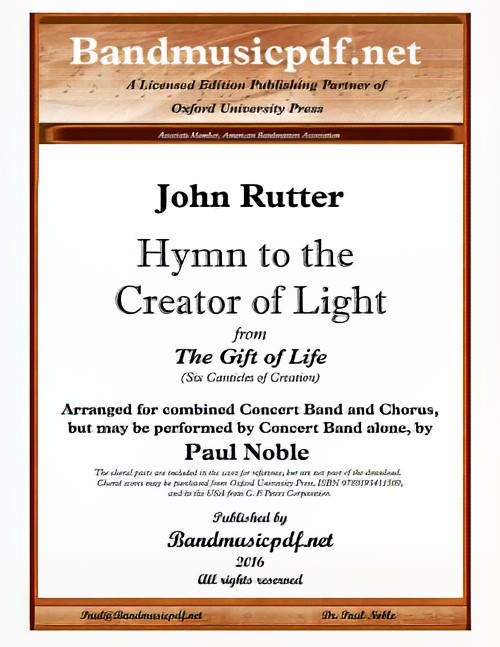
Hymn to the Creator of Light (from The Gift of Life) (Concert Band with Optional Choir - Score and Parts) - Rutter, John - Noble, Paul
The Gift of Life was written early in 2015 as a commission to honour a retiring Minister of Music at a church in Dallas, Texas. In planning this piece, John Rutter has stated: In 1985 I had written a Requiem - which, like any Requiem, inevitably reflects on death - why not write the opposite, a work celebrating life? Unlike a Requiem, where a set form of words is laid down in Catholic liturgy, no framework exists for a celebration of life, and I had to choose (and in three cases, write) texts which were appropriate to a theme rarely expressed in music since Haydn's wondrous oratorio The Creation in 1798. The six movements reflect different facets of the miracles of creation and of life. This arrangement is written for combined Concert Band and Chorus, but may be performed by Concert Band alone.
Estimated dispatch 7-14 working days
-
 £95.00
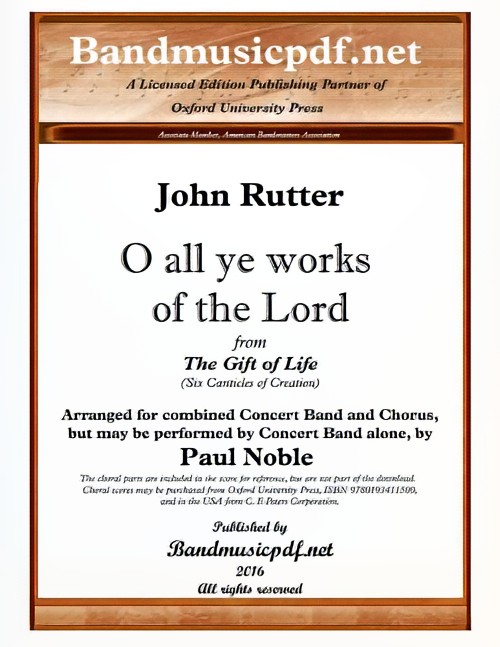
O All Ye Works of the Lord (from The Gift of Life) (Concert Band with Optional Choir - Score and Parts) - Rutter, John - Noble, Paul
The Gift of Life was written early in 2015 as a commission to honour a retiring Minister of Music at a church in Dallas, Texas. In planning this piece, John Rutter has stated: In 1985 I had written a Requiem - which, like any Requiem, inevitably reflects on death - why not write the opposite, a work celebrating life? Unlike a Requiem, where a set form of words is laid down in Catholic liturgy, no framework exists for a celebration of life, and I had to choose (and in three cases, write) texts which were appropriate to a theme rarely expressed in music since Haydn's wondrous oratorio The Creation in 1798. The six movements reflect different facets of the miracles of creation and of life. This arrangement is written for combined Concert Band and Chorus, but may be performed by Concert Band alone.
Estimated dispatch 7-14 working days
-
 £95.00
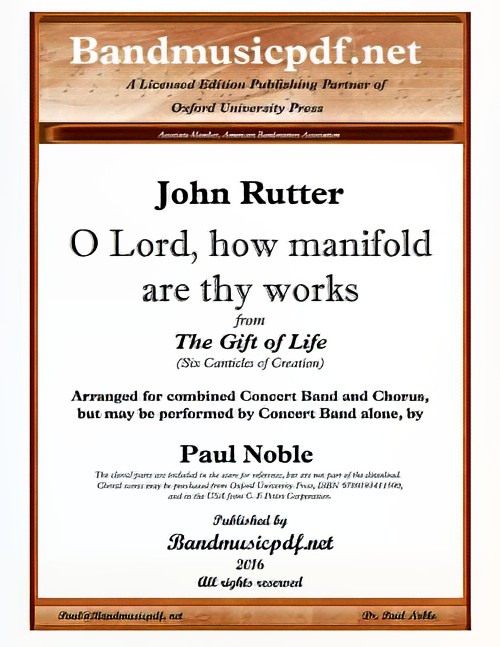
O Lord, How Manifold are Thy Works (from The Gift of Life) (Concert Band with Optional Choir - Score and Parts) - Rutter, John - Noble, Paul
The Gift of Life was written early in 2015 as a commission to honour a retiring Minister of Music at a church in Dallas, Texas. In planning this piece, John Rutter has stated: In 1985 I had written a Requiem - which, like any Requiem, inevitably reflects on death - why not write the opposite, a work celebrating life? Unlike a Requiem, where a set form of words is laid down in Catholic liturgy, no framework exists for a celebration of life, and I had to choose (and in three cases, write) texts which were appropriate to a theme rarely expressed in music since Haydn's wondrous oratorio The Creation in 1798. The six movements reflect different facets of the miracles of creation and of life. This arrangement is written for combined Concert Band and Chorus, but may be performed by Concert Band alone.
Estimated dispatch 7-14 working days
-
 £75.00
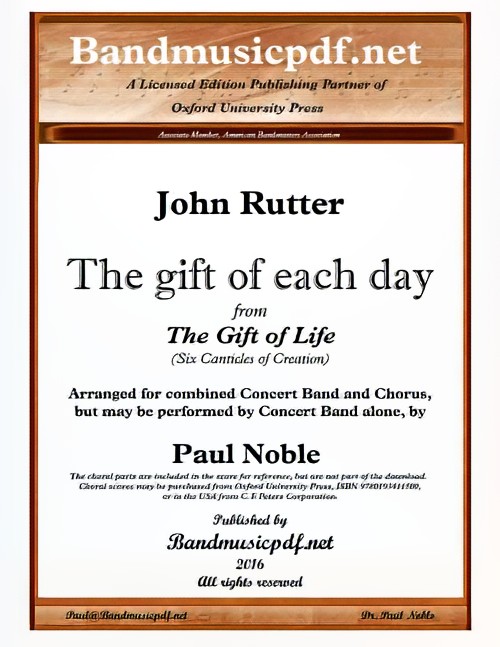
The Gift of Each Day (from The Gift of Life) (Concert Band with Optional Choir - Score and Parts) - Rutter, John - Noble, Paul
The Gift of Life was written early in 2015 as a commission to honour a retiring Minister of Music at a church in Dallas, Texas. In planning this piece, John Rutter has stated: In 1985 I had written a Requiem - which, like any Requiem, inevitably reflects on death - why not write the opposite, a work celebrating life? Unlike a Requiem, where a set form of words is laid down in Catholic liturgy, no framework exists for a celebration of life, and I had to choose (and in three cases, write) texts which were appropriate to a theme rarely expressed in music since Haydn's wondrous oratorio The Creation in 1798. The six movements reflect different facets of the miracles of creation and of life. This arrangement is written for combined Concert Band and Chorus, but may be performed by Concert Band alone.
Estimated dispatch 7-14 working days
 View Music