
Results
-
£104.99
Celtic Gathering - André Waignein
Roland Kernen has developed a true fascination for the traditional music scene and for Celtic folk music in particular. The Celts fed on a rich blend of legend and myth which is skillfully portrayed in Celtic Gathering. This lyrical piece embraces two musical atmospheres. The first melodic line, written in a minor key, expresses the cheerful character of a group dance, whilst the second line, written in a major key, portrays perfectly the joyful mood of a Celt village.Why not add a touch of Celtic magic to your band repertoire.
Estimated dispatch 7-14 working days
-
 £104.99
Celtic Gathering Wind Band Set (Score & Parts)
Roland Kernen has developed a true fascination for the traditional music scene and for Celtic folk music in particular. The Celts fed on a rich blend of legend and myth which is skillfully portrayed in Celtic Gathering. This lyrical piece embraces two musical atmospheres. The first melodic line, written in a minor key, expresses the cheerful character of a group dance, whilst the second line, written in a major key, portrays perfectly the joyful mood of a Celt village.Why not add a touch of Celtic magic to your band repertoire.
Estimated dispatch 7-14 working days
-
 £61.95
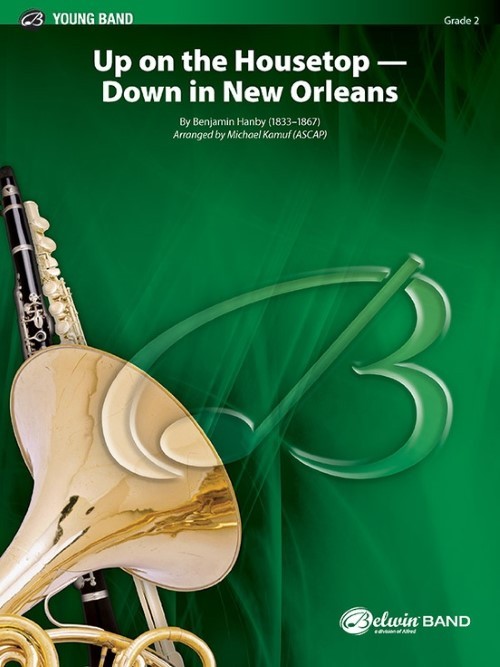
Up on the Housetop - Down in New Orleans (Concert Band - Score and Parts) - Hanby, Benjamin - Kamuf, Michael
Watch out! The Big Guy is hungry, and he wants Jambalaya! This reworking of the famous holiday carol incorporates jazz harmonies and a New Orleans inspired Second Line feel combining to create a fun and memorable holiday selection that your students and audiences will love! Let the good times roll! Duration: 2:45
Estimated dispatch 7-14 working days
-
 £49.50
Basin Street Barbeque (Concert Band - Score and Parts)
Take everybody to the sunny south for a big helpin' of some authentic N'awlins down-home cookin'! Basin Street Barbeque creates a big easy street party that your band and audiences will love! Trombones step right off and take the lead, backed with plenty of New Orleans Second Line drummin'. Solid ensemble writing, plenty of optional suggested solos for the instruments of your choice and high-energy swagger make this a "can't miss" favorite!
Estimated dispatch 7-14 working days
-
£139.99
Cobra - Jan Bosveld
Shortly after the Second World War, a combative movement of Danish, Belgian and Dutch artists chose the cobra snake - extremely dangerous yet considered sacred - as a symbol of their resistance to strict guideliness of form. The name "Cobra" also happens to contain the first letters of the cities Copenhagen, Brussels ans Amsterdam, from where most of the movement's members came. The Cobra movement, which existed from November 1948 until November 1951, can with some justicication be called the last major avant-garde movement of the 20th century.The source of inspiration for the composition Cobra comes from four paintings: "Obhobning" by the Dane Egill Jacobsen; "La jeune fille et lamort" by the Belgian Pierre Alechinsky; "Orgeldraaier" and "Le rythme joyeux de la ville" by the Dutch artists Karel Appel and Corneille. Obhobning means "pile-up", which is represented musically in the first part by a melodic and harmonic pilling up of perfect fourth's. The first part is also characterized by a rhythmic feeling, which the painting gives through its use of numerous black stripes. In the painting La jeune fille et la mort, Pierre Alechinsky places a young girl opposite Death. The second part features the constantly pulsating motion of live while a creeping, dark, melodic line develops. The tension between life and death is tangible as a battle reveals itself. In part three, one hears the Orgeldraaier by Karel Appel, as cheerful and playful as an organ grinder's music. The painting Le rythme joyeux de la ville by Corneille is busy and extremely dynamic, a perfect source of inspiration for a powerful, rhythmic ending to this composition.
Estimated dispatch 7-14 working days
-
£139.99
Cobra Wind Band Set (Score & Parts)
Shortly after the Second World War, a combative movement of Danish, Belgian and Dutch artists chose the cobra snake - extremely dangerous yet considered sacred - as a symbol of their resistance to strict guideliness of form. The name "Cobra" also happens to contain the first letters of the cities Copenhagen, Brussels ans Amsterdam, from where most of the movement's members came. The Cobra movement, which existed from November 1948 until November 1951, can with some justicication be called the last major avant-garde movement of the 20th century.The source of inspiration for the composition Cobra comes from four paintings: "Obhobning" by the Dane Egill Jacobsen; "La jeune fille et la mort" by the Belgian Pierre Alechinsky; "Orgeldraaier" and "Le rythme joyeux de la ville" by the Dutch artists Karel Appel and Corneille. Obhobning means "pile-up", which is represented musically in the first part by a melodic and harmonic pilling up of perfect fourth's. The first part is also characterized by a rhythmic feeling, which the painting gives through its use of numerous black stripes. In the painting La jeune fille et la mort, Pierre Alechinsky places a young girl opposite Death. The second part features the constantly pulsating motion of live while a creeping, dark, melodic line develops. The tension between life and death is tangible as a battle reveals itself. In part three, one hears the Orgeldraaier by Karel Appel, as cheerful and playful as an organ grinder's music. The painting Le rythme joyeux de la ville by Corneille is busy and extremely dynamic, a perfect source of inspiration for a powerful, rhythmic ending to this composition. 0:09:57
Estimated dispatch 7-14 working days
-
 £154.99
Symphonic Variations - Jacob de Haan
This composition is based on a passacaglia theme, in which artistic perfection, symphonic drama and oriental melody lines play a role. The passacaglia is originally a dance made up of a series of variations above a bass line constantly present as an ostinato. It is not in this sense that the "Symphonic Variations" are in the passacaglia form but in the sense of the open form of the variations. Jacob de Haan, himself originally an organist, took his inspiration for this piece from the famous passacaglia for organ in C-minor by J.S. Bach. Following the introduction of the passacaglia theme (in the bass) the entry by the trumpets and trombones forms the majestic start to amusical adventure, in which this theme (often fragmentary) returns in variations. Then there follow two faster movements with dramatic contrasts and virtuose passages. Particularly striking here is the use of two characteristic intervals from the beginning of the theme namely the minor second and the augmented fourth. An apause in the composition comes in the slow bridge where a syncopated bourdon (perfect fifth) is constantly repeated. The tension grows in dynamics and harmony, and the oriental-flavour becomes obvious in the melody. We arrive at a faster movement via an accelerando, in which a perpetuum mobile based on the passacaglia theme is central. Finally the whole flows into a martial theme, in which the ostinato accompaniment n the descant derives from the passacaglia theme.
Estimated dispatch 7-14 working days
-
 £239.99
The Three Musketeers, Op. 8 - Maxime Aulio
Les Trois Mousquetaires (The Three Musketeers) was commissioned by the Miraphone company for the Miraphone Tuba Quartett and the Musique des Gardiens de la Paix (Paris, France). It was premired in Guebwiller (France), on 28 June 2003 by its dedicatees.Even if you have never read a line of the mythical novel The Three Musketeers (1844) by Alexandre Dumas, father, you will at least have heard of the "four invincibles"; four extraordinary names - D'Artagnan, Athos, Porthos, and Aramis - and one unique motto "All for one, and one for all." The musical texture of Les Trois Mousquetaires is focused on specific elements of a character's personality rather thanon its influence on the book's plot. Maxime Aulio has largely turned his attention on D'Artagnan, the sensitive, romantic and perfect gentleman who is easily charmed by women such as the gentle Constance Bonacieux and the perfidious Milady de Winter whose beguiling beauty seduced him. The first movement - D'Artagnan - is true to the character of the young provincial noble of the Gascony region: heroic and enthusiastic in all circumstances. The second movement entitled Constance Bonacieux, is romantic, delicate and passionate. The third and last movement is as duplicitous as the bewitching femme fatale its reveals: Milady de Winter.
Estimated dispatch 7-14 working days
-
 £77.90
La matita di leonardo - Luciano Feliciani
2019 coincided with the 500-year anniversary of the death of Leonardo Da Vinci, one of the greatest men of genius in history, a universal genius who was a scientist, philosopher, architect, painter, musician, engineer, anatomist, botanist, designer, and planner. This composition entitled La Matita di Leonardo (Leonardo's Pencil), represents an ideal journey into the mind of the Tuscan genius: in the first part of the piece, percussion instruments underline the ticking of the passage of time that anticipates the birth of the idea, while short thematic cells in various instruments alternate, drawing the rhythmic melodic line. On this background, we hear the main theme entrusted to the dark tones of trombone and euphonium. The music proceeds with a growing pace and an adventurous character to represent the genesis of Leonardo's machines, which are in fact the result of the drawings of his pencil. In the second, more animated part, a new theme is introduced, varied, and elaborated, thus giving life to a vigorous movement meant to describe the drawings that come to life, leaving the pages of Leonardo's codes. In the coda the two themes overlap, transporting the listener towards a resolute and rhythmically energetic conclusion in an enthralling and engaging finale.
Estimated dispatch 7-14 working days
-
 £256.99
Clarinet Concerto - Wolfgang Amadeus Mozart
Mozart originally wrote this concerto for a clarinet with an extended lower range, compared to the conventional instrument. As early as 1802, published versions appeared with registral changes, which made the concerto playable on instruments without the extra keys. When producing an edition for the conventional clarinet there are two choices to be made about the 'extra' notes - is it better to maintain the musical line, and hence transpose whole phrases or passages up an octave, rather than single notes, or is the chalumeau tone more important, in which case it may possibly be better to alter one or two notes to keep the correct octave. In this edition Philip Sparke has usually gonefor the former so the 'sequences' make musical sense, but have taken the second option in some places. This fantastic work will prove popular with soloist, band and audience alike.
Estimated dispatch 7-14 working days
 View Music