
Results
-
 £115.60
How Far I'll Go (From "Vaiana") - Lin-Manuel Miranda
Walt Disney Pictures movie Vaiana from 2016 tells the story of Vaiana, the strong-willed daughter of the master in a Polynesian tribe. She is elected by the sea to reunite a mysterious relic with a goddess. When a disease affects the island she lives on, Vaiana set sails searching for Maui, a legendary demigod. Her goal is to save her people. The great theme song from the movie, How far I'll go, is magnificent and original and has elements of folk music. The song is nominated for Oscar in the Best original song-category. The modulation in this arrangement is re-written a semitone to make it fit our Young Band Entertainment-series.
Estimated dispatch 7-14 working days
-
 £99.99
Salute to the Victor - Philip Sparke
Salute to the Victor is in traditional march form and contains, as a tribute to Victor Grieve who was a devotee of English music (in particular that of Sir Edward Elgar), a short quote from Elgar's Sea Pictures in the trio. Salute tothe Victor was commissioned by Helen, Alex and James Grieve for the Golden Kangaroos (Hornsby Concert Band) from Sydney, Australia, in memory of their parents, Louise and Victor Grieve, Founder and Director.
Estimated dispatch 7-14 working days
-
 £49.95
Wings of Apollo - Vince Gassi
NASA's Apollo program is known for landing the first humans on the moon in 1969. In this composition, your dauntless adventure begins with a powerful lift off. Once achieved, the main theme is presented by flutes, oboe, and then trumpets, with stabilizers provided by baritone, tenor sax, and eventually the remainder of the crew. Stage 1 boosters (a strong, rhythmic accompaniment) provide the propulsion needed to voyage through to a sea of tranquility (lyrical section). From there we journey to an adventurous transition and a final re-entry of the main theme. (2:35)
Estimated dispatch 7-14 working days
-
 £52.95
Capturing the Blue Riband - Scott Watson
Capturing the Blue Riband musically celebrates the excitement and sense of occasion experienced when traveling aboard the grand, early 20th century transatlantic liners, such as the Queen Mary and Lusitania. The Blue Riband was the coveted trophy bestowed on the vessel that clocked the fastest transatlantic time. The energetic opening and closing sections of this piece evoke the exhilaration of taking to the sea in this historic race of prestige, while a contrasting section conveys the sense of grandeur and honor central to the era and the award. (3:05)
Estimated dispatch 7-14 working days
-
 £137.70
Song of the Koster Girls - Evert Taube
The author of Kosterflickornas visa "the Song of the Koster Girls" is Evert Taube (1890-1976). It is one of the 200 popular and beloved songs he wrote and which have made him one of Sweden's "national poets". His popularity and greatness is madeevident since he is honoured to be on the new 50 Kronor banknote which will be issued during 2015. The Koster islands are the most westerly inhabited part of Sweden. The islands are situated in the northern part of the county Bohusln, not far fromthe Norwegian border. The song text goes:Here is the sea that embraces our Bohusln islandsand carries our father and brother in a rocking boat.Come to the beach, come with me, come singby my sideout over Skagerack inthe calm summer night.The arrangement for flute and wind band is written by Jerker Johansson (born 1967), who is conductor of the Gteborg Wind Orchestra, which has made a CD-recording of the song with Evert Taube's son Sven-Bertilinterpreting his father's work.
Estimated dispatch 7-14 working days
-
 £149.40
Sunny Memories - Jerker Johansson
The inspiration to this piece comes from the composer's impression of the beautiful Bohusln coast, more precise the island of Hls in the Gothenburg archipelago. Here the Nordic light appears in a particular way against the barren rocks sticking out of the sea during calm and clear summer evenings. The piece is dedicated to the memory of ...ke Edefors (1945-2014) who was a great enthusiast in the music life of Gothenburg and who lived on the island of Hls.
Estimated dispatch 7-14 working days
-
 £89.99
Atlantic Overture - Thierry Deleruyelle
Atlantic Overture is a sparkling piece symbolising a journey by ship from Europe to the Americas. The music tells the story of a ship leaving the European coast on a journey that depicts the beauty of the open sea and the sunlight on the horizon. Finally, the main theme returns in a brilliant ending that heralds the arrival in America.
Estimated dispatch 7-14 working days
-
 £57.50
Letter from Sado - Jodie Blackshaw
Letter from Sado is an exciting piece for young band designed to draw out the musicality in young players. With a focus on interpretation of an ancient haiku poem with natural imagery, performers are invited to become decision makers about specific sections in the music. Their decisions include ideas regarding tempo, dynamics and articulation in order to represent a wild stormy sea and a still starry night. Free interdisciplinary curriculum for teaching Sado is available at BandQuest.org. Dur: 5-7 minutes Recorded by the University of Minnesota Wind Ensemble - Craig Kirchhoff, conductor BandQuest, an exciting series of new music and accompanying curricula for band, is a program published by the American Composers Forum. The series was started as a response to feedback from music educators that there is a pressing need for new, fresh band music. The heart of this program is new works written by a diverse group of leading American composers who have created challenging pieces that are a true departure from standard middle school repertoire. Every BandQuest project includes a residency component in which the composer works collaboratively with a middle school as they create their new piece. Many BandQuest pieces are accompanied by an interdisciplinary curriculum designed to assist students as they learn the music and to integrate each piece with non-music studies. Visit www.bandquest.org to learn more about this innovative series, and email [email protected] to request a free downloadable audio catalog.
Estimated dispatch 7-14 working days
-
 £184.99
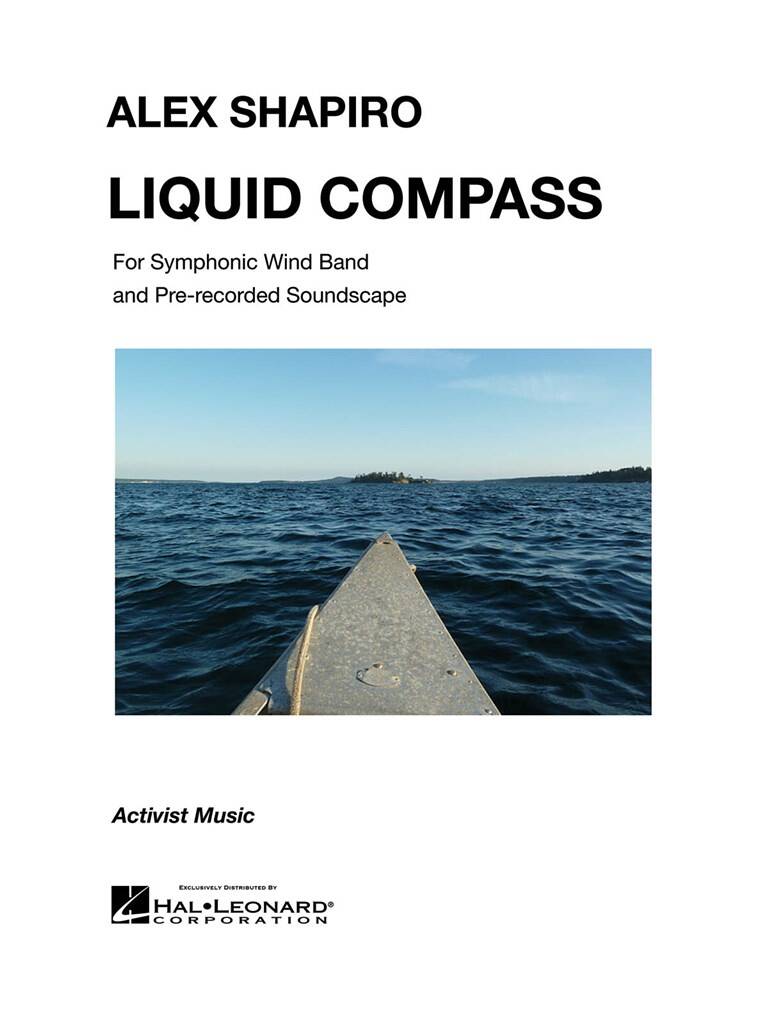
Liquid Compass - Alex Shapiro
Continuing in the tradition of her innovative electroacoustic band works including Paper Cut, Immersion, and Tight Squeeze, Alex Shapiro's Liquid Compass takes the musicians and the audience on a journey that spans the mysticaland the triumphant. A subliminal connection to the sea is conveyed through the creative use of metal bowls filled with water, and flutists will particularly enjoy the otherworldly ooh-wah effect that wends through the piece.Commemoratingthe 140th anniversary of Carthage College's wind band, this workmigrates to different places, but never loses its bearings in pursuit of a musical true north. To perform the piece, you'll need an audio systemcapable of playing the prerecorded audio tracks from a laptop computer via a small digital audio interface connected to an audio mixer. Download information is provided in the printed piece. Dur: 9:00 Recorded by the CentralWashington University Wind Ensemble, Lewis Norfleet - Director.
Estimated dispatch 7-14 working days
-
£154.99
Leviathan - Franco Cesarini
The leviathan, a demoniacal sea monster that appears as a dragon or serpent, is considered in the Old Testament to be the embodiment of evil. The defeat of the demon is prophesied in Isaiah 27:1: "On that day the Lord will punish with his cruel sword, his mighty and powerful sword Leviathan that primeval sea-serpent, that writhing serpent Leviathan, and slay the monster of the deep ."The composer's main goal is to create an atmosphere thick with agitation, tumult and extreme tension rather than express specific events musically. The monstrous form of the leviathan slowly emerges from the abyss of primordial sounds at the start of the piece, recalling the eternal conflict betweengood and evil.
Estimated dispatch 7-14 working days
 View Music