
Results
-
Taking the Fifth - Peter Meechan
Written during the Covid-19 pandemic, originally as an adaptable chart, Taking the Fifth takes its title from both the primary interval of the work as well as from a general British expression that when something is outrageous, remarkable, or the worse of its kind that it "takes the biscuit".Given that the piece was written during the Covid-19, and that even more unpredictable news that followed every day during the pandemic, it seemed an apt title!Upbeat, occasionally dark, but always with drive and a sense of fun, Taking the Fifth was the piece that got my creative juices flowing again, having initially found myself pretty lost for inspiration during the early stages of pandemic.Taking the Fifth is dedicated to my dear friend, Robert Ambrose.Peter Meechan 2021Anthony Reimer, Calgary, CanadaBenedictine College - Tom Davoren, Director of BandsBrandon University - Wendy Zander McCallum, Conductor, Symphonic BandBrooklyn Wind Symphony - Jeff W. Ball, Artistic Director & ConductorDordt University - Onsby C. Rose, Director of Instrumental StudiesGeorgia State University - Robert Ambrose, Director of BandsGlobal Bandroom Podcast - Keith Kelly, HostKansas State University - Frank Tracz, Director of BandsUniversity of Kansas - Matthew Smith, Associate Director of BandsUniversity of Regina - Brent Ghiglione, Director of BandsWinona State University - Melanie Brooks, Director of Bands
Estimated dispatch 5-14 working days
-
Fragile Oasis - Peter Meechan
Fragile Oasis is the name of a collective who describe themselves as "...a grass-roots participatory initiative that connects the shared perspective of astronauts from different countries and cultures with people on Earth, encouraging all to work together so that our planet is not only visibly beautiful, but beautiful for all".Many involved in the project are astronauts on the International Space Station (I.S.S.), who post, on their website (http://www.fragileoasis.org) many different details of their experiments, photos from space, and some incredible video footage of our Earth.One such time lapse video (a video made up many still images) was posted on their website by astronaut Ron Garan (http://www.fragileoasis.org/blog/2011/11/coming-back-down-to-our-fragile-oasis-2/) in 2011. It is made up of images taken from the I.S.S. of what Garan described as "...a couple of laps around our Fragile Oasis before coming back down [to Earth]" and features all kinds of amazing views from space.Each of the five sections of this work relate to an aspect of the video - either something literal or something more metaphorical. The opening section, i: The lights from Above, is a musical description of the view of the Aurora Australis from above the lights. The second section, ii: The Storm from Above (part i), is also a musical portrayal of portions of the video clip - in this case the many lightning storms we see from above. The storms that are so powerful on Earth appear as small bolts of electricity dancing through the clouds.The third section, iii: Freya, has its roots in personal family tragedy. The name Freya derives from a Norse goddess who was associated with both beauty and love, and in this central section I wanted to write music that not only acknowledged how fragile life itself is, but that every day of it counts and should be celebrated.iv: The Storm from Above (part ii) is a again a reference to the lightning storms, but also to the huge hurricanes we see in the video. It leads us to the final section, v: The Oasis from Above - a description of the size and grandeur of Earth, our Fragile Oasis.Fragile Oasis is dedicated to Natalie Youson, in friendship.The original wind orchestra scoring was completed in 2014, and was revised in 2017 with the editorial advice of Robert Ambrose whose support of this work I am eternally grateful for.This wind orchestra scoring was completed in 2014 and was commissioned by a consortium of the following bands:Agrupacin Msico-Cultural "Las Musas" de Guadalupe (Murcia) - Dr. Jos Ibez Barrachina - SpainBand of the Coldstream Guards - Major Darren Wolfendale - UKBorge Musikkorps - Sverre Stakston Olsrud - NorwayThe Brooklyn Wind Symphony - Jeff W. Ball, Artistic Director - USADunshan Symphonic Wind Orchestra - Adrian Schneider - ChinaKoninklijke harmonie Ste. Cecilia Zele - Bart Picqueur - BelgiumMusikgesellschaft Emmen - Manuel Imhof - SwitzerlandUniversity of Saskatchewan Wind Orchestra - Dr. Darrin Oehlerking - Canada
Estimated dispatch 5-14 working days
-
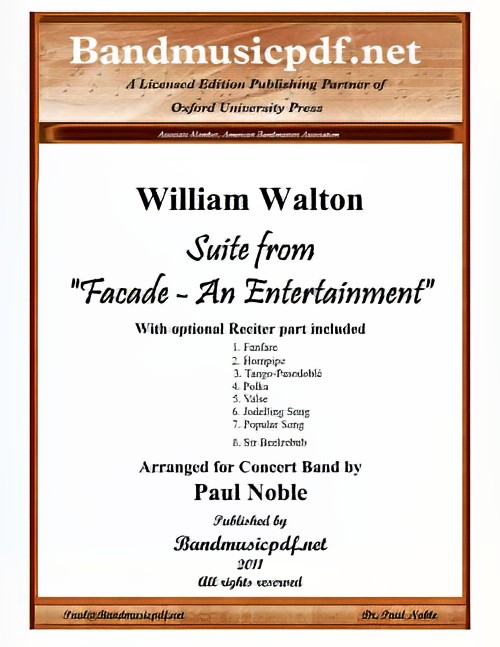 £375.00
Facade - An Entertainment, Suite from (Concert Band with Optional Narrator - Score and Parts) - Walton, William - Noble, Paul
This Suite from Facade - An Entertainment, composed by William Walton, with poems by Dame Edith Sitwell, presents for the first time a grouping of movements selected and arranged by Paul Noble for Concert Band and optional Reciter. The original composition was written between 1921 and 1928, containing forty-three numbers. They had their origin in a new style of poetry that Edith Sitwell evolved in the early 1920s, poems that her brother Osbert later described as 'experiments in obtaining through the medium of words the rhythm and dance measures such as waltzes, polkas, foxtrots... Some of the resulting poems were sad and serious... Others were mocking and gay... All possessed a quite extraordinary and haunting fascination.' Possibly influenced by the dance references in some of the numbers, Osbert declared that the poems might be further enhanced if spoken to a musical accompaniment. The obvious choice of composer was the young man who lived and worked in an attic room of the Sitwell brothers' house in Carlyle Square W[illiam] T[urner] Walton, as he then styled himself. The now historic first performance of the Facade Entertainment took place in an L-shaped first-floor drawing-room on January 24, 1922. Accompaniments to sixteen poems and two short musical numbers were performed by an ensemble of five players. The performers were obscured from the audience by a decorated front curtain, through which a megaphone protruded for Edith to declaim her poems. This was, as she put it, 'to deprive the work of any personal quality'. The first public performance of Facade was given at the Aeolian Hall on June 12, 1923. By now, fourteen poems had been set, others revised or rejected, and an alto saxophone added to the ensemble. The occasion gave rise to widespread publicity, both pro and contra, and the name of the twenty-one year old W. T. Walton was truly launched. In the ensuing years the Facade has gone through revisions and additions, with full orchestral arrangements of selected movements being made without the Reciter. Former Band Director Robert O'Brien arranged some movements for band, again without Reciter, which are now out of print. So this 'history making' addition is the first opportunity for Concert Bands to present some movements of Facade with poems as originally intended. The luxury of electronic amplification allows the full ensemble to perform without necessarily overshadowing the Reciter. And the arrangements are written with considerable doubling so that the ensemble may play in full, or reduced in size as may be desired for proper balance. And, though not encouraged, the arrangements are written so that the band can perform the music without the Reciter. Program notes are adapted in part from those written by David Lloyd-Jones and published by Oxford University Press in the Study Score of William Walton's Facade Entertainments.
Estimated dispatch 7-14 working days
 View Music