
Results
-
 £164.99
A Centennial Journey - Philip Sparke
A Centennial Journey was commissioned by the Norwegian ensemble Stavanger Musikkorps av 1919 to celebrate their 100th anniversary in 2019. The work was premiered under conductor Morten E. Hansen at their Jubilee Concert in the Stavanger Konserthus on 28th September 2019. The piece opens dramatically with a sweeping melody on horns and saxophones under florid woodwind figuration, building to a majestic climax. A trio for the trombones calms the mood until the opening melody returns in a gentler style, eventually building to a busy molto vivo. The woodwind figuration continues over a series of brass trios until the main theme of the work appears on clarinets and euphoniums. This develops to introduce a change of key, featuring a long, hymn-like melody on clarinets and horns. The melody is then taken up by the full band, interspersed with sporadic brass fanfares. The opening of the molto vivo returns and leads to a return of the opening horn melody, building to a thrilling coda based on previous melodic material.
Estimated dispatch 7-14 working days
-
 £122.50
Mercury Rising - Philip Sparke
Mercury Rising was commissioned by sinfonisches blasorchester wehdel and its conductor Thomas Ratzek, to celebrate their 50th anniversary in 2018. They premiered this piece in their half-century concert on 2nd November 2018 in the Bremerhaven Stadttheater in Germany. Designed as a virtuosic and lively opener, Mercury Rising opens with nervous energy and driving, syncopated rhythms in a blaze of colour. The horns and saxophones then introduce a broad melody, which the trumpets subsequently take up after a change of tonality. A quieter moment introduces a distant fanfare on muted horns over bubbling semiquavers in the low clarinets. This is interrupted by a passionate tenor melody but soon returns on the full brass section, accompanied by echoes of the opening woodwind figuration, and is extended to bring the piece to a triumphant close.
Estimated dispatch 7-14 working days
-
 £84.99
Don't Start Now
'Don't Start Now', by the British singer Dua Lipa, is the first single from her second studio album, Future Nostalgia. The accompanying music video was uploaded to her YouTube channel upon the single's release. In the song, the singer tells her ex-lover that she is now over him. She gave her first live performance of it on The Graham Norton Show, after that she sang it a number of times at various award shows, TV programmes and music festivals. This arrangement by Tom Stanford will make sure that this disco pop song will also find its way into the world of wind music.
Estimated dispatch 7-14 working days
-
 £139.99
Papyrus - Thomas Doss
The history of paper ranges over more than five thousand years: likely starting around 3500 BC in old Egypt with the use of papyrus. The oldest findings of written paper date from 2700 BC. In China, the first production of paper took place in the year 105 AD. The Arabs acquired their knowledge of the art of making paper around 750 AD, thanks to Chinese prisoners of war. Around the same time, the Celtic Ogham script was created in Ireland and carved into stones or trees. In Europe, the first paper mill was not put into operation until the 12th century! No matter how different the production methods and its historical use, paper was always a way to pass on wisdom, art and knowledge. Even today, in the age of digitalisation, paper still has a somewhat 'sacred' image. With Papyrus, Thomas Doss has written a wonderful composition in which the history of paper is reflected, and listeners can very much hear the various periods of this history represented throughout the piece.
Estimated dispatch 7-14 working days
-
 £134.99
Cleopatra - Thierry Deleruyelle
Queen Cleopatra ruled Egypt for over 20 years. She is one of antiquity's best-known women, in particular because of her relationships with Julius Caesar and, above all, Mark-Anthony, but also because the cause of her death remains a mystery. The work is split into three parts and performed without breaks. The first section begins with a bright introduction representing Mark-Anthony. Dynamic in nature and reminiscent of military music, this characterises the Roman general. But soon after, another theme emerges, softer and more melodic, symbolising Cleopatra's femininity. The two characters then combine on a faster tempo. The middle section of the work depicts the love that Mark-Anthony and Cleopatra feel for each other. This passionate relationship lasted ten years and produced three children. This is expressed by a warm and intense theme, just like the beauty of the Egyptian queen. The third and last section opens in a determined and military mood. Mark-Anthony and Cleopatra were often apart, the Roman general was often away on a campaign. They met up in Alexandria to celebrate their triumph. But, as the targets of the jealousy and ambition of Octavius, Julius Caesar's son, the lovers are trapped and await the inevitable conquest of Egypt by the Romans. When Mark-Anthony heard the false news that Cleopatra had committed suicide, he ended his own life. The Queen of Egypt, for her part, was imprisoned shortly afterwards. The two lovers remain one of History's most famous couples. This piece was commissioned by the Wind Orchestra of the town of Antony, near Paris, directed by Philippe Rossignol, to mark its 90th anniversary.
Estimated dispatch 7-14 working days
-
 £79.99
Burnished Brass: A Concert Opener - James Barnes
Written in a quick two, this Show-Style Opener lives up to its title with much of the thematic materials in the opening theme faalling to the brass, while the woodwinds interject flourishes and counterpoints. The woodwinds come to the fore during the middle section until the brass take over again when the original theme returns, leading to a rousing finish.
Estimated dispatch 7-14 working days
-
 £139.99
Golden Peak - Thierry Deleruyelle
Golden Peak is a concert piece that takes us deep into the world of volcanoes of the Auvergne in central France. They are dormant volcanoes whose origins date back from 7,000 to over 65 million years ago. Among the most well-known are the 80 volcanoes of the Chane des Puys, a spectacular natural environment ranking among the most fascinating landscapes in the world. The title of this dynamic and rhythmic piece is a reference to the local spa town of Mont-Dore and calls upon all sections of the orchestra. The central theme is very mellow yet riveting and the music depicts both the dynamism and tranquillity of the region.
Estimated dispatch 7-14 working days
-
 £79.99
Commemoration - James Barnes
Commemoration was commissioned by the members of the Northwest North Carolina Bandmasters Association to recognize the distinguished career of Dr. William A. Gora, the longtime Director of Bands at Appalachian State University, who passed away in 2015. Bill was loved by his students, respected by his peers and cherised by his many friends. A brilliant musician, a fine conductor and a warm human being with a marvelous sense of humor, Bill has been sorely missed by all. Gora was friends with composer James Barnes for over 40 years. They met when Barnes was still in graduate school at Kansas and Gora had just finished his DMA at the University of Florida. When the NNCBDA asked Barnes to compose a work in Bill's honor, he was honored to do so. He decided to write a cheerful work for Bill, full of energy, color and melody, because he knew this is what he would have wanted; no funeral dirges for Bill Gora. The soft middle portion of the work, a hymn-like tune scored in saxophone choir, was included because Bill was a fine saxophonist and, for many years, the saxophone teacher at ASU.
Estimated dispatch 7-14 working days
-
 £149.99
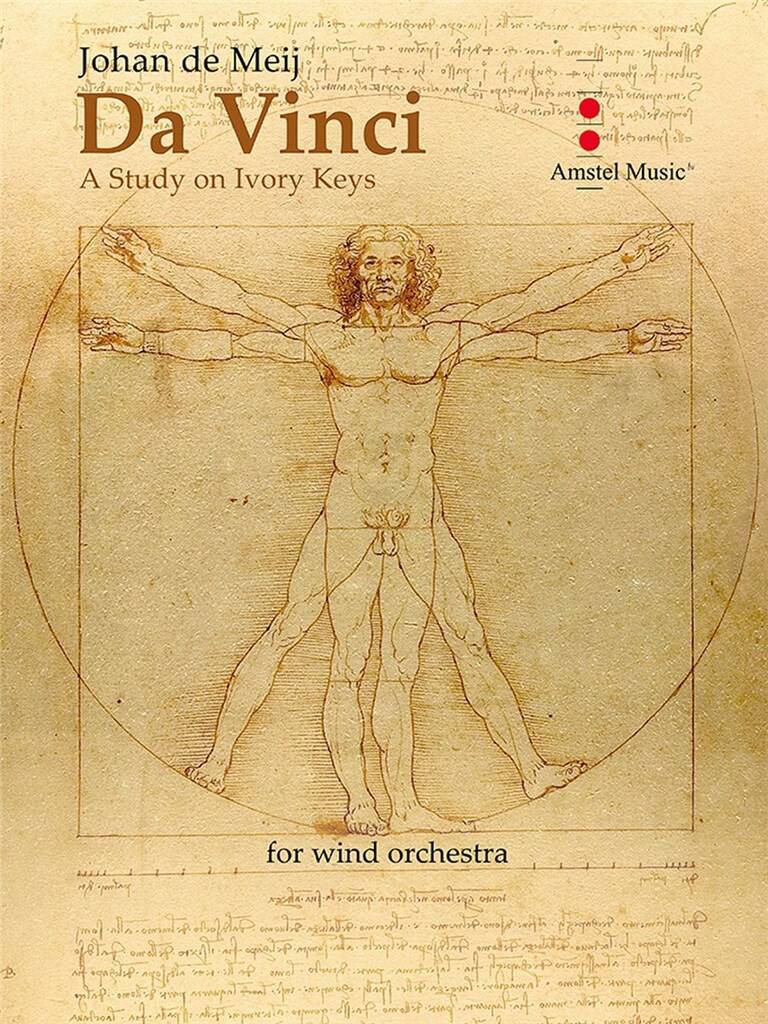
Da Vinci - Johan de Meij
The fascinating life of Leonardo da Vinci and his enormous curiosity spurred Johan de Meij to experiment with musical material, by using only the ivory keys of the piano during the composition process. DA VINCI opens with a grand, massive chord over five octaves throughout the orchestra. This chord, the Da Vinci Chord, is the connective tissue between the various sections, and it leads to a radiant C major chord, as an ode to one of the greatest geniuses of all time.
Estimated dispatch 7-14 working days
-
 £137.99
Friendly Takeover - Oliver Waespi
Friendly Takeover was composed for the 2016 Swiss Wind Band Convention in Montreux. In this three movement piece the composer experiments with lyrical motives combined with rhythmical pulses in different meters throughout the piece. In the finale, the musical scene is taken over completely by groove-based rhythms. This takeover, however, is of a friendly nature, as the various beats are not being conceived as rivals of the lyrical motives, but are rather supposed to infuse energy and vitality to the latter. Thus, one gets the impression of an ongoing acceleration throughout the piece.
Estimated dispatch 7-14 working days
 View Music